Fritzsch Bernd, Martin Paul R
Department of Biology & Department of Otolaryngology, The University of Iowa, Iowa City, IA, 52242, USA.
Faculty of Medicine and Health, Save Sight Institute & ARC Centre for Integrative Brain Function, University of Sydney, NSW 2006, Australia.
IBRO Neurosci Rep. 2022 Apr 1;12:240-248. doi: 10.1016/j.ibneur.2022.03.008. eCollection 2022 Jun.
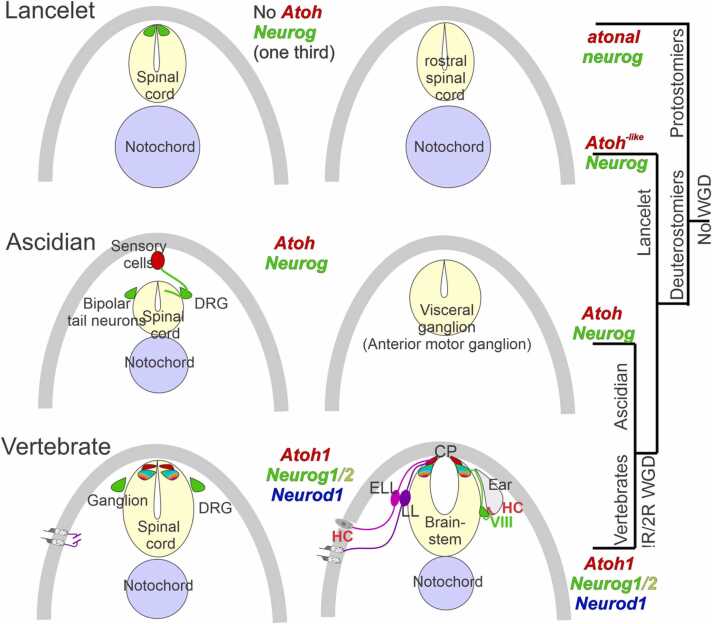
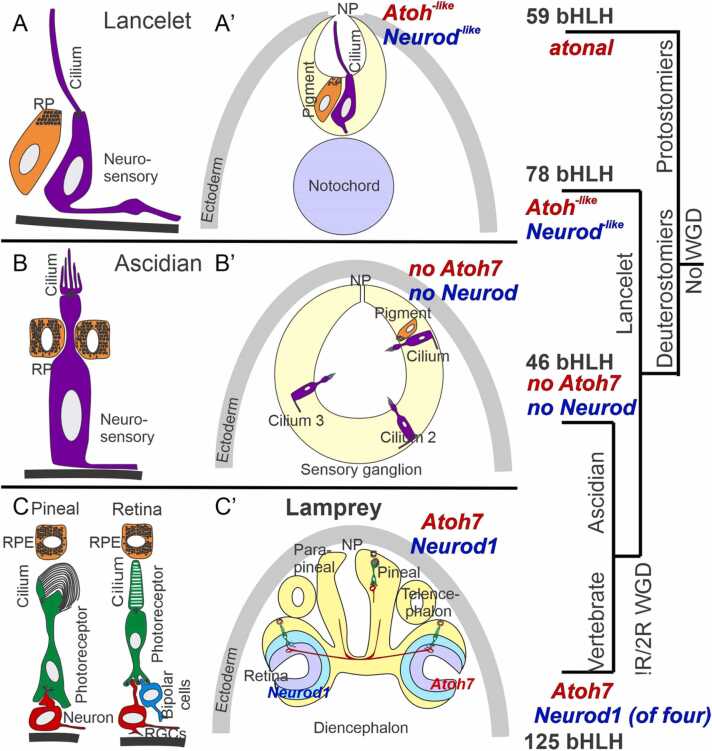
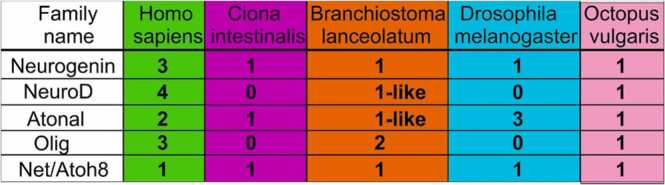
Early in vertebrate evolution, a single homeobox (Hox) cluster in basal chordates was quadrupled to generate the Hox gene clusters present in extant vertebrates. Here we ask how this expanded gene pool may have influenced the evolution of the visual system. We suggest that a single neurosensory cell type split into ciliated sensory cells (photoreceptors, which transduce light) and retinal ganglion cells (RGC, which project to the brain). In vertebrates, development of photoreceptors is regulated by the basic helix-loop-helix (bHLH) transcription factor whereas RGC development depends on and related bHLH genes. Lancelet (a basal chordate) does not express or and possesses a few neurosensory cells with cilia that reach out of the opening of the neural tube. Sea-squirts (Ascidians) do not express and express a different bHLH gene, that is likely expressed in the anterior vesicle. Recent data indicate the neurosensory cells in lancelets may correspond to three distinct eye fields in ascidians, which in turn may be the basis of the vertebrate retina, pineal and parapineal. In this review we contrast the genetic control of visual structure development in these chordates with that of basal vertebrates such as lampreys and hagfish, and jawed vertebrates. We propose an evolutionary sequence linking whole-genome duplications, initially to a split between photoreceptor and projection neurons (RGC) and subsequently between pineal and lateral eye structures.
在脊椎动物进化早期,基础脊索动物中的单个同源框(Hox)簇扩增为四倍,从而产生了现存脊椎动物中存在的Hox基因簇。在此,我们探讨这种扩展的基因库可能如何影响视觉系统的进化。我们认为,单一的神经感觉细胞类型分化为纤毛感觉细胞(光感受器,可传导光)和视网膜神经节细胞(RGC,投射至大脑)。在脊椎动物中,光感受器的发育受基本螺旋-环-螺旋(bHLH)转录因子调控,而RGC的发育则依赖于 及相关的bHLH基因。文昌鱼(一种基础脊索动物)不表达 或 ,并拥有一些带有纤毛的神经感觉细胞,这些细胞伸出神经管的开口。海鞘不表达 ,而是表达一种不同的bHLH基因 ,该基因可能在前部泡囊中表达。最近的数据表明,文昌鱼中的神经感觉细胞可能对应于海鞘中的三个不同的眼区,而这反过来可能是脊椎动物视网膜、松果体和副松果体的基础。在本综述中,我们将这些脊索动物与如七鳃鳗和盲鳗等基础脊椎动物以及有颌脊椎动物在视觉结构发育的遗传控制方面进行了对比。我们提出了一个进化序列,将全基因组复制首先与光感受器和投射神经元(RGC)之间的分化联系起来,随后与松果体和侧眼结构之间的分化联系起来。