Department Biomolecular Health Sciences, Faculty of Veterinary Medicine, Utrecht University, Utrecht, The Netherlands.
Department of Veterinary Tropical Diseases, Faculty of Veterinary Sciences, University of Pretoria, Private Bag X40, Onderstepoort, 0110, South Africa.
Parasitol Res. 2022 Jul;121(7):1887-1893. doi: 10.1007/s00436-022-07518-3. Epub 2022 Apr 22.
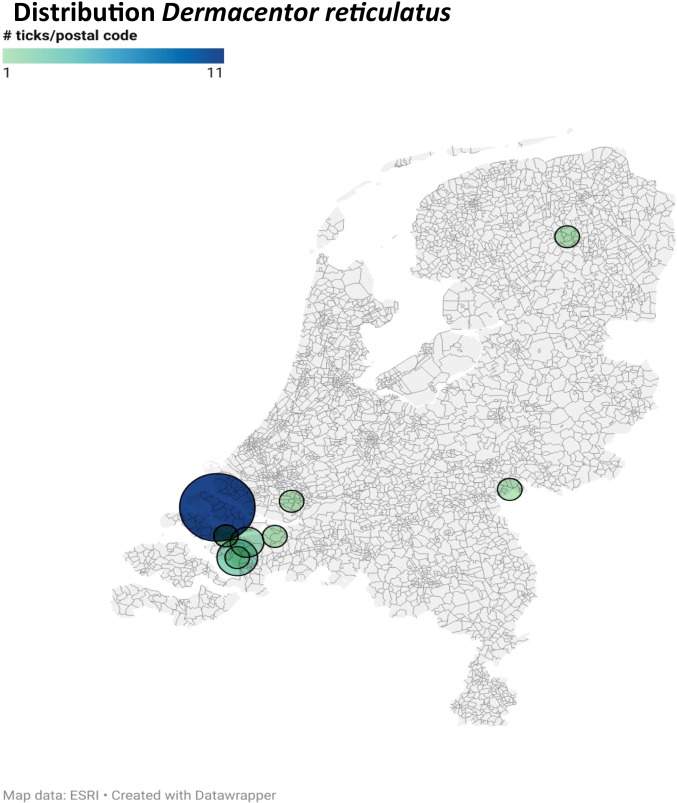
Ticks are vectors for many pathogens of veterinary and medical interest. In order to monitor ticks and tick-borne pathogens, the "Tekenscanner" (Dutch for Tick scanner), a citizen science project, was launched in The Netherlands. It is a smartphone application for pet-owners to get ticks from their dog or cat, identified and checked for pathogens for free. At the same time, information about the pet and the geographic location of tick infestation becomes available for research. The application was launched in 2018, and the results of the first 6 months after launch of the app were reported. Ticks were identified based on morphology, and DNA was extracted and amplified by a panel of tick-borne pathogen-specific primers. Next, the amplicons were subjected to reverse line blot with specific probes for important pathogens to determine their presence or absence. The present paper describes the results of 2019 and 2020. There were 2260 ticks collected from 871 dogs and 255 cats (26 ticks were from an unknown host) and all pet owners were informed about the results. Four species of ticks were collected: Ixodes ricinus (90.0%), Ixodes hexagonus (7.3%), Dermacentor reticulatus (2.8%) and Rhipicephalus sanguineus (0.1%). Ixodes ricinus was the tick with the most divergent pathogens: Anaplasma sp. (1.3%), Babesia sp. (0.8%), Borrelia spp. (4.8%), Neoehrlichia sp. (3.7%) and Rickettsia helvetica (12.6%). In I. hexagonus, R. helvetica (1.8%) and Babesia sp. (0.6%) were detected and Rickettsia raoultii in D. reticulatus (16.2%). One of the two nymphs of R. sanguineus was co-infected with Borrelia and R. helvetica and the other one was uninfected. The high numbers of different pathogens found in this study suggest that companion animals, by definition synanthropic animals, and their ticks can serve as sentinels for emerging tick-borne pathogens.
蜱是兽医和医学相关病原体的重要传播媒介。为了监测蜱和蜱传病原体,荷兰启动了一个名为“Tekenscanner”(荷兰语意为蜱扫描器)的公民科学项目。这是一款供宠物主人使用的智能手机应用程序,可以免费从他们的狗或猫身上取下蜱虫并进行鉴定和病原体检查。同时,宠物的信息和蜱虫感染的地理位置也可供研究使用。该应用程序于 2018 年推出,并报告了应用程序推出后前 6 个月的结果。蜱虫是根据形态学鉴定的,通过一组蜱传病原体特异性引物提取和扩增 DNA。然后,将扩增子用特定探针进行反向线杂交,以确定重要病原体的存在与否。本文介绍了 2019 年和 2020 年的结果。从 871 只狗和 255 只猫身上采集了 2260 只蜱虫(26 只蜱虫来自未知宿主),并向所有宠物主人告知了结果。共采集到 4 种蜱虫:硬蜱(90.0%)、扇头蜱(7.3%)、璃眼蜱(2.8%)和血红扇头蜱(0.1%)。硬蜱携带的病原体最多样:嗜吞噬细胞无形体(1.3%)、巴贝斯虫(0.8%)、伯氏疏螺旋体(4.8%)、新立克次体(3.7%)和瑞士赫尔尼亚病毒(12.6%)。在扇头蜱中,检测到瑞士赫尔尼亚病毒(1.8%)和巴贝斯虫(0.6%),在璃眼蜱中检测到拉氏疏螺旋体(16.2%)。血红扇头蜱的两只若虫中,一只同时感染了伯氏疏螺旋体和瑞士赫尔尼亚病毒,另一只未感染。本研究发现了大量不同的病原体,这表明伴侣动物(按定义为拟寄生动物)及其蜱虫可以作为新兴蜱传病原体的哨兵。