Department of Physical Therapy, Occupational Therapy, Physical Medicine and Rehabilitation, Facultad de Ciencias de la Salud, Universidad Rey Juan Carlos (URJC), Avenida de Atenas s/n, Alcorcón, 28922, Madrid, Spain.
Intelligent Data Analysis Laboratory, Department of Electronic Engineering, ETSE (Engineering School), Universitat de València (UV), Valencia, Spain.
Infection. 2023 Feb;51(1):61-69. doi: 10.1007/s15010-022-01822-x. Epub 2022 Apr 22.
To identify subgroups of COVID-19 survivors exhibiting long-term post-COVID symptoms according to clinical/hospitalization data by using cluster analysis in order to foresee the illness progress and facilitate subsequent prognosis.
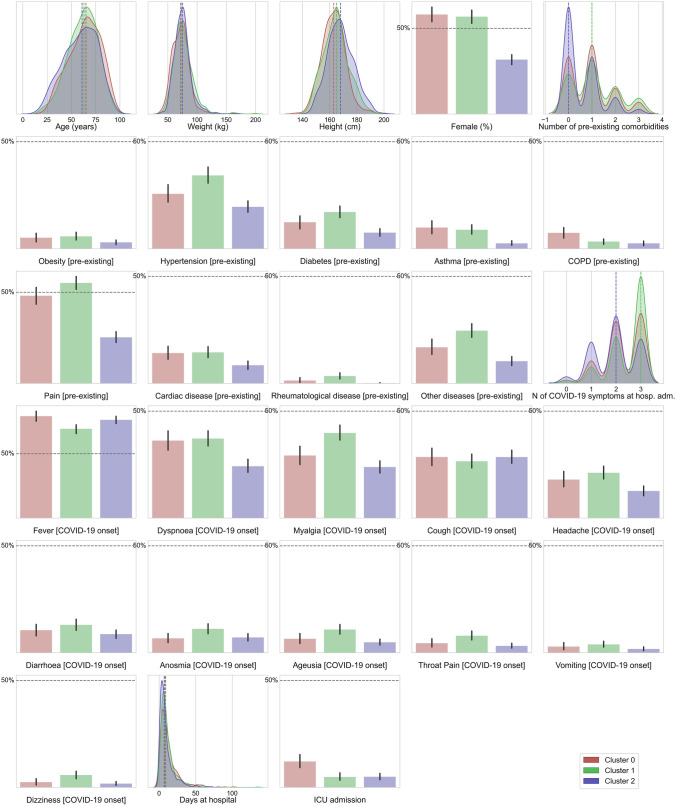
Age, gender, height, weight, pre-existing medical comorbidities, Internal Care Unit (ICU) admission, days at hospital, and presence of COVID-19 symptoms at hospital admission were collected from hospital records in a sample of patients recovered from COVID-19 at five hospitals in Madrid (Spain). A predefined list of post-COVID symptoms was systematically assessed a mean of 8.4 months (SD 15.5) after hospital discharge. Anxiety/depressive levels and sleep quality were assessed with the Hospital Anxiety and Depression Scale and Pittsburgh Sleep Quality Index, respectively. Cluster analysis was used to identify groupings of COVID-19 patients without introducing any previous assumptions, yielding three different clusters associating post-COVID symptoms with acute COVID-19 symptoms at hospital admission.
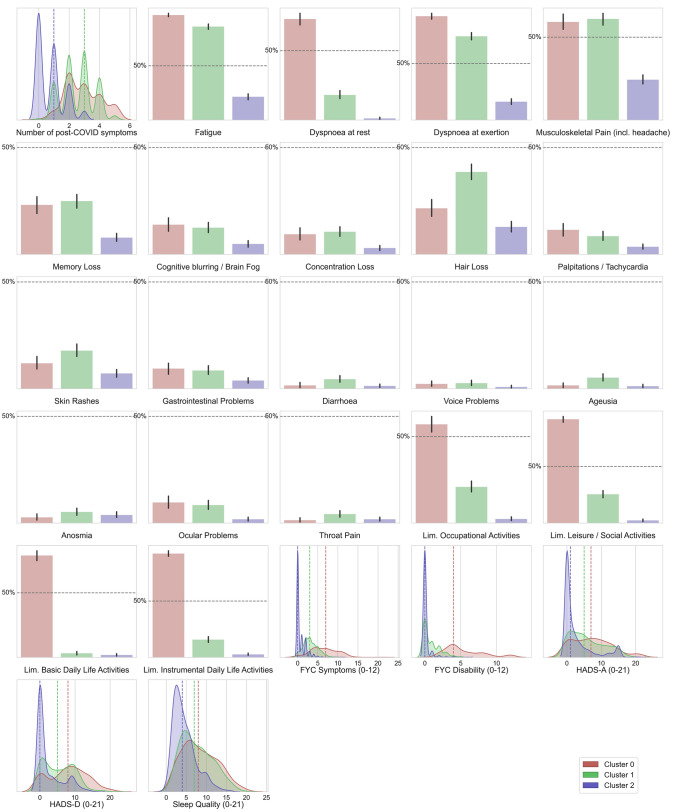
Cluster 2 grouped subjects with lower prevalence of medical co-morbidities, lower number of COVID-19 symptoms at hospital admission, lower number of post-COVID symptoms, and almost no limitations with daily living activities when compared to the others. In contrast, individuals in cluster 0 and 1 exhibited higher number of pre-existing medical co-morbidities, higher number of COVID-19 symptoms at hospital admission, higher number of long-term post-COVID symptoms (particularly fatigue, dyspnea and pain), more limitations on daily living activities, higher anxiety and depressive levels, and worse sleep quality than those in cluster 2.
The identified subgrouping may reflect different mechanisms which should be considered in therapeutic interventions.
通过聚类分析,根据临床/住院数据,识别出具有长期 COVID 后症状的 COVID-19 幸存者亚组,以预测疾病进展并促进后续预后。
从马德里五家医院 COVID-19 康复患者的病历中收集年龄、性别、身高、体重、既往合并症、入住重症监护病房(ICU)、住院天数以及入院时 COVID-19 症状等临床数据。在出院后平均 8.4 个月(SD 15.5)时,系统评估了一份预先确定的 COVID-19 后症状清单。焦虑/抑郁水平和睡眠质量分别使用医院焦虑和抑郁量表和匹兹堡睡眠质量指数进行评估。聚类分析用于识别 COVID-19 患者的分组,而无需引入任何先前的假设,得出与入院时急性 COVID-19 症状相关的三个不同亚组。
亚组 2 与其他亚组相比,合并症患病率较低,入院时 COVID-19 症状较少,COVID-19 后症状较少,日常生活活动受限几乎没有。相比之下,亚组 0 和 1 的个体具有更高的既往合并症患病率,更多的入院时 COVID-19 症状,更多的长期 COVID-19 后症状(尤其是疲劳、呼吸困难和疼痛),更多的日常生活活动受限,更高的焦虑和抑郁水平,以及更差的睡眠质量。
所确定的分组可能反映了不同的机制,这些机制应在治疗干预中加以考虑。