Alayash Abdu I
Laboratory of Biochemistry and Vascular Biology, Division of Blood Components and Devices (DBCD), Center for Biologics Evaluation and Research (CBER), Food and Drug Administration (FDA), Silver Spring, MD 20993, USA.
Antioxidants (Basel). 2022 Apr 8;11(4):747. doi: 10.3390/antiox11040747.
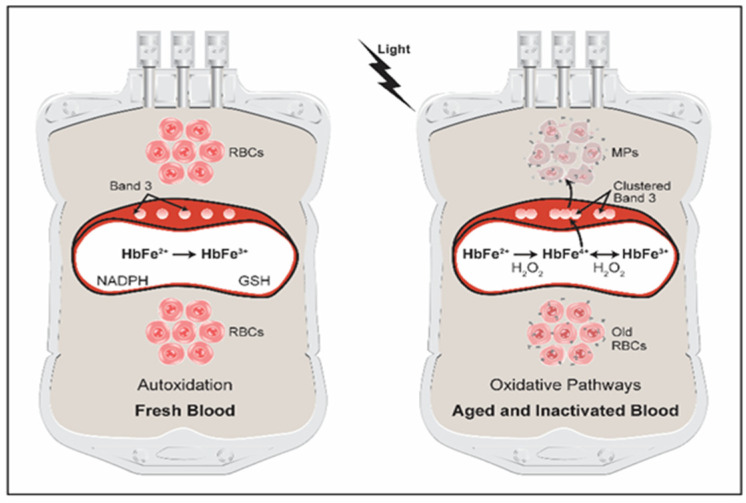
Hemoglobin (Hb) inside and outside the red blood cells (RBCs) undergoes constant transformation to an oxidized form in a process known as autoxidation. The ferrous heme iron (Fe) of the prosthetic group is spontaneously transformed into an oxidized ferric (Fe) form, but under oxidative stress conditions a higher oxidation ferryl heme (Fe) is also formed. Although Fe is a non-functional form of Hb, the Fe is also extremely reactive towards other biological molecules due to its high redox potential. The RBC contains an effective reductive machinery that maintains Hb in the functional form with little oxidation during its life span. The redox transformation of Hb occurs to a lesser extent in young RBCs; it may, however, have detrimental effects on the integrity of these cells during ex vivo storage or when RBCs are subjected to pathogen reduction processes. In this review, Hb oxidation reactions ("oxidative lesion") will be described, including details of how these reactions might impact the clinical use of stored or processed blood for therapeutic purposes.
红细胞(RBC)内外的血红蛋白(Hb)在一个称为自氧化的过程中不断转化为氧化形式。辅基的亚铁血红素铁(Fe)会自发转化为氧化的三价铁(Fe)形式,但在氧化应激条件下,还会形成更高氧化态的高铁血红素(Fe)。虽然Fe是Hb的无功能形式,但由于其高氧化还原电位,Fe对其他生物分子也极具反应性。红细胞含有有效的还原机制,可在其寿命期间将Hb维持在功能形式,氧化程度很低。Hb的氧化还原转化在年轻红细胞中发生的程度较小;然而,在体外储存期间或当红细胞进行病原体灭活过程时,它可能会对这些细胞的完整性产生不利影响。在这篇综述中,将描述Hb氧化反应(“氧化损伤”),包括这些反应如何可能影响储存或处理过的血液用于治疗目的的临床应用的详细信息。