Gámez-Vázquez Héctor G, Rosales-Nieto César A, Urrutia-Morales Jorge, Mellado Miguel, Meza-Herrera César A, Vázquez-García Juan M, Hernández-Arteaga Luisa E S, Negrete-Sánchez Luis O, Loredo-Osti Catarina, Rivas-Jacobo Marco A, Beltrán-López Sergio
Instituto Nacional de Investigaciones Forestales, Agrícolas y Pecuarias, Campo Experimental San Luis, San Luis Potosí 78431, Mexico.
Facultad de Agronomía y Veterinaria, Universidad Autónoma de San Luis Potosí, San Luis Potosí 78321, Mexico.
Biology (Basel). 2022 Mar 28;11(4):517. doi: 10.3390/biology11040517.
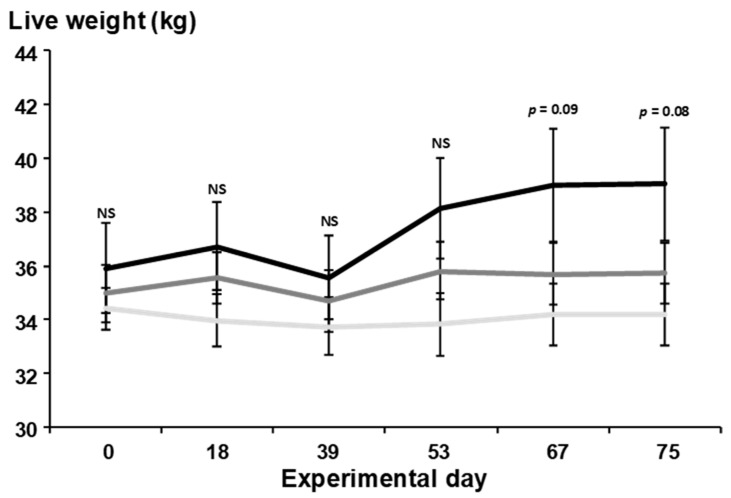
Tillandsia recurvata is an epiphyte that grows on the canopy of many trees in tropical and subtropical areas of America. The objective of this study was to evaluate the effect of partial or complete substitution of sorghum stubble with T. recurvata on liveweight change, metabolic profile, and complete blood count of goats fed increasing levels (0, 30, and 60%, dry matter basis) of T. recurvata. Thirty non-pregnant three-year-old, non-lactating, healthy mixed-breed goats, ten animals per treatment (T0, T30, and T60), were adapted to diets and facilities for 14 days (d-14). Blood samples were collected at d-15, 28, and 56. At the last phase of the trial (from days 67 on), control goats tended to gain more (p = 0.09) weight than their counterparts consuming T. recurvata. Plasma protein, glucose, triglycerides, calcium, and phosphorus concentrations did not differ among dietary treatments (p > 0.05). Dietary treatment influenced red blood cells (higher for T60; p < 0.01), white blood cells (higher for T30; p < 0.05), mean corpuscular volume (higher for T0; p < 0.001), and mean corpuscular hemoglobin concentration (higher for T0; p < 0.01), although not the rest of the blood variables (p > 0.05). The hematocrit percentage tended to be higher (p = 0.06) in T30 than T0 and T60. It was concluded that replacing sorghum stubble with T. recurvata did not modify the metabolic status and maintained live weight of goats. Nevertheless, the use of T. recurvata as feed for goats would improve the nutrition of these animals in the dry season compared to the current diet obtained from an arid rangeland, reducing production costs, and would alleviate the damage caused by this aggressive epiphyte to host trees.
弯叶铁兰是一种附生植物,生长在美洲热带和亚热带地区许多树木的树冠上。本研究的目的是评估用弯叶铁兰部分或完全替代高粱茬对采食弯叶铁兰水平不断增加(0、30%和60%,干物质基础)的山羊体重变化、代谢谱和全血细胞计数的影响。30只非妊娠、三岁、非泌乳、健康的混种山羊,每组10只动物(T0、T30和T60),在日粮和饲养设施中适应14天(第-14天)。在第-15天、28天和56天采集血样。在试验的最后阶段(从第67天开始),对照山羊的体重增加趋势比采食弯叶铁兰的山羊更明显(p = 0.09)。日粮处理之间的血浆蛋白、葡萄糖、甘油三酯、钙和磷浓度没有差异(p > 0.05)。日粮处理影响红细胞(T60组较高;p < 0.01)、白细胞(T30组较高;p < 0.05)、平均红细胞体积(T0组较高;p < 0.001)和平均红细胞血红蛋白浓度(T0组较高;p < 0.01),尽管其他血液变量没有受到影响(p > 0.05)。T30组的血细胞比容百分比有高于T0组和T60组的趋势(p = 0.06)。得出的结论是,用弯叶铁兰替代高粱茬不会改变山羊的代谢状态,且能维持山羊体重。然而,与目前从干旱牧场获得的日粮相比,在旱季将弯叶铁兰用作山羊饲料可以改善这些动物的营养状况,降低生产成本,并减轻这种侵略性附生植物对寄主树木造成的损害。