Huang Teng, Gao Jia, Cai Long, Xie Hao, Wang Yuhan, Wang Yi, Zhou Qing
National Health Commission Key Laboratory of Pulmonary Diseases, Department of Respiratory and Critical Care Medicine, The Center for Biomedical Research, Tongji Hospital, Tongji Medical College, Huazhong University of Science and Technology, Wuhan 430074, China.
Unit 95969 of the People's Liberation Army, Wuhan 430000, China.
Pharmaceutics. 2022 Apr 7;14(4):813. doi: 10.3390/pharmaceutics14040813.
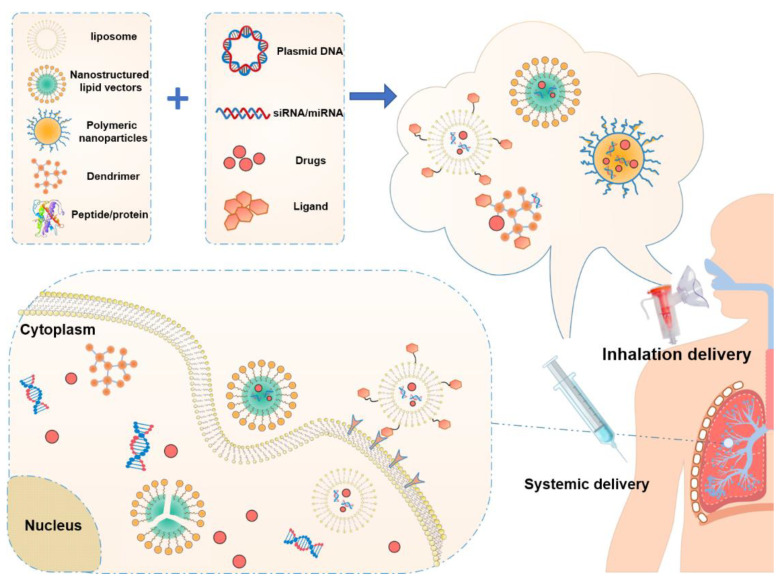
Idiopathic pulmonary fibrosis (IPF) is a chronic, progressive lung disease characterized by irreversible lung scarring, which achieves almost 80% five-year mortality rate. Undeniably, commercially available pharmaceuticals, such as pirfenidone and nintedanib, exhibit certain effects on improving the well-being of IPF patients, but the stubbornly high mortality still indicates a great urgency of developing superior therapeutics against this devastating disease. As an emerging strategy, gene therapy brings hope for the treatment of IPF by precisely regulating the expression of specific genes. However, traditional administration approaches based on viruses severely restrict the clinical application of gene therapy. Nowadays, non-viral vectors are raised as potential strategies for in vivo gene delivery, attributed to their low immunogenicity and excellent biocompatibility. Herein, we highlight a variety of non-viral vectors, such as liposomes, polymers, and proteins/peptides, which are employed in the treatment of IPF. By respectively clarifying the strengths and weaknesses of the above candidates, we would like to summarize the requisite features of vectors for PF gene therapy and provide novel perspectives on design-decisions of the subsequent vectors, hoping to accelerate the bench-to-bedside pace of non-viral gene therapy for IPF in clinical setting.
特发性肺纤维化(IPF)是一种慢性进行性肺部疾病,其特征是肺部出现不可逆的瘢痕形成,五年死亡率接近80%。不可否认,市售药物如吡非尼酮和尼达尼布对改善IPF患者的健康状况有一定作用,但居高不下的死亡率仍表明迫切需要开发更有效的治疗这种毁灭性疾病的方法。作为一种新兴策略,基因治疗通过精确调控特定基因的表达为IPF治疗带来了希望。然而,基于病毒的传统给药方法严重限制了基因治疗的临床应用。如今,非病毒载体因其低免疫原性和优异的生物相容性而成为体内基因递送的潜在策略。在此,我们重点介绍了多种用于IPF治疗的非病毒载体,如脂质体、聚合物和蛋白质/肽。通过分别阐明上述候选载体的优缺点,我们总结了PF基因治疗载体的必要特征,并为后续载体的设计决策提供新的视角,希望加快非病毒基因治疗IPF从实验室到临床应用的进程。