Division of Public Health, Department of Social Medicine, Nihon University School of Medicine, 30-1 Oyaguchi-kamimachi, Itabasi-ku, Tokyo 173-8610, Japan.
Int J Environ Res Public Health. 2022 Apr 15;19(8):4806. doi: 10.3390/ijerph19084806.
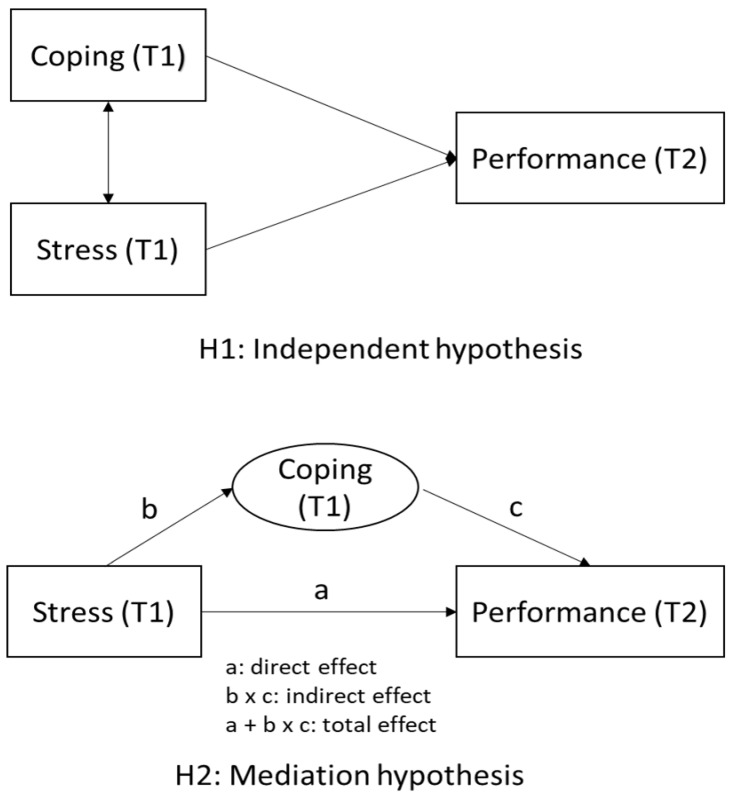
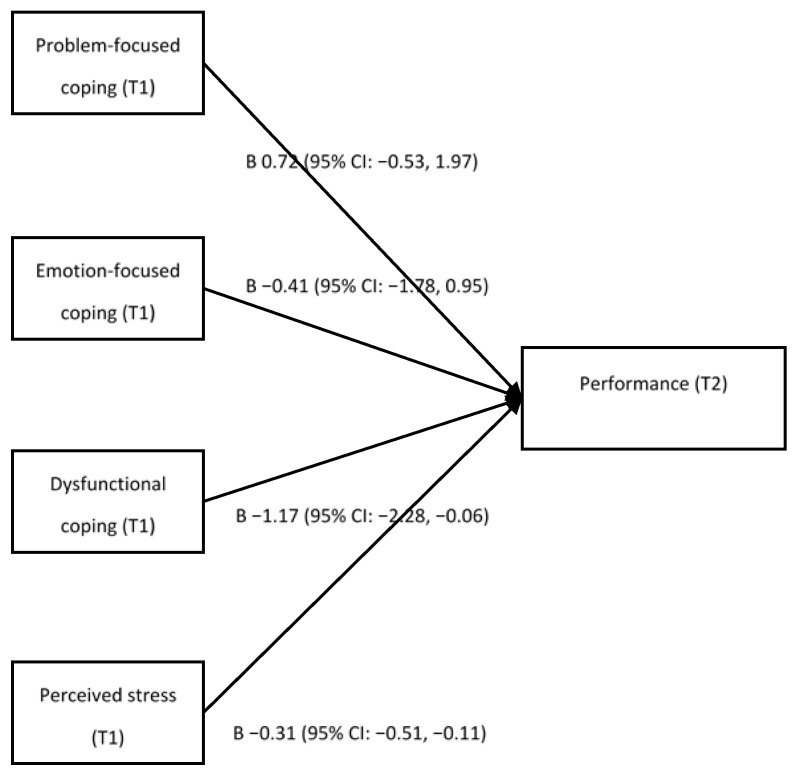
This study aimed to investigate the effects of coping profiles on work performance. Data were collected during a 2-year prospective cohort study of 1359 employees in Japan. Participants completed a self-administered questionnaire in 2018 (T1; baseline) and again in 2020 (T2; followup; followup rate: 69.8%) to enable the assessment of work performance, perceived stress, and stress coping profiles at T1 and T2. Multivariate logistic regression models and causal mediation analysis were performed to identify the effects of coping profiles on work performance. Covariates included age, sex, company, job type, employment status, working hours, holidays, and lifestyle behaviors (e.g., smoking, sleep duration). A dysfunctional coping profile (β = −1.17 [95% CI, −2.28 to −0.06], p = 0.039) was negatively associated with work performance. Coping profiles of planning (β = 0.86 [95% CI, 0.07−1.66]) and self-blame (β = −1.33 [95% CI, −1.96 to −0.70], p < 0.001) were significantly associated with work performance. Dysfunctional coping, specifically, self-blame (β = −1.22 [95% CI, −1.83 to −0.61]), mediated the association between stress and work performance. Thus, some coping profiles may lead to an increase or decrease in work performance. The possible impact of coping strategies on workers’ productivity requires further exploration. Furthermore, information on effective coping profiles should be incorporated into occupational health examinations.
本研究旨在探讨应对方式对工作绩效的影响。数据来自于日本一项为期 2 年的前瞻性队列研究,共纳入了 1359 名员工。参与者于 2018 年(T1;基线)和 2020 年(T2;随访;随访率:69.8%)完成了一份自我管理问卷,以评估 T1 和 T2 时的工作绩效、感知压力和压力应对方式。采用多变量逻辑回归模型和因果中介分析来确定应对方式对工作绩效的影响。协变量包括年龄、性别、公司、工作类型、雇佣状态、工作时间、休假和生活方式行为(如吸烟、睡眠时间)。功能失调的应对方式(β=-1.17[95%CI,-2.28 至-0.06],p=0.039)与工作绩效呈负相关。计划(β=0.86[95%CI,0.07-1.66])和自责(β=-1.33[95%CI,-1.96 至-0.70],p<0.001)的应对方式与工作绩效显著相关。功能失调的应对方式,特别是自责(β=-1.22[95%CI,-1.83 至-0.61]),介导了压力与工作绩效之间的关系。因此,一些应对方式可能会导致工作绩效的增加或减少。应对策略对工人生产力的可能影响需要进一步探讨。此外,应将有效的应对方式信息纳入职业健康检查。