Department of Communication, Faculty of Arts, University of Ottawa, Ottawa, ON K1N 6N5, Canada.
School of Psychology, Faculty of Social Sciences, University of Ottawa, Ottawa, ON K1N 6N5, Canada.
Int J Environ Res Public Health. 2022 Apr 16;19(8):4866. doi: 10.3390/ijerph19084866.
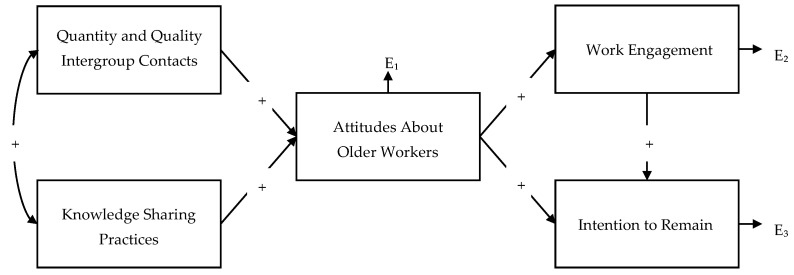
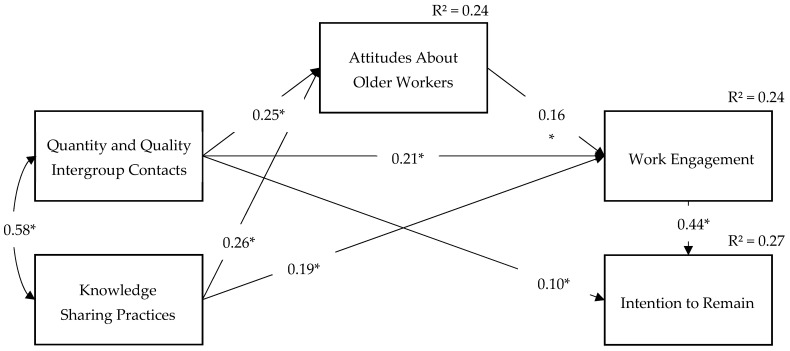
Negative outcomes of ageism in the context of the Canadian labor market are well documented. Older workers remain the target of age-based stereotypes and attitudes on the part of employers. This study aims at assessing (1) the extent to which quality and quantity intergroup contacts between younger and older workers as well as knowledge-sharing practices reduce ageist attitudes, in turn (2) how a decrease in ageist attitudes increase the level of workers' engagement and intentions to remain in the organization. Data were collected from 603 Canadian workers (aged 18 to 68 years old) from private and public organizations using an online survey measuring concepts under study. Results of a path analysis suggest that intergroup contacts and knowledge-sharing practices are associated with positive attitudes about older workers. More so, positive attitudes about older workers generate higher levels of work engagement, which in turn are associated with stronger intentions to remain with the organization. However, positive attitudes about older workers had no effect on intentions to remain in the workplace. Results are discussed in light of the intergroup contact theory.
年龄歧视在加拿大劳动力市场中的负面后果已有充分记录。老年工人仍然是雇主基于年龄的刻板印象和态度的目标。本研究旨在评估(1)年轻和老年工人之间的群体间接触的质量和数量以及知识共享实践在多大程度上减少年龄歧视态度,进而(2)减少年龄歧视态度如何提高工人的敬业度和留在组织的意愿。数据来自 603 名来自私营和公共组织的加拿大工人(年龄在 18 至 68 岁之间),使用在线调查衡量研究中的概念。路径分析的结果表明,群体间接触和知识共享实践与对老年工人的积极态度有关。更重要的是,对老年工人的积极态度会产生更高水平的工作投入,而工作投入又与更强的留在组织的意愿相关。然而,对老年工人的积极态度对留在工作场所的意愿没有影响。研究结果根据群体间接触理论进行了讨论。