Department of Sport Sciences and Physical Activity, College of Education, University of Hail, Hail 81411, Saudi Arabia.
Research Laboratory: Education, Motricity, Sport and Health, EM2S, LR19JS01, High Institute of Sport and Physical Education of Sfax, University of Sfax, Sfax 3000, Tunisia.
Int J Environ Res Public Health. 2022 Apr 18;19(8):4893. doi: 10.3390/ijerph19084893.
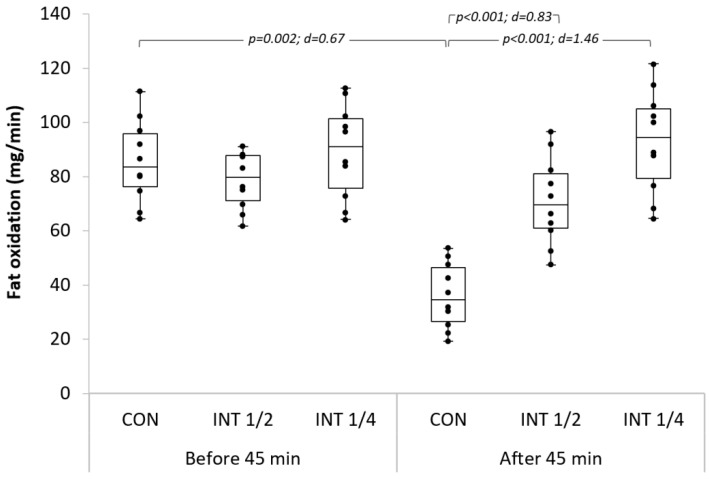
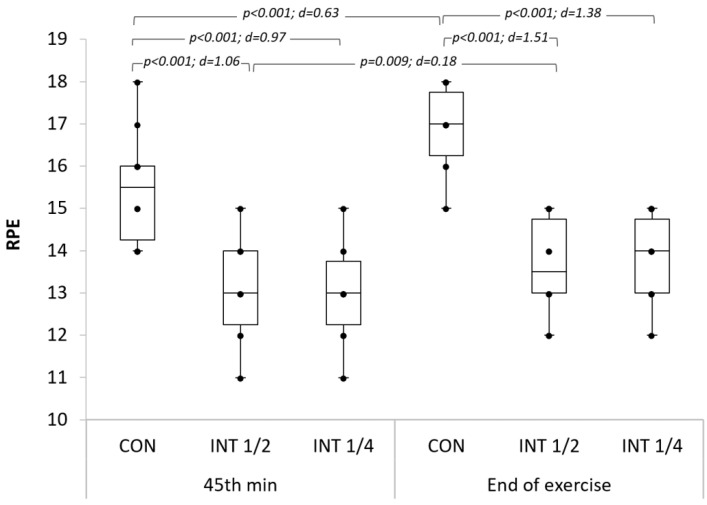
Physical exercise is a common strategy in overweight and obesity management. Exercise type, intensity, duration, energy expenditure and the rate of perceived exertion (RPE) are the essential determinants of exercise efficiency. The purpose of the present study was to compare continuous and intermittent exercises targeted at the maximal fat oxidation intensity (FAT max) in obese individuals. Ten obese males (BMI > 30 kg/m2; age: 19 to 35 years) who maintained a sedentary lifestyle were recruited for this study to perform three separate exhaustive exercises: a continuous exercise at FAT max (CON), an intermittent exercise that alternates two minutes at FAT max −10% with one minute at FAT max +20% (INT½), and a second intermittent exercise that alternates four minutes at FAT max −10% with one minute at FAT max +40% (INT¼). The duration of the INT¼ exercise (65.1 min ± 13.4) was significantly longer than that of the CON exercise (55.4 min ± 6.0). No significant difference in the total amount of energy expenditure was observed across the three types of exercise (CON: 372 Kcal ± 98.2, INT¼: 398 Kcal ± 145.5, INT½: 374.4 Kcal ± 116.1). The fat oxidation rate after 45 min during the INT exercises (INT¼: 93.0 ± 19.1 mg/min, INT½: 71.1 ± 15.6 mg/min) was significantly higher than that of the CON exercise (36.1 ± 12.2 mg/min). The CON exercise was less well tolerated. The rate of perceived exertion (RPE) at the end of the CON (15.8 ± 2) was significantly higher than that of the INT exercises (13.5 ± 2 for the INT¼ and 13.1 ± 1.8 for the INT½). The INT exercises were more efficient in terms of duration, fat oxidation and RPE.
身体锻炼是超重和肥胖管理的常用策略。运动类型、强度、持续时间、能量消耗和感知用力程度(RPE)是运动效率的重要决定因素。本研究的目的是比较针对最大脂肪氧化强度(FAT max)的连续运动和间歇运动在肥胖个体中的效果。招募了 10 名保持久坐生活方式的肥胖男性(BMI>30 kg/m2;年龄:19 至 35 岁)进行了三项单独的极限运动:FAT max 持续运动(CON)、交替两分钟 FAT max-10%和一分钟 FAT max+20%的间歇运动(INT½),以及交替四分钟 FAT max-10%和一分钟 FAT max+40%的第二种间歇运动(INT¼)。INT¼ 运动的持续时间(65.1 分钟±13.4)明显长于 CON 运动(55.4 分钟±6.0)。三种运动类型的总能量消耗没有显著差异(CON:372 卡路里±98.2,INT¼:398 卡路里±145.5,INT½:374.4 卡路里±116.1)。INT 运动 45 分钟后的脂肪氧化率(INT¼:93.0±19.1mg/min,INT½:71.1±15.6mg/min)明显高于 CON 运动(36.1±12.2mg/min)。CON 运动的耐受性较差。CON 运动结束时的感知用力程度(RPE)(15.8±2)明显高于 INT 运动(INT¼为 13.5±2,INT½为 13.1±1.8)。INT 运动在持续时间、脂肪氧化和 RPE 方面更有效。