Novel Bacteria and Drug Discovery Research Group (NBDD), Microbiome and Bioresource Research Strength (MBRS), Jeffrey Cheah School of Medicine and Health Sciences, Monash University Malaysia, Subang Jaya 47500, Malaysia.
Clinical School Johor Bahru, Jeffrey Cheah School of Medicine and Health Sciences, Monash University Malaysia, Johor Bahru 80100, Malaysia.
Nutrients. 2022 Apr 14;14(8):1647. doi: 10.3390/nu14081647.
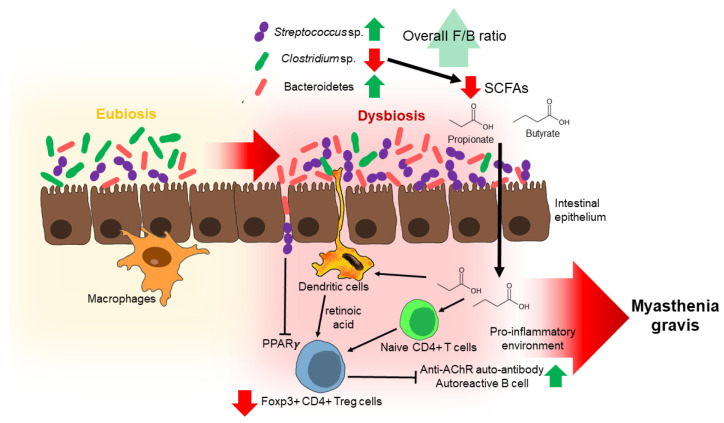
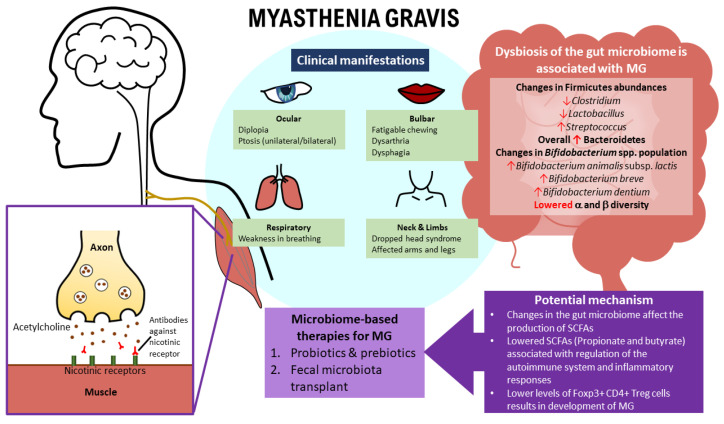
The human gut microbiota is vital for maintaining human health in terms of immune system homeostasis. Perturbations in the composition and function of microbiota have been associated with several autoimmune disorders, including myasthenia gravis (MG), a neuromuscular condition associated with varying weakness and rapid fatigue of the skeletal muscles triggered by the host's antibodies against the acetylcholine receptor (AChR) in the postsynaptic muscle membrane at the neuromuscular junction (NMJ). It is hypothesized that perturbation of the gut microbiota is associated with the pathogenesis of MG. The gut microbiota community profiles are usually generated using 16S rRNA gene sequencing. Compared to healthy individuals, MG participants had an altered gut microbiota's relative abundance of bacterial taxa, particularly with a drop in Clostridium. The microbial diversity related to MG severity and the overall fecal short-chain fatty acids (SCFAs) were lower in MG subjects. Changes were also found in terms of serum biomarkers and fecal metabolites. A link was found between the bacterial Operational Taxonomic Unit (OTU), some metabolite biomarkers, and MG's clinical symptoms. There were also variations in microbial and metabolic markers, which, in combination, could be used as an MG diagnostic tool, and interventions via fecal microbiota transplant (FMT) could affect MG development. Probiotics may influence MG by restoring the gut microbiome imbalance, aiding the prevention of MG, and lowering the risk of gut inflammation by normalizing serum biomarkers. Hence, this review will discuss how alterations of gut microbiome composition and function relate to MG and the benefits of gut modulation.
人类肠道微生物群对于维持免疫系统稳态的人类健康至关重要。微生物群的组成和功能的紊乱与几种自身免疫性疾病有关,包括重症肌无力(MG),这是一种神经肌肉疾病,与骨骼肌的不同程度的虚弱和快速疲劳有关,这些虚弱和疲劳是由宿主针对神经肌肉接头(NMJ)后肌膜上乙酰胆碱受体(AChR)的抗体引起的。据推测,肠道微生物群的紊乱与 MG 的发病机制有关。肠道微生物群群落谱通常使用 16S rRNA 基因测序生成。与健康个体相比,MG 参与者的肠道微生物群的细菌分类群相对丰度发生了改变,特别是梭菌的减少。与 MG 严重程度相关的微生物多样性和总粪便短链脂肪酸(SCFAs)在 MG 患者中较低。在血清生物标志物和粪便代谢物方面也发现了变化。在细菌操作分类单元(OTU)、一些代谢物生物标志物和 MG 的临床症状之间发现了联系。微生物和代谢标志物也存在差异,这些标志物结合起来可以作为 MG 的诊断工具,通过粪便微生物群移植(FMT)的干预可以影响 MG 的发展。益生菌可能通过恢复肠道微生物群失衡、帮助预防 MG 以及通过使血清生物标志物正常化来降低肠道炎症的风险来影响 MG。因此,本综述将讨论肠道微生物群组成和功能的改变如何与 MG 相关,以及肠道调节的益处。