Ser Hooi-Leng, Letchumanan Vengadesh, Goh Bey-Hing, Wong Sunny Hei, Lee Learn-Han
Novel Bacteria and Drug Discovery Research Group, Microbiome and Bioresource Research Strength, Jeffrey Cheah School of Medicine and Health Sciences, Monash University Malaysia, Bandar Sunway, Malaysia.
Biofunctional Molecule Exploratory Research Group, School of Pharmacy, Monash University Malaysia, Bandar Sunway, Malaysia.
Front Microbiol. 2021 May 13;12:519836. doi: 10.3389/fmicb.2021.519836. eCollection 2021.
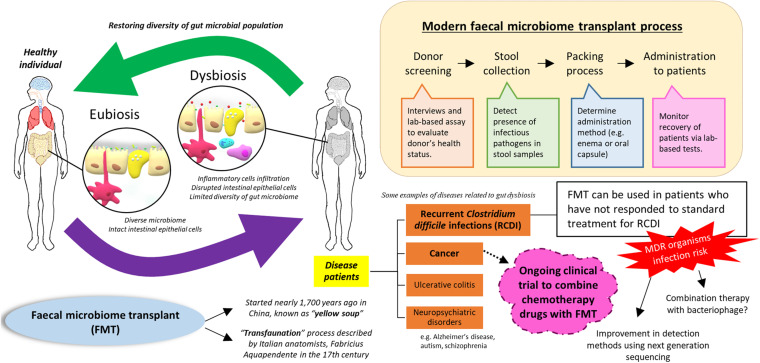
Fecal microbiome transplant (FMT) has gained popularity over the past few years, given its success in treating several gastrointestinal diseases. At the same time, microbial populations in the gut have been shown to have more physiological effects than we expected as "habitants" of the gut. The imbalance in the gut microbiome or dysbiosis, particularly when there are excessive harmful pathogens, can trigger not just infections but can also result in the development of common diseases, such as cancer and cardiometabolic diseases. By using FMT technology, the dysbiosis of the gut microbiome in patients can be resolved by administering fecal materials from a healthy donor. The current review summarizes the history and current uses of FMT before suggesting potential ideas for its high-quality application in clinical settings.
在过去几年中,粪便微生物群移植(FMT)因其在治疗多种胃肠道疾病方面的成功而受到欢迎。与此同时,肠道中的微生物群已被证明具有比我们预期的作为肠道“居民”更多的生理作用。肠道微生物群的失衡或生态失调,特别是当存在过多有害病原体时,不仅会引发感染,还会导致常见疾病的发生,如癌症和心脏代谢疾病。通过使用FMT技术,患者肠道微生物群的生态失调可以通过给予健康供体的粪便物质来解决。本综述总结了FMT的历史和当前用途,然后提出了其在临床环境中高质量应用的潜在思路。