Department of Nutrition and Food Science, Faculty of Pharmacy, Complutense University of Madrid, 28040 Madrid, Spain.
Department of Metabolism and Nutrition, Institute of Food Science, Technology and Nutrition (ICTAN), Spanish National Research Council (CSIC), 28040 Madrid, Spain.
Nutrients. 2022 Apr 18;14(8):1682. doi: 10.3390/nu14081682.
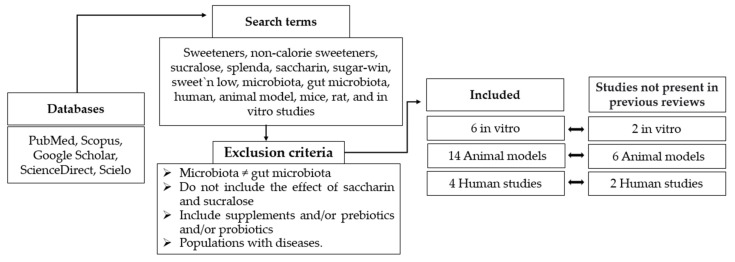
Artificial sweeteners are additives widely used in our diet. Although there is no consensus, current evidence indicates that sucralose and saccharin could influence the gut microbiota. The aim of this study was to analyze the existing scientific evidence on the effects of saccharin and sucralose consumption on gut microbiota in humans. Different databases were used with the following search terms: sweeteners, non-caloric-sweeteners, sucralose, splenda, saccharin, sugartwin, sweet'n low, microbiota, gut microbiota, humans, animal model, mice, rats, and/or in vitro studies. In vitro and animal model studies indicate a dose-dependent relationship between the intake of both sweeteners and gut microbiota affecting both diversity and composition. In humans, long-term study suggests the existence of a positive correlation between sweetener consumption and some bacterial groups; however, most short-term interventions with saccharin and sucralose, in amounts below the ADI, found no significant effect on those groups, but there seems to be a different basal microbiota-dependent response of metabolic markers. Although studies in vitro and in animal models seem to relate saccharin and sucralose consumption to changes in the gut microbiota, more long-term studies are needed in humans considering the basal microbiota of participants and their dietary and lifestyle habits in all population groups. Toxicological and basal gut microbiota effects must be included as relevant factors to evaluate food safety and nutritional consequences of non-calorie sweeteners. In humans, doses, duration of interventions, and number of subjects included in the studies are key factors to interpret the results.
人工甜味剂是我们饮食中广泛使用的添加剂。尽管目前尚无定论,但现有证据表明,三氯蔗糖和糖精可能会影响肠道微生物群。本研究旨在分析现有的关于糖精和三氯蔗糖摄入对人类肠道微生物群影响的科学证据。使用了不同的数据库,并使用了以下搜索词:甜味剂、无热量甜味剂、三氯蔗糖、Splenda、糖精、Sugartwin、甜菊糖、微生物群、肠道微生物群、人类、动物模型、小鼠、大鼠和/或体外研究。体外和动物模型研究表明,这两种甜味剂的摄入量与肠道微生物群之间存在剂量依赖性关系,这会影响多样性和组成。在人类中,长期研究表明,甜味剂摄入与某些细菌群之间存在正相关;然而,大多数短期摄入糖精和三氯蔗糖的干预研究(低于 ADI),并未发现这些细菌群有显著影响,但似乎存在不同的基于基础微生物群的代谢标志物的反应。尽管体外和动物模型研究表明糖精和三氯蔗糖的摄入与肠道微生物群的变化有关,但需要在人类中进行更多的长期研究,考虑到参与者的基础微生物群以及所有人群的饮食和生活方式习惯。毒理学和基础肠道微生物群的影响必须作为评估非热量甜味剂的食品安全和营养后果的相关因素。在人类中,剂量、干预持续时间和研究对象的数量是解释结果的关键因素。