Lara-Castor Laura, O'Hearn Meghan, Cudhea Frederick, Miller Victoria, Shi Peilin, Zhang Jianyi, Sharib Julia R, Cash Sean B, Barquera Simon, Micha Renata, Mozaffarian Dariush
Food Is Medicine Institute, Friedman School of Nutrition Science and Policy, Tufts University, Boston, MA, USA.
Institute of Health Metrics and Evaluation, University of Washington, Seattle, WA, USA.
Nat Med. 2025 Feb;31(2):552-564. doi: 10.1038/s41591-024-03345-4. Epub 2025 Jan 6.
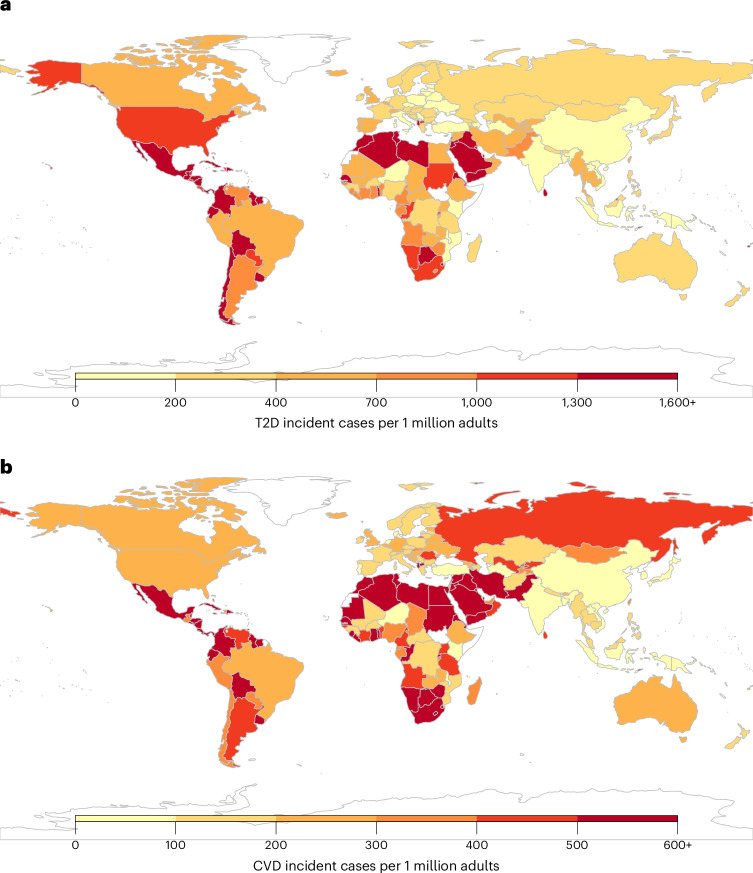
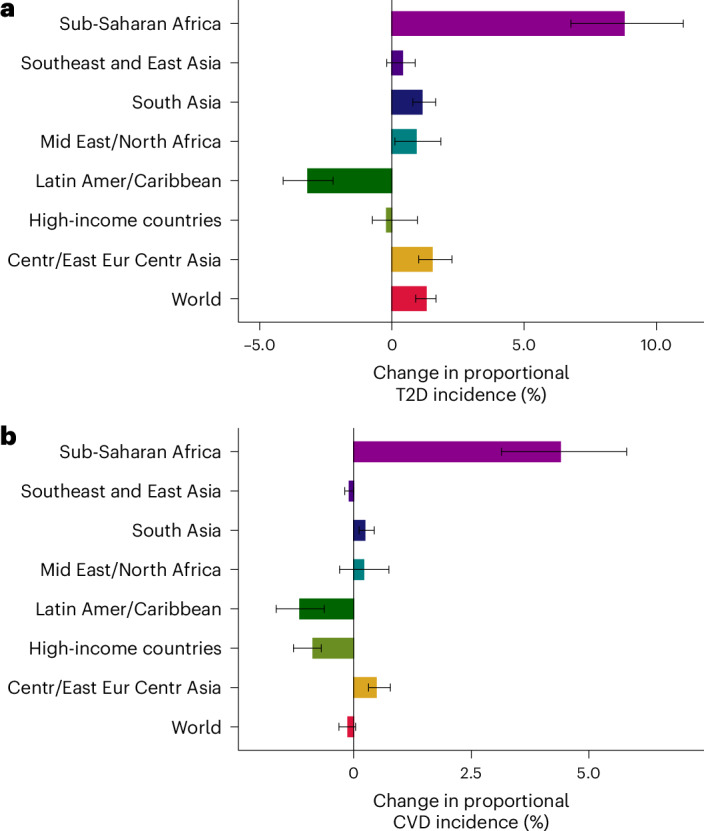
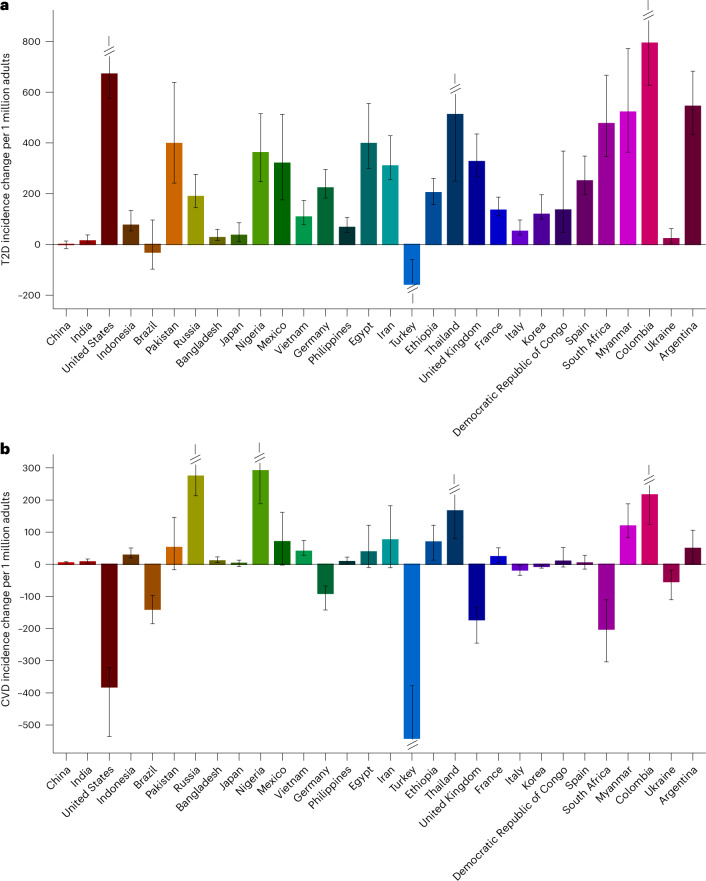
The consumption of sugar-sweetened beverages (SSBs) is associated with type 2 diabetes (T2D) and cardiovascular diseases (CVD). However, an updated and comprehensive assessment of the global burden attributable to SSBs remains scarce. Here we estimated SSB-attributable T2D and CVD burdens across 184 countries in 1990 and 2020 globally, regionally and nationally, incorporating data from the Global Dietary Database, jointly stratified by age, sex, educational attainment and urbanicity. In 2020, 2.2 million (95% uncertainty interval 2.0-2.3) new T2D cases and 1.2 million (95% uncertainty interval 1.1-1.3) new CVD cases were attributable to SSBs worldwide, representing 9.8% and 3.1%, respectively, of all incident cases. Globally, proportional SSB-attributable burdens were higher among men versus women, younger versus older adults, higher- versus lower-educated adults, and adults in urban versus rural areas. By world region, the highest SSB-attributable percentage burdens were in Latin America and the Caribbean (T2D: 24.4%; CVD: 11.3%) and sub-Saharan Africa (T2D: 21.5%; CVD: 10.5%). From 1990 to 2020, the largest proportional increases in SSB-attributable incident T2D and CVD cases were in sub-Saharan Africa (+8.8% and +4.4%, respectively). Our study highlights the countries and subpopulations most affected by cardiometabolic disease associated with SSB consumption, assisting in shaping effective policies and interventions to reduce these burdens globally.
饮用含糖饮料(SSB)与2型糖尿病(T2D)和心血管疾病(CVD)相关。然而,对含糖饮料所致全球负担进行的最新全面评估仍然匮乏。在此,我们结合全球饮食数据库的数据,按年龄、性别、教育程度和城市化程度进行联合分层,估计了1990年和2020年全球、区域和国家层面184个国家中含糖饮料所致的T2D和CVD负担。2020年,全球范围内220万例(95%不确定区间为200万 - 230万)新发T2D病例和120万例(95%不确定区间为110万 - 130万)新发CVD病例可归因于含糖饮料,分别占所有发病病例的9.8%和3.1%。在全球范围内,含糖饮料所致负担比例在男性与女性之间、年轻人与老年人之间、高学历与低学历成年人之间以及城市与农村成年人之间,男性、年轻人、高学历者以及城市居民的比例更高。按世界区域划分,含糖饮料所致负担百分比最高的是拉丁美洲和加勒比地区(T2D:24.4%;CVD:11.3%)以及撒哈拉以南非洲(T2D:21.5%;CVD:10.5%)。从1990年到2020年,含糖饮料所致T2D和CVD发病病例比例增幅最大的是撒哈拉以南非洲(分别为 +8.8%和 +4.4%)。我们的研究突出了受含糖饮料消费相关心脏代谢疾病影响最严重的国家和亚人群体,有助于制定有效的政策和干预措施以在全球范围内减轻这些负担。