Institute for Physical Activity and Nutrition (IPAN), School of Exercise and Nutrition Sciences, Deakin University, Geelong, Australia.
Physical Activity Laboratory, Baker Heart and Diabetes Institute, Melbourne, Australia.
BMC Geriatr. 2022 Apr 22;22(1):357. doi: 10.1186/s12877-022-03033-3.
Being overweight or obese may be associated with lower physical and cognitive function, but in late-adulthood (≥ 65 years) evidence is mixed. This study aimed to investigate how being overweight or obese affected interactions between muscle strength, function and cognition in Australians aged ≥ 50 years, and whether interactions varied according to age (i.e. ≥ 50-65 vs > 65 years).
This study included 2368 adults [mean (standard deviation) age: 63 (7) years; 56% female] from the 2011/2012 Australian Diabetes, Obesity and Lifestyle (AusDiab) follow-up. Physical function was assessed via timed up-and-go (TUG) and muscle strength from knee extensor strength (KES). Cognition was assessed using Mini-Mental-State Exam (MMSE), Spot-the-Word (STW), California Verbal Learning Test (CVLT) and Symbol-Digit-Modalities Test (SDMT). Beta binomial regression was used to evaluate how being overweight or obese influenced strength, physical and cognitive function associations.
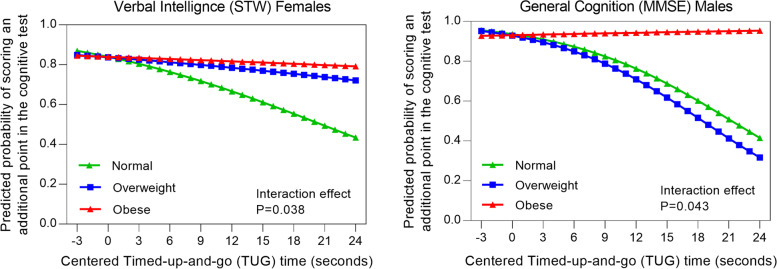
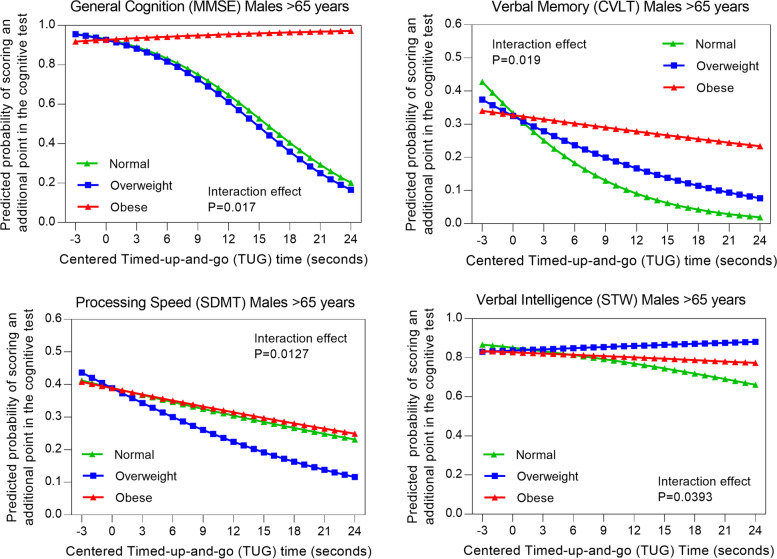
Being overweight or obese did not affect strength-cognition associations regardless of sex or age. With slower physical function; obese females showed better STW (odds ratio [OR] 95% CI]: 1.070 [1.016, 1.127], P = 0.011); obese men better MMSE (OR [95% CI]: 1.157 [1.012, 1.322], P = 0.033); and obese men aged > 65 better CVLT (OR [95% CI]: 1.122 [1.035, 1.217], P = 0.019) and MMSE (OR [95% CI]: 1.233 [1.049, 1.449], P = 0.017) compared to normal weight participants.
Slower physical function was associated with better performance in some cognitive domains in obese, but not in non-obese adults aged ≥ 50 years. These findings suggest some benefits of obesity to aspects of cognition when physical function is slower, but longitudinal follow-up studies are needed.
超重或肥胖可能与较低的身体和认知功能有关,但在成年后期(≥65 岁),证据存在差异。本研究旨在调查超重或肥胖如何影响澳大利亚≥50 岁成年人的肌肉力量、功能和认知之间的相互作用,以及这种相互作用是否因年龄(即≥50-65 岁与>65 岁)而异。
本研究纳入了 2011/2012 年澳大利亚糖尿病、肥胖和生活方式(AusDiab)随访中的 2368 名成年人(平均[标准差]年龄:63[7]岁;56%为女性)。通过计时起立行走(TUG)和膝关节伸展力量(KES)评估身体功能,通过简易精神状态检查(MMSE)、单词识别测试(STW)、加利福尼亚语言学习测试(CVLT)和符号数字模式测试(SDMT)评估认知。采用贝塔二项式回归评估超重或肥胖如何影响力量、身体和认知功能之间的关联。
无论性别或年龄如何,超重或肥胖并不影响力量与认知之间的关联。在身体功能较慢的情况下,肥胖女性在 STW 方面表现更好(优势比[95%置信区间]:1.070[1.016, 1.127],P=0.011);肥胖男性在 MMSE 方面表现更好(优势比[95%置信区间]:1.157[1.012, 1.322],P=0.033);肥胖且年龄>65 岁的男性在 CVLT(优势比[95%置信区间]:1.122[1.035, 1.217],P=0.019)和 MMSE(优势比[95%置信区间]:1.233[1.049, 1.449],P=0.017)方面表现更好,与正常体重参与者相比。
在≥50 岁的成年人中,较慢的身体功能与肥胖者认知领域的某些方面表现更好相关,但与非肥胖者无关。这些发现表明,当身体功能较慢时,肥胖对认知方面有一定益处,但需要进行纵向随访研究。