Neuroscience Research Group (NEUROS), NeuroVitae Center, Escuela de Medicina y Ciencias de la Salud, Universidad del Rosario, Bogotá, Colombia.
Grupo de investigación Escuela Barraquer, Escuela Superior de Oftalmología del Instituto Barraquer de America, Bogotá, Colombia.
Syst Rev. 2022 Apr 22;11(1):75. doi: 10.1186/s13643-022-01940-5.
Down syndrome (DS) is a chromosomal anomaly that is characterized by an extra chromosome 21. Ophthalmological manifestations have a high prevalence in patients with DS.
To review the scientific evidence and estimate the prevalence of ophthalmological manifestations in the pediatric population with DS.
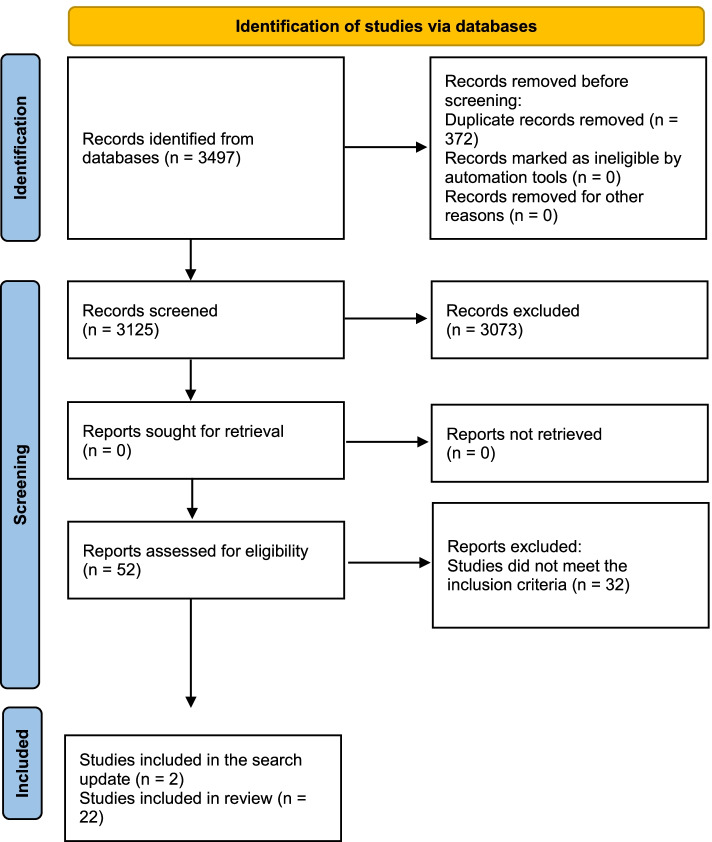
Electronic databases including MEDLINE, Cochrane Library, EMBASE, ScienceDirect, and LILACS.
Published observational studies with available and original data were included. Articles were excluded if the study design was a review, letter to the editor, case report, case series, or systematic review and if the subjects had ophthalmological manifestations secondary to other conditions.
Pediatric and adolescent population with DS and with ophthalmological evaluation.
A data collection form was designed in Excel. Five reviewers extracted relevant details about the design and results of each study. The quality of the studies was assessed by applying the tools for systematic reviews of prevalence and incidence from the Joanna Briggs Institute. We calculated the weighted prevalence of ophthalmological manifestations, considering only the studies reporting the measurement of each manifestation.
Twenty-two articles (from 15 countries, published during 1994-2020) were included in the present systematic review. Ocular manifestations were observed in 85% of the studied pediatric and adolescent populations with DS. The most frequent ones were slanting fissures, oblique fissures, epicanthus, and epiblepharon.
The ocular manifestations in the pediatric and adolescent populations with DS are varied, and some can irreversibly affect visual development. Screening of the pediatric population with DS should be conducted from the first months of age and continued annually.
PROSPERO CRD42019127717.
唐氏综合征(DS)是一种染色体异常,其特征是 21 号染色体额外存在一条。眼科表现在 DS 患者中发病率较高。
回顾科学证据并估计儿科 DS 患者眼科表现的患病率。
包括 MEDLINE、Cochrane 图书馆、EMBASE、ScienceDirect 和 LILACS 的电子数据库。
纳入具有可用原始数据的已发表观察性研究。如果研究设计为综述、给编辑的信、病例报告、病例系列或系统评价,或者如果受试者的眼科表现继发于其他情况,则排除该研究。
儿科和青少年 DS 患者,并进行眼科评估。
设计了一个 Excel 数据收集表。五名审查员提取了关于每个研究的设计和结果的相关详细信息。应用 Joanna Briggs 研究所的系统评价和发病率工具评估研究质量。我们仅考虑报告了每种表现的测量值的研究,计算了眼科表现的加权患病率。
本系统评价共纳入 22 篇文章(来自 15 个国家,发表于 1994 年至 2020 年期间)。在研究的儿科和青少年 DS 患者群体中,观察到 85%存在眼部表现。最常见的是斜视裂、斜裂、内眦赘皮和上睑赘皮。
DS 儿科和青少年人群的眼部表现多种多样,其中一些可能会对视觉发育造成不可逆的影响。应从儿童首次出现症状的第一个月开始对 DS 患儿进行筛查,并持续每年进行筛查。
PROSPERO CRD42019127717。