Department of Public Health and Primary Care, University of Cambridge, Cambridge, UK.
Deanary of Biomedical Sciences, University of Edinburgh, Edinburgh, UK.
BJU Int. 2022 Nov;130(5):550-561. doi: 10.1111/bju.15752. Epub 2022 May 7.
To review the current state of genetic risk models for predicting the development of kidney cancer, by identifying and comparing the performance of published models.
Risk models were identified from a recent systematic review and the Cancer-PRS web directory. A narrative synthesis of the models, previous validation studies and related genome-wide association studies (GWAS) was carried out. The discrimination and calibration of the identified models was then assessed and compared in the UK Biobank (UKB) cohort (cases, 452; controls, 487 925).
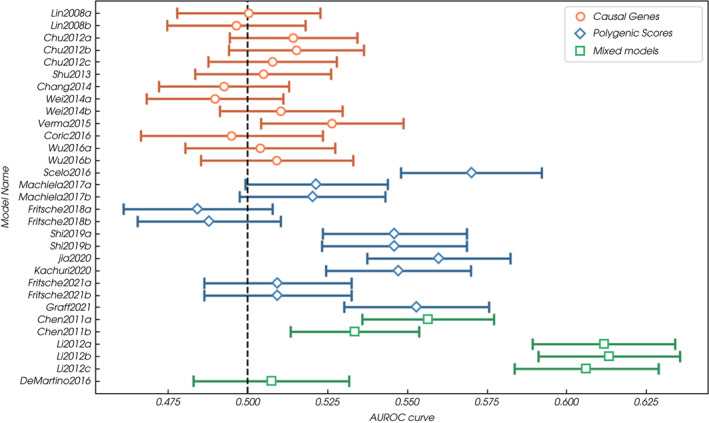
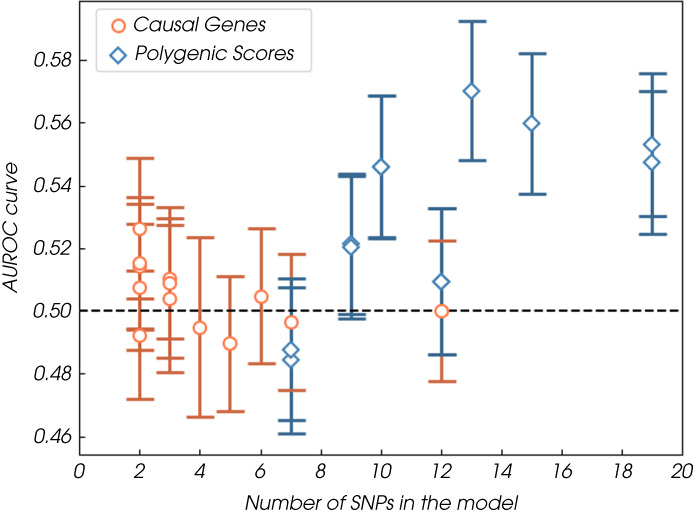
A total of 39 genetic models predicting the development of kidney cancer were identified and 31 were validated in the UKB. Several of the genetic-only models (seven of 25) and most of the mixed genetic-phenotypic models (five of six) had some discriminatory ability (area under the receiver operating characteristic curve >0.5) in this cohort. In general, models containing a larger number of genetic variants identified in GWAS performed better than models containing a small number of variants associated with known causal pathways. However, the performance of the included models was consistently poorer than genetic risk models for other cancers.
Although there is potential for genetic models to identify those at highest risk of developing kidney cancer, their performance is poorer than the best genetic risk models for other cancers. This may be due to the comparatively small number of genetic variants associated with kidney cancer identified in GWAS to date. The development of improved genetic risk models for kidney cancer is dependent on the identification of more variants associated with this disease. Whether these will have utility within future kidney cancer screening pathways is yet to determined.
通过识别和比较已发表模型的性能,回顾目前用于预测肾癌发生的遗传风险模型的现状。
从最近的系统评价和癌症-PRS 网络目录中确定风险模型。对模型、以前的验证研究和相关的全基因组关联研究(GWAS)进行了叙述性综合。然后在英国生物库(UKB)队列(病例 452 例,对照 487925 例)中评估和比较确定模型的区分度和校准度。
共确定了 39 个预测肾癌发生的遗传模型,其中 31 个在 UKB 中得到验证。在该队列中,几种遗传模型(25 个中的 7 个)和大多数混合遗传表型模型(6 个中的 5 个)具有一定的区分能力(接受者操作特征曲线下面积>0.5)。一般来说,包含 GWAS 中鉴定出的大量遗传变异的模型比包含与已知因果途径相关的少量变异的模型性能更好。然而,纳入模型的性能始终逊于其他癌症的最佳遗传风险模型。
尽管遗传模型有可能识别出患肾癌风险最高的人群,但它们的性能不如其他癌症的最佳遗传风险模型。这可能是由于迄今为止在 GWAS 中鉴定出的与肾癌相关的遗传变异数量相对较少。开发用于肾癌的改良遗传风险模型取决于识别更多与该疾病相关的变异。这些是否将在未来的肾癌筛查途径中具有实用性还有待确定。