Graduate School of Health Sciences, Neuroscience Master's Program, Bahcesehir University, Istanbul, Turkey.
Department of Obstetrics and Gynecology, School of Medicine, Acibadem Mehmet Ali Aydinlar University, Istanbul, Turkey.
BMC Pregnancy Childbirth. 2022 Apr 23;22(1):354. doi: 10.1186/s12884-022-04598-y.
To evaluate the effectiveness of immersive virtual reality (VR) on patient satisfaction as a distractive tool and pain relief among laboring women.
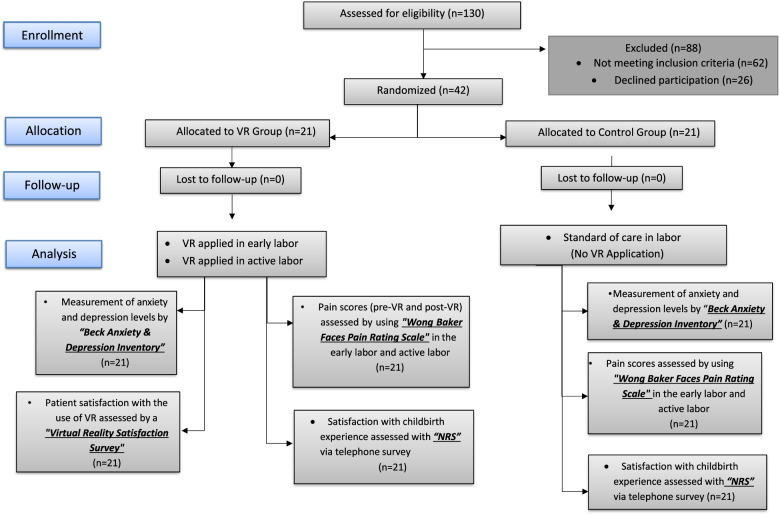
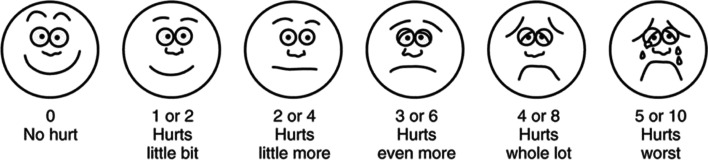
This was a randomized, controlled clinical trial with 42 laboring women allocated to VR intervention and control groups. Among women in the VR group, patient satisfaction with the use of VR was assessed by a Virtual Reality Satisfaction Survey, measured by a Visual Analog Scale (VAS) score and evaluated by questioning them about whether they would choose VR in future labor. As a primary outcome, patient satisfaction scores regarding the overall childbirth experience were compared between women in the two groups. A secondary outcome was pain assessed by a visual pain rating scale in the early and active phases of labor in women in both groups. Psychometric information was also collected from participants in each group using the Beck Anxiety Inventory and Beck Depression Inventory.
We observed a high level of patient satisfaction with the use of immersive VR during labor. The VAS revealed a mean satisfaction score of 87.7 ± 12.9 out of a maximum of 100. Twenty out of 21 (95%) women in the VR group stated that they would like to use VR again in future labor. VR improved pain scores in early labor and contributed positively to the overall childbirth experience. The mean pain score pre-VR was 2.6 ± 1.2 compared to 2.0 ± 1.3 post-VR (p < 0.01). Anxiety and depression scores were similar in participants in the intervention and control groups (p = 0.103 and p = 0.13, respectively).
Immersive VR application during labor was associated with higher patient satisfaction based on our study findings. VR also improved participants' pain scores in early labor before epidural administration. Immersive VR may find a place as an adjunct in labor and delivery units to improve lengthy labor experiences for women. Studies with larger groups of participants are needed to confirm these observations.
ClinicalTrials.gov: NCT05032456.
评估沉浸式虚拟现实 (VR) 作为一种分散注意力的工具和减轻分娩妇女疼痛的有效性。
这是一项随机对照临床试验,共纳入 42 名分娩妇女,分为 VR 干预组和对照组。在 VR 组中,通过虚拟现实满意度调查评估患者对 VR 使用的满意度,采用视觉模拟评分 (VAS) 评分进行测量,并通过询问她们是否会在未来的分娩中选择 VR 来评估。作为主要结局,比较两组女性对整体分娩体验的满意度评分。次要结局是评估两组女性在分娩早期和活跃期的视觉疼痛评分量表上的疼痛。还使用贝克焦虑量表和贝克抑郁量表从每组参与者收集心理计量学信息。
我们观察到分娩时使用沉浸式 VR 的患者满意度很高。VAS 显示,最高得分为 100 分,VR 组的平均满意度评分为 87.7±12.9 分。21 名 VR 组中的 20 名女性表示她们希望在未来的分娩中再次使用 VR。VR 降低了早期分娩时的疼痛评分,并对整体分娩体验产生了积极影响。VR 前的平均疼痛评分为 2.6±1.2,VR 后为 2.0±1.3(p<0.01)。干预组和对照组参与者的焦虑和抑郁评分相似(p=0.103 和 p=0.13,分别)。
根据我们的研究结果,分娩时使用沉浸式 VR 与更高的患者满意度相关。VR 还在硬膜外给药前改善了早期分娩时的疼痛评分。沉浸式 VR 可能会作为分娩和分娩单位的辅助手段,改善女性漫长的分娩体验。需要更大样本量的研究来证实这些观察结果。
ClinicalTrials.gov:NCT05032456。