Jung Diagnostics GmbH, Hamburg, Germany.
Institute of Diagnostic and Interventional Neuroradiology, University Hospital Carl Gustav Carus, Technische Universität Dresden, Dresden, Germany.
Neuroradiology. 2022 Oct;64(10):2001-2009. doi: 10.1007/s00234-022-02961-6. Epub 2022 Apr 25.
Total intracranial volume (TIV) is often a nuisance covariate in MRI-based brain volumetry. This study compared two TIV adjustment methods with respect to their impact on z-scores in single subject analyses of regional brain volume estimates.
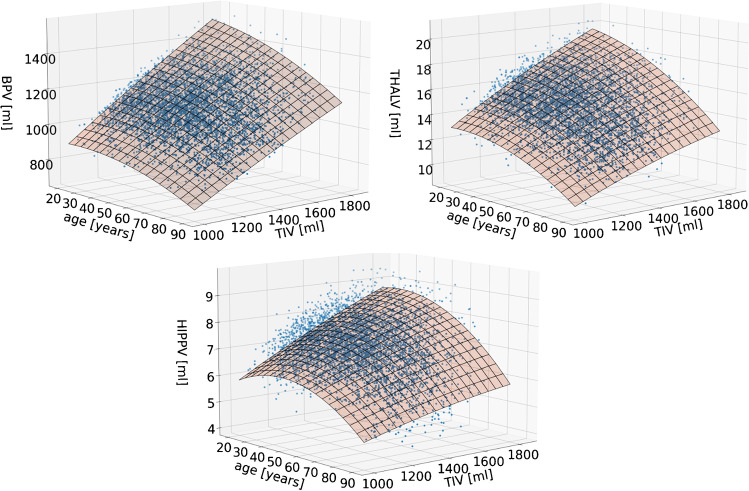
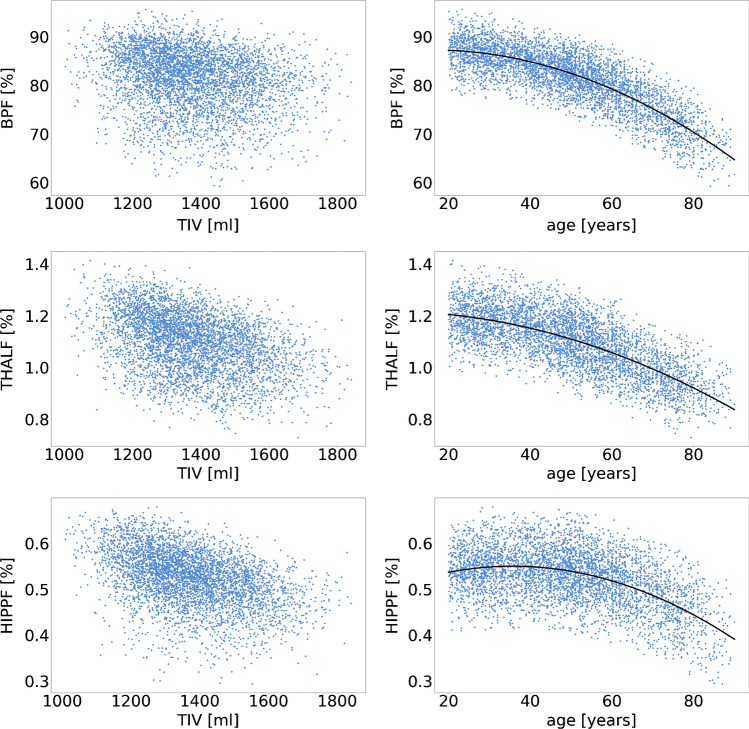
Brain parenchyma, hippocampus, thalamus, and TIV were segmented in a normal database comprising 5059 T1w images. Regional volume estimates were adjusted for TIV using the residual method or the proportion method. Age was taken into account by regression with both methods. TIV- and age-adjusted regional volumes were transformed to z-scores and then compared between the two adjustment methods. Their impact on the detection of thalamus atrophy was tested in 127 patients with multiple sclerosis.
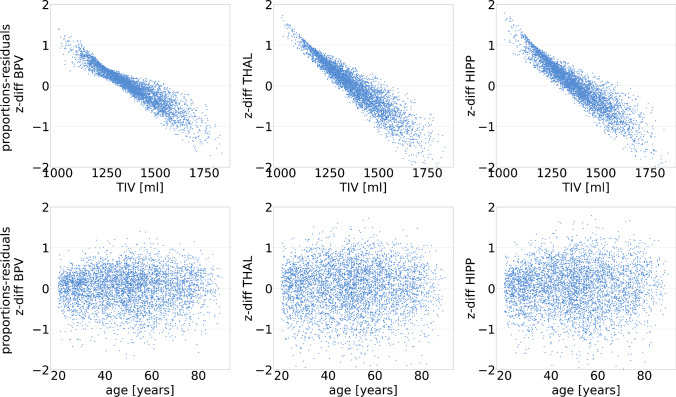
The residual method removed the association with TIV in all regions. The proportion method resulted in a switch of the direction without relevant change of the strength of the association. The reduction of physiological between-subject variability was larger with the residual method than with the proportion method. The difference between z-scores obtained with the residual method versus the proportion method was strongly correlated with TIV. It was larger than one z-score point in 5% of the subjects. The area under the ROC curve of the TIV- and age-adjusted thalamus volume for identification of multiple sclerosis patients was larger with the residual method than with the proportion method (0.84 versus 0.79).
The residual method should be preferred for TIV and age adjustments of T1w-MRI-based brain volume estimates in single subject analyses.
全脑容量(TIV)通常是 MRI 脑容积测量中的一个干扰协变量。本研究比较了两种 TIV 调整方法对个体脑区容积估计的 z 分数的影响。
在一个由 5059 个 T1w 图像组成的正常数据库中,对脑实质、海马体、丘脑和 TIV 进行分割。使用残差法或比例法对 TIV 进行调整,对 TIV 和年龄进行回归。将 TIV 和年龄调整后的区域容积转换为 z 分数,然后比较两种调整方法。在 127 名多发性硬化症患者中,测试了它们对丘脑萎缩检测的影响。
残差法消除了所有区域与 TIV 的相关性。比例法导致了相关性的方向改变,而没有改变相关性的强度。残差法比比例法更能减少生理上的个体间变异性。与比例法相比,残差法获得的 z 分数之间的差异与 TIV 密切相关。在 5%的受试者中,这种差异大于一个 z 分数点。TIV 和年龄调整后的丘脑容积的 ROC 曲线下面积,残差法比比例法更大(0.84 比 0.79)。
在个体脑区容积估计的 T1w-MRI 分析中,应优先使用残差法进行 TIV 和年龄调整。