Miranda Angelica Espinosa, Rosadas Carolina, Assone Tatiane, Pereira Gerson Fernando Mendes, Vallinoto Antonio Carlos Rosário, Ishak Ricardo
Departamento de Condições Crônicas e Infecções Sexualmente Transmissíveis, Secretaria de Vigilância em Saúde, Ministério da Saúde, Brasília, Brazil.
Departamento de Medicina Social, Universidade Federal do Espírito Santo, Vitória, Brazil.
Front Med (Lausanne). 2022 Apr 7;9:859115. doi: 10.3389/fmed.2022.859115. eCollection 2022.
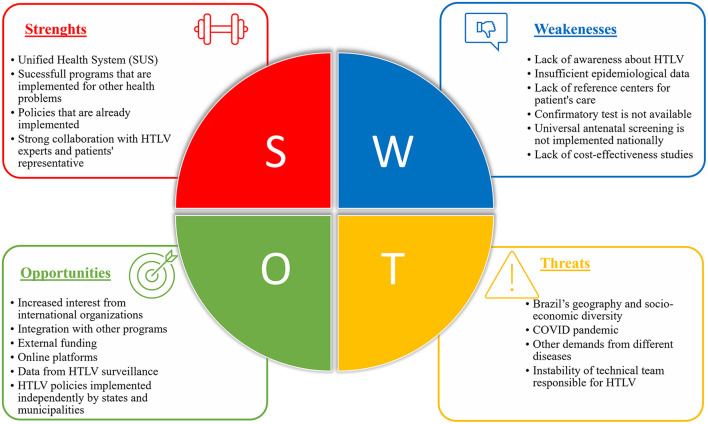
Human T lymphotropic virus 1 (HTLV-1) is a public health issue for most countries and imposes important consequences on patients' health and socioeconomic status. Brazil is one of the global leaders of the public health response to these viruses. The country has challenges to overcome to implement meaningful policies aiming to eliminate HTLV-1/2. An analysis of strengths, weaknesses, opportunities, and threats (SWOT) for the implementation of public health policies on HTLV-1/2 was performed. The strengths identified were the Brazilian Unified Health System (SUS); Brazilian expertise in public health programs successfully implemented; currently available policies targeting HTLV; and strong collaboration with researchers and patient's representative. Lack of awareness about HTLV, insufficient epidemiological data, lack of reference centers for patient care, insufficient availability of confirmatory tests, lack of universal antenatal screening, and absence of cost-effectiveness studies were identified as weaknesses. Some interesting opportunities included the increased interest from international organizations on HTLV, possibility of integrating HTLV into other programs, external funding for research, available online platforms, opportunity to acquire data from HTLV-1/2 surveillance to gather epidemiological information, and HTLV policies that were implemented independently by states and municipalities. In addition to the COVID-19 pandemic, existing demands from different diseases, the country's demography and its marked sociocultural diversity and the volatility of the technical team working with HTLV-1/2 at the Brazilian Ministry of Health are threats to the implementation of public policies on HTLV-1/2. This SWOT analysis will facilitate strategic planning to allow continuous progress of the Brazilian response to HTLV-1/2 infection.
人类嗜T淋巴细胞病毒1型(HTLV-1)对大多数国家而言都是一个公共卫生问题,会给患者的健康和社会经济状况带来重大影响。巴西是全球应对这些病毒的公共卫生行动的领导者之一。该国在实施旨在消除HTLV-1/2的有意义政策方面面临诸多挑战。我们对实施HTLV-1/2公共卫生政策的优势、劣势、机遇和威胁(SWOT)进行了分析。确定的优势包括巴西统一卫生系统(SUS);在成功实施的公共卫生项目方面的专业知识;目前针对HTLV的现有政策;以及与研究人员和患者代表的紧密合作。对HTLV缺乏认识、流行病学数据不足、缺乏患者护理参考中心、确证检测的可及性不足、缺乏普遍的产前筛查以及缺乏成本效益研究被确定为劣势。一些有趣的机遇包括国际组织对HTLV的兴趣增加、将HTLV纳入其他项目的可能性、外部研究资金、可用的在线平台、从HTLV-1/2监测中获取数据以收集流行病学信息的机会,以及各州和各市独立实施的HTLV政策。除了新冠疫情外,来自不同疾病的现有需求、该国的人口结构及其显著的社会文化多样性,以及巴西卫生部从事HTLV-1/2工作的技术团队的不稳定,都是实施HTLV-1/2公共政策的威胁。这项SWOT分析将有助于战略规划,使巴西应对HTLV-1/2感染的行动能够持续取得进展。