Juncker Hannah G, Mulleners Sien J, Ruhé Eliza J M, Coenen Esmée R M, Bakker Sjors, van Doesburg Maritt, Harinck Jolinda E, Rood Romee D, Bouhuijs Joey H, Oomen Melissa, de Groot Prof Christianne J M, Pajkrt Prof Dasja, Korosi Aniko, van Goudoever Prof Johannes B, van Gils Marit J, van Keulen Britt J
Amsterdam UMC, Vrije Universiteit, University of Amsterdam, Emma Children's Hospital, Amsterdam Reproduction & Development Research Institute, Department of Pediatrics, Amsterdam, the Netherlands.
Swammerdam Institute for Life Sciences - Center for Neuroscience, University of Amsterdam, Amsterdam, The Netherlands.
EClinicalMedicine. 2022 May;47:101393. doi: 10.1016/j.eclinm.2022.101393. Epub 2022 Apr 18.
Vaccination of lactating women against COVID-19 may protect not only themselves but also their breastfed infant through human milk. Therefore, it is important to gain insight into the human milk antibody response after immunization with the various vaccines that are currently widely used. The aim of this study is to determine and compare the antibody response in human milk following vaccination with mRNA- and vector-based vaccines up to over two months post-vaccination.
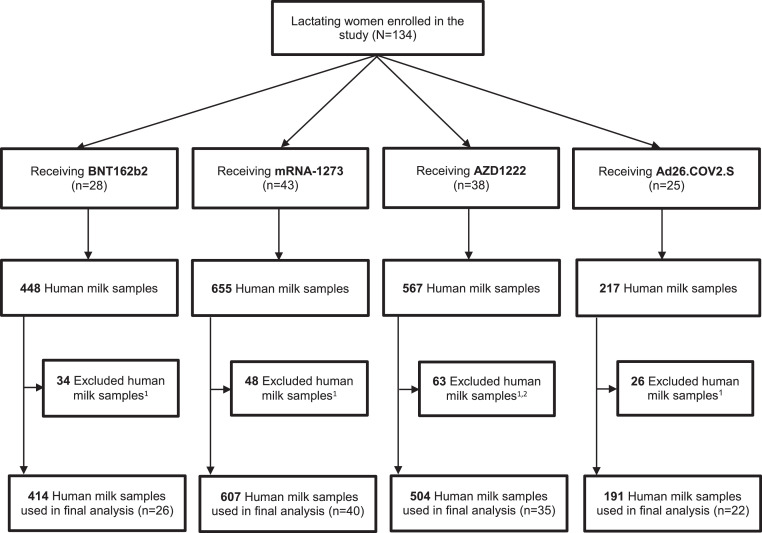
This prospective cohort study was conducted in the Netherlands between January 06, 2021 and July 31, 2021. Participants were recruited through social media. Human milk samples were collected longitudinally during a period of 70 days from women receiving one of the four different severe acute respiratory coronavirus 2 (SARS-CoV-2) vaccines: Pfizer-BioNTech (BNT162b2), Moderna (mRNA-1273), Oxford/AstraZeneca (AZD1222) and Johnson&Johnson (Ad26.COV2.S). SARS-CoV-2-specific antibodies were measured using an enzyme-linked immunosorbent assay. The area under the curve (AUC) of the Immunoglobulins A (IgA) and G (IgG) antibody response was determined over 15 and 70 days following the first vaccination and compared between the different vaccines.
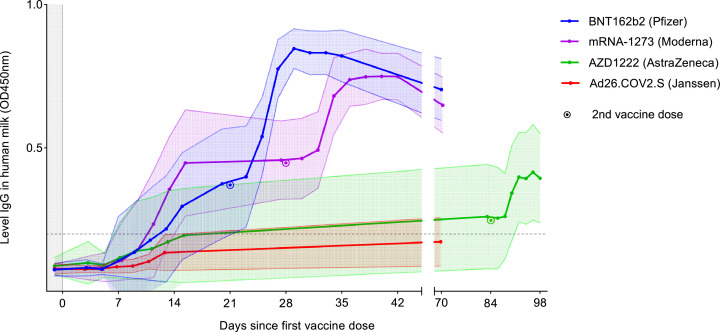
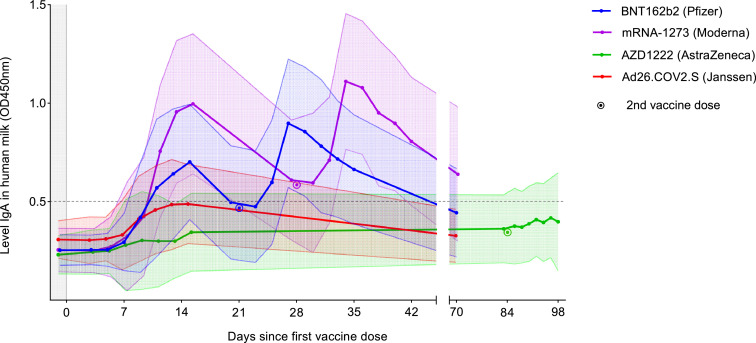
This study enrolled 134 vaccinated lactating women of whom 97 participated the entire study period. In total, 1887 human milk samples were provided. The human milk antibody response differed between SARS-CoV-2 vaccines over the study period. The mean AUC of SARS-CoV-2-specific IgA, but not IgG, in human milk over 15 days was higher after vaccination with an mRNA-based vaccine than a vector-based vaccine (AUC with respect to ground [AUCg] ± the standard error of the mean [SEM] for IgA was 6·09 ± 0·89 in the BNT162b2 group, 7·48 ± 1·03 in the mRNA-1273 group, 4·17 ± 0·73 in the AZD1222 group, and 5·71 ± 0·70 in the Ad26.COV2.S group). Over a period of 70 days, the mean AUCg of both IgA and IgG was higher after vaccination with an mRNA-based vaccine than a vector-based vaccine (AUCg ± SEM for IgA was 38·77 ± 6·51 in the BNT162b2 group, 50·13 ± 7·41 in the mRNA-1273 group, 24·12 ± 5·47 in the AZD1222 group, and 28·15 ± 6·69 in the Ad26.COV2.S group; AUCg ± SEM for IgG was 40·43 ± 2·67 in the BNT162b2 group, 37·01 ± 2·38 in the mRNA-1273 group, 16·04 ± 5·09 in the AZD1222 group, and 10·44 ± 2·50 in the Ad26.COV2.S group).
Overall, maternal vaccination during lactation with an mRNA-based vaccine resulted in higher SARS-CoV-2 antibody responses in human milk compared to vector-based vaccines. Therefore, vaccination with mRNA-based vaccines, preferably with the mRNA-1273 vaccine, might not only provide better immunological protection for the mother but also for her breastfed infant
Stichting Steun Emma Kinderziekenhuis and the Amsterdam Infection and Immunity Institute (grant 24175).
哺乳期妇女接种新冠疫苗不仅可以保护她们自身,还能通过母乳保护其母乳喂养的婴儿。因此,深入了解目前广泛使用的各种疫苗免疫后母乳中的抗体反应非常重要。本研究的目的是确定并比较接种基于信使核糖核酸(mRNA)和载体的疫苗后长达两个多月母乳中的抗体反应。
这项前瞻性队列研究于2021年1月6日至2021年7月31日在荷兰进行。参与者通过社交媒体招募。在70天的时间里,对接受四种不同的严重急性呼吸综合征冠状病毒2(SARS-CoV-2)疫苗之一的女性纵向采集母乳样本:辉瑞-生物新技术公司(BNT162b2)、莫德纳公司(mRNA-1273)、牛津/阿斯利康公司(AZD1222)和强生公司(Ad26.COV2.S)。使用酶联免疫吸附测定法测量SARS-CoV-2特异性抗体。在首次接种疫苗后的15天和70天内测定免疫球蛋白A(IgA)和G(IgG)抗体反应的曲线下面积(AUC),并在不同疫苗之间进行比较。
本研究招募了134名接种疫苗的哺乳期妇女,其中97名参与了整个研究期。总共提供了1887份母乳样本。在研究期间,不同SARS-CoV-2疫苗的母乳抗体反应有所不同。接种基于mRNA的疫苗后,母乳中SARS-CoV-2特异性IgA(而非IgG)在15天内的平均AUC高于接种基于载体的疫苗(BNT162b2组IgA相对于基线的AUC [AUCg]±平均标准误[SEM]为6.09±0.89,mRNA-1273组为7.48±1.03,AZD1222组为4.17±0.73,Ad26.COV2.S组为5.71±0.70)。在70天的时间里,接种基于mRNA的疫苗后,IgA和IgG的平均AUCg均高于接种基于载体的疫苗(BNT162b2组IgA的AUCg±SEM为38.77±6.51,mRNA-1273组为50.13±7.41,AZD1222组为24.12±5.47,Ad26.COV2.S组为28.15±6.69;BNT162b2组IgG的AUCg±SEM为40.43±2.67,mRNA-1273组为37.01±2.38,AZD1222组为16.04±5.09,Ad26.COV2.S组为10.44±2.50)。
总体而言,哺乳期母亲接种基于mRNA的疫苗后,母乳中SARS-CoV-2抗体反应高于接种基于载体的疫苗。因此,接种基于mRNA的疫苗,最好是mRNA-1273疫苗,可能不仅能为母亲提供更好的免疫保护,也能为其母乳喂养的婴儿提供更好的免疫保护。
斯泰恩·艾玛儿童医院基金会和阿姆斯特丹感染与免疫研究所(资助编号24175)。