Department of Pediatrics, University of Pittsburgh School of Medicine, Pittsburgh, Pennsylvania, United States of America.
University of Pittsburgh School of Medicine, Pittsburgh, Pennsylvania, United States of America.
PLoS One. 2023 Jun 13;18(6):e0287103. doi: 10.1371/journal.pone.0287103. eCollection 2023.
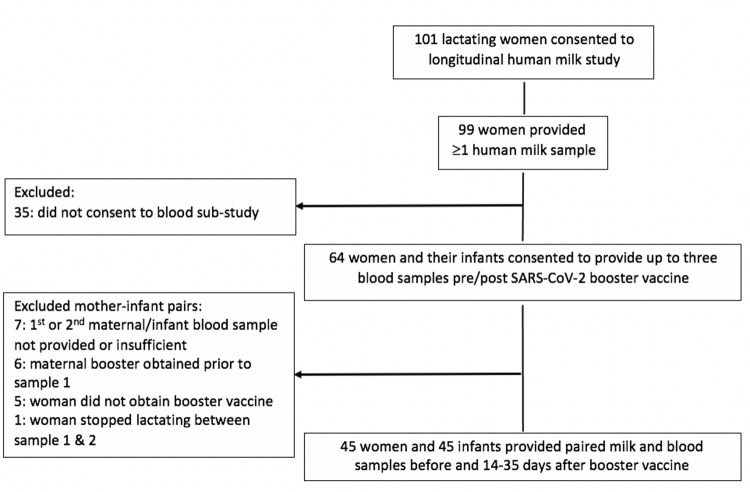
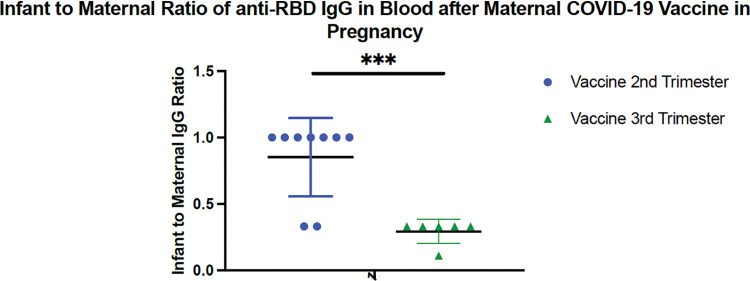
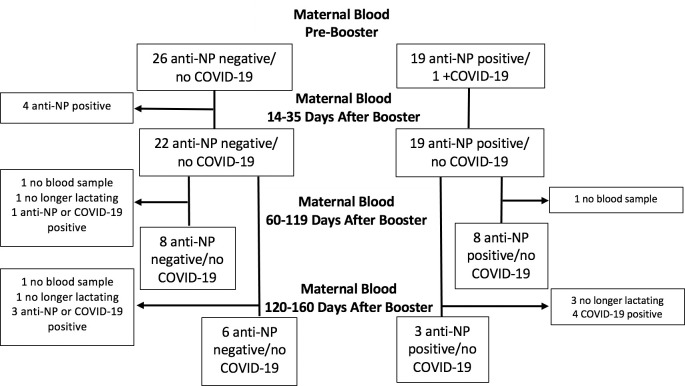
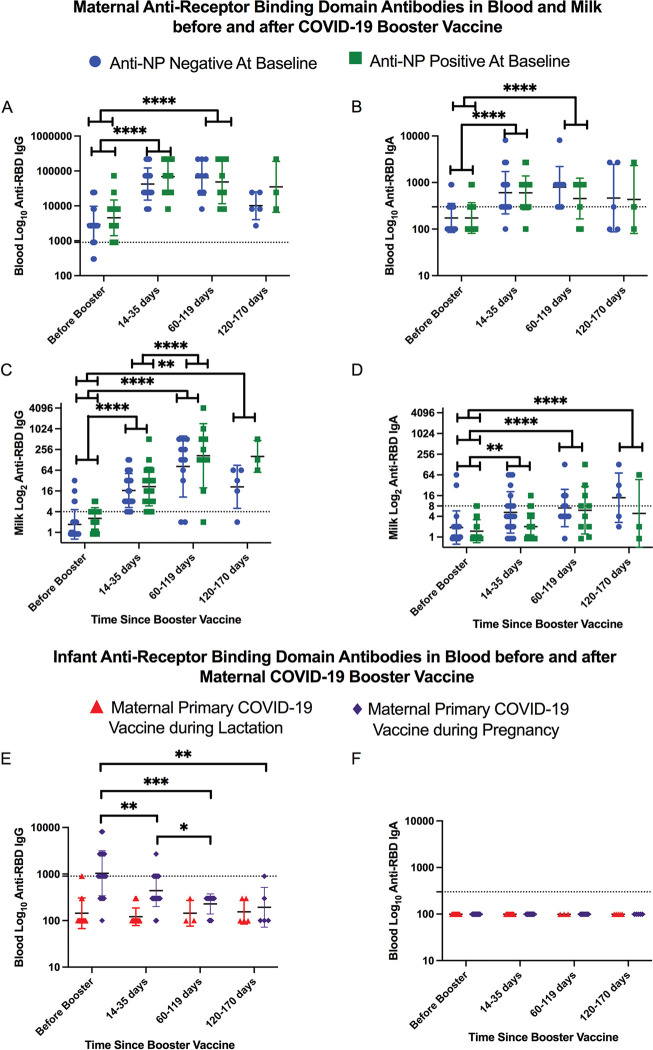
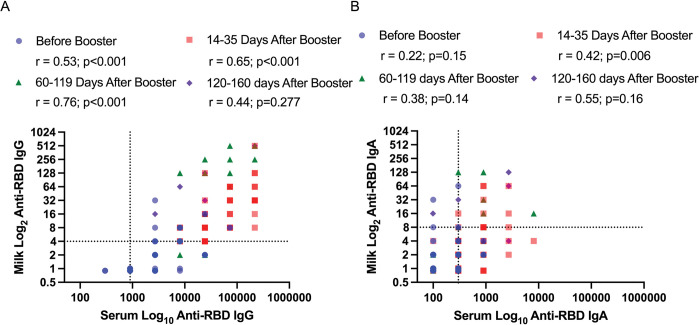
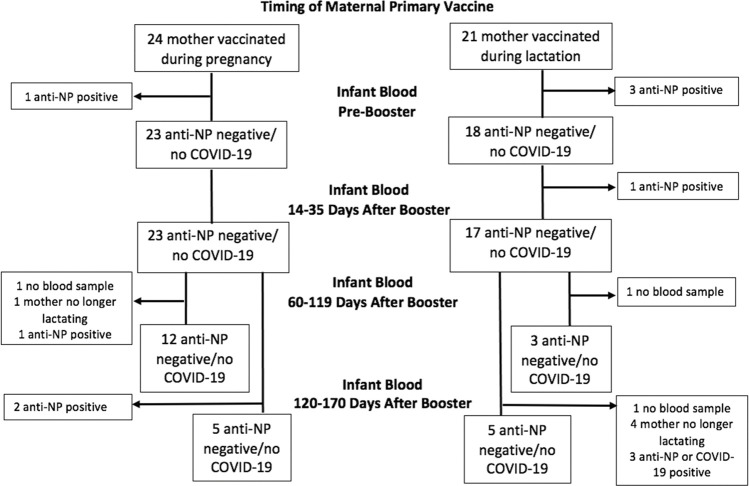
Maternal COVID-19 vaccination could protect infants who are ineligible for vaccine through antibody transfer during pregnancy and lactation. We measured the quantity and durability of SARS-CoV-2 antibodies in human milk and infant blood before and after maternal booster vaccination. Prospective cohort of lactating women immunized with primary and booster COVID-19 vaccines during pregnancy or lactation and their infants. Milk and blood samples from October 2021 to April 2022 were included. Anti-nucleoprotein (NP) and anti-receptor binding domain (RBD) IgG and IgA in maternal milk and maternal and infant blood were measured and compared longitudinally after maternal booster vaccine. Forty-five lactating women and their infants provided samples. 58% of women were anti-NP negative and 42% were positive on their first blood sample prior to booster vaccine. Anti-RBD IgG and IgA in milk remained significantly increased through 120-170 days after booster vaccine and did not differ by maternal NP status. Anti-RBD IgG and IgA did not increase in infant blood after maternal booster. Of infants born to women vaccinated in pregnancy, 74% still had positive serum anti-RBD IgG measured on average 5 months after delivery. Infant to maternal IgG ratio was highest for infants exposed to maternal primary vaccine during the second trimester compared to third trimester (0.85 versus 0.29; p<0.001). Maternal COVID-19 primary and booster vaccine resulted in robust and long-lasting transplacental and milk antibodies. These antibodies may provide important protection against SARS-CoV-2 during the first six months of life.
母体 COVID-19 疫苗接种可通过妊娠和哺乳期的抗体转移,为不符合疫苗接种条件的婴儿提供保护。我们测量了母体加强免疫接种前后人乳和婴儿血液中 SARS-CoV-2 抗体的数量和持久性。前瞻性队列研究纳入了在妊娠或哺乳期接受过 COVID-19 疫苗初级和加强免疫接种的哺乳期妇女及其婴儿。纳入了 2021 年 10 月至 2022 年 4 月的母乳和血液样本。测量并比较了母体母乳和母婴血液中的抗核蛋白(NP)和抗受体结合域(RBD)IgG 和 IgA,并在母体加强疫苗后进行纵向比较。45 名哺乳期妇女及其婴儿提供了样本。在加强疫苗前的第一次血液样本中,58%的妇女抗 NP 为阴性,42%为阳性。加强疫苗后 120-170 天,母乳中抗 RBD IgG 和 IgA 仍显著增加,与母体 NP 状态无关。婴儿血液中抗 RBD IgG 和 IgA 在母体加强后并未增加。在妊娠期间接种疫苗的妇女所生的婴儿中,74%的婴儿在平均分娩后 5 个月时仍有阳性血清抗 RBD IgG。与第三孕期相比,第二孕期暴露于母体初级疫苗的婴儿的母婴 IgG 比值最高(0.85 比 0.29;p<0.001)。母体 COVID-19 初级和加强疫苗接种可产生强大且持久的胎盘和母乳抗体。这些抗体可能在生命的头六个月提供针对 SARS-CoV-2 的重要保护。