• 文献检索
  • 文档翻译
  • 深度研究
  • 学术资讯
  • Suppr Zotero 插件Zotero 插件
  • 邀请有礼
  • 套餐&价格
  • 历史记录
应用&插件
Suppr Zotero 插件Zotero 插件浏览器插件Mac 客户端Windows 客户端微信小程序
定价
高级版会员购买积分包购买API积分包
服务
文献检索文档翻译深度研究API 文档MCP 服务
关于我们
关于 Suppr公司介绍联系我们用户协议隐私条款
关注我们

Suppr 超能文献

核心技术专利:CN118964589B侵权必究
粤ICP备2023148730 号-1Suppr @ 2026

文献检索

告别复杂PubMed语法,用中文像聊天一样搜索,搜遍4000万医学文献。AI智能推荐,让科研检索更轻松。

立即免费搜索

文件翻译

保留排版,准确专业,支持PDF/Word/PPT等文件格式,支持 12+语言互译。

免费翻译文档

深度研究

AI帮你快速写综述,25分钟生成高质量综述,智能提取关键信息,辅助科研写作。

立即免费体验

知信偏差在临床和非临床的幻听者中:一项定性主题分析研究。

Epistemic injustice amongst clinical and non-clinical voice-hearers: A qualitative thematic analysis study.

机构信息

Department of Psychology, University of Bath, Bath, UK.

Institute for Mental Health, School of Psychology, University of Birmingham, Birmingham, UK.

出版信息

Br J Clin Psychol. 2022 Nov;61(4):947-963. doi: 10.1111/bjc.12368. Epub 2022 Apr 24.

DOI:10.1111/bjc.12368
PMID:35466414
原文链接:https://pmc.ncbi.nlm.nih.gov/articles/PMC9790593/
Abstract

OBJECTIVES

Research has suggested people who hear voices may be at risk of epistemic injustice. This is a form of discrimination whereby someone is unfairly judged to be an unreliable knower (testimonial injustice) or is unable to contribute to, and therefore access, concepts that make sense of their experience within mainstream society (hermeneutical injustice). Voice-hearing occurs both in people who are mental health service users and in the general population (clinical and non-clinical voice-hearers, respectively). The degree of distress and impairment associated with voices has been shown to relate to how individuals make sense of their experiences and how others respond to their identity as a voice-hearer. The aim of this study was to explore people's experiences of epistemic injustice in relation to voice-hearing and to understand how these may differ between clinical and non-clinical voice-hearers.

DESIGN

A qualitative design was used.

METHOD

Eight clinical and nine non-clinical voice-hearers partook in semi-structured interviews, which were analysed using thematic analysis.

RESULTS

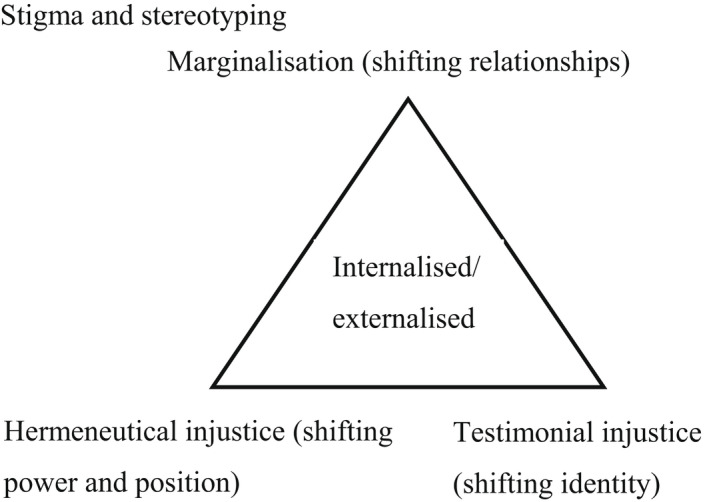
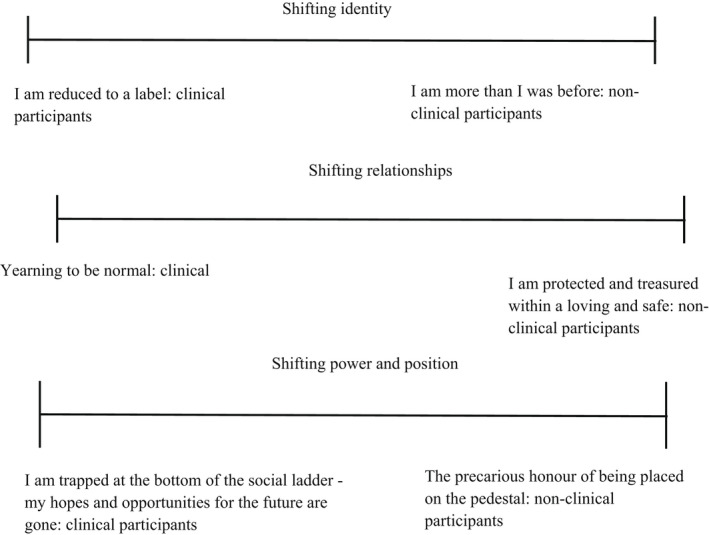
Three pairs of themes related to (i) identity, (ii) relationships and (iii) power and position were constructed across the clinical and non-clinical groups, and two shared themes within both groups were created relating to testimonial and hermeneutical injustice.

CONCLUSION

Both clinical and non-clinical voice-hearers described experiencing epistemic injustice in wider society. The presence of a 'safe haven' (e.g. spiritualist churches) for non-clinical voice-hearers ameliorated the impact of this to some degree, by allowing people to make connections with others with similar experiences within a non-judgemental and accepting community.

摘要

目的

研究表明,听到声音的人可能面临认知不公正的风险。这是一种歧视形式,即某人被不公平地判断为不可靠的知情者(证言不公正),或者无法为理解其在主流社会中的经验的概念做出贡献,因此无法获得这些概念(解释学不公正)。在精神卫生服务使用者和一般人群中都存在幻听(分别为临床和非临床幻听者)。与幻听相关的痛苦和障碍程度与个人如何理解自己的经历以及他人如何回应他们作为幻听者的身份有关。这项研究的目的是探讨人们在幻听方面的认知不公正的经历,并了解这些经历在临床和非临床幻听者之间可能有何不同。

设计

采用定性设计。

方法

八名临床和九名非临床幻听者参与了半结构式访谈,采用主题分析进行分析。

结果

在临床和非临床两组中构建了三对主题,涉及(i)身份、(ii)关系和(iii)权力和地位,在两组中都创建了两个与证言和解释学不公正有关的共同主题。

结论

临床和非临床幻听者都描述了在更广泛的社会中经历认知不公正。非临床幻听者的“安全港”(例如,灵媒教堂)的存在在某种程度上减轻了这种影响,因为它允许人们在一个非评判和接受的社区中与具有类似经历的人建立联系。
https://cdn.ncbi.nlm.nih.gov/pmc/blobs/d704/9790593/b09336744e3f/BJC-61-947-g001.jpg
https://cdn.ncbi.nlm.nih.gov/pmc/blobs/d704/9790593/aed9e6aae7c3/BJC-61-947-g002.jpg
https://cdn.ncbi.nlm.nih.gov/pmc/blobs/d704/9790593/b09336744e3f/BJC-61-947-g001.jpg
https://cdn.ncbi.nlm.nih.gov/pmc/blobs/d704/9790593/aed9e6aae7c3/BJC-61-947-g002.jpg
https://cdn.ncbi.nlm.nih.gov/pmc/blobs/d704/9790593/b09336744e3f/BJC-61-947-g001.jpg

相似文献

1
Epistemic injustice amongst clinical and non-clinical voice-hearers: A qualitative thematic analysis study.知信偏差在临床和非临床的幻听者中:一项定性主题分析研究。
Br J Clin Psychol. 2022 Nov;61(4):947-963. doi: 10.1111/bjc.12368. Epub 2022 Apr 24.
2
Experiences of mental health nursing staff working with voice hearers in an acute setting: An interpretive phenomenological approach.精神科护理人员在急症环境中与幻听者合作的体验:一种解释性现象学方法。
J Psychiatr Ment Health Nurs. 2018 Apr;25(3):157-166. doi: 10.1111/jpm.12448. Epub 2018 Feb 8.
3
Voice hearing within the context of hearers' social worlds: an interpretative phenomenological analysis.在听众的社会世界背景下的幻听:一种阐释现象学分析。
Psychol Psychother. 2011 Sep;84(3):256-72. doi: 10.1348/147608310X524883. Epub 2011 Apr 13.
4
Social Sense-Making and Explanatory Models for Voice-Hearing Within Hearing Voices Network Groups.“听见声音”网络组织中幻听的社会意义建构与解释模型
Community Ment Health J. 2025 Feb;61(2):372-381. doi: 10.1007/s10597-024-01391-3. Epub 2024 Dec 27.
5
Interpersonal processes and hearing voices: a study of the association between relating to voices and distress in clinical and non-clinical hearers.人际关系过程与幻听:一项关于幻听与临床和非临床聆听者的痛苦之间关联的研究。
Behav Cogn Psychother. 2010 Mar;38(2):127-40. doi: 10.1017/S1352465809990506. Epub 2009 Nov 2.
6
Benefits of Hearing Voices Groups & Other Self-Help Groups for Voice Hearers: A Systematic Review.幻听群体及其他针对幻听患者的自助群体的益处:一项系统评价
Issues Ment Health Nurs. 2023 Apr;44(4):228-244. doi: 10.1080/01612840.2023.2189953. Epub 2023 Apr 19.
7
The distress experienced by voice hearers is associated with the perceived relationship between the voice hearer and the voice.幻听患者所经历的痛苦与幻听患者和幻听之间的感知关系有关。
Br J Clin Psychol. 2004 Jun;43(Pt 2):143-153. doi: 10.1348/014466504323088024.
8
Voice hearers' explanations of trauma-related voices and processes of change throughout imagery rescripting: A qualitative exploration.声音幻听者对创伤相关声音的解释,以及意象重写过程中的变化:一项定性探索。
Psychol Psychother. 2023 Dec;96(4):982-998. doi: 10.1111/papt.12491. Epub 2023 Aug 28.
9
Epistemic struggles: The role of advocacy in promoting epistemic justice and rights in mental health.认知斗争:倡导在促进心理健康中的认知正义和权利中的作用。
Soc Sci Med. 2018 Dec;219:36-44. doi: 10.1016/j.socscimed.2018.10.003. Epub 2018 Oct 10.
10
'You don't talk about the voices': voice hearers and community mental health nurses talk about responding to voice hearing experiences.“你不要谈论那些声音”:幻听患者与社区精神科护士谈应对幻听经历
J Clin Nurs. 2008 Jun;17(12):1591-600. doi: 10.1111/j.1365-2702.2007.02185.x.

引用本文的文献

1
Addressing epistemic injustice in the mental healthcare of Indigenous people in Bangladesh: Implications for global mental health.解决孟加拉国原住民心理保健中的认知不公:对全球心理健康的启示。
Glob Ment Health (Camb). 2025 May 22;12:e52. doi: 10.1017/gmh.2025.10008. eCollection 2025.
2
'Lemons to lemonade': Identity integration in researchers with lived experience of psychosis.“化苦为甜”:有精神病生活经历的研究者的身份认同整合
Psychol Psychother. 2025 Sep;98(3):643-662. doi: 10.1111/papt.12582. Epub 2025 Feb 24.
3
Adverse Events Reporting in Digital Interventions Evaluations for Psychosis: A Systematic Literature Search and Individual Level Content Analysis of Adverse Event Reports.

本文引用的文献

1
Threats to epistemic agency in young people with unusual experiences and beliefs.有异常经历和信念的年轻人的认知能动性所面临的威胁。
Synthese. 2021;199(3-4):7689-7704. doi: 10.1007/s11229-021-03133-4. Epub 2021 Mar 30.
2
Honoring the Voice of the Client in Clinical Social Work Practice: Negotiating with Epistemic Injustice.尊重临床社会工作实践中服务对象的声音:应对认知不公正
Soc Work. 2019 Jan 1;64(1):29-40. doi: 10.1093/sw/swy050.
3
Contributory injustice in psychiatry.精神病学中的贡献性不公正。
数字干预措施评估精神分裂症不良事件报告:不良事件报告的系统文献检索和个体水平内容分析。
Schizophr Bull. 2024 Nov 8;50(6):1436-1455. doi: 10.1093/schbul/sbae031.
4
Self-dehumanisation in voice hearers: the end of a continuum.幻听患者的自我非人化:连续体的终结。
Front Psychiatry. 2023 Oct 3;14:1173380. doi: 10.3389/fpsyt.2023.1173380. eCollection 2023.
5
Mental Health Experts as Objects of Epistemic Injustice-The Case of Autism Spectrum Condition.作为认知不公正对象的心理健康专家——以自闭症谱系障碍为例
Diagnostics (Basel). 2023 Mar 1;13(5):927. doi: 10.3390/diagnostics13050927.
6
Phenomenology as a resource for translational research in mental health: methodological trends, challenges and new directions.现象学作为精神健康转化研究的资源:方法学趋势、挑战与新方向。
Epidemiol Psychiatr Sci. 2023 Jan 16;32:e5. doi: 10.1017/S2045796022000762.
J Med Ethics. 2019 Feb;45(2):97-100. doi: 10.1136/medethics-2018-104761. Epub 2018 Oct 18.
4
A qualitative study: experiences of stigma by people with mental health problems.一项定性研究:精神健康问题患者的污名体验。
Psychol Psychother. 2018 Sep;91(3):380-397. doi: 10.1111/papt.12167. Epub 2018 Jan 18.
5
The impact of stigma on emotional distress and recovery from psychosis: The mediatory role of internalised shame and self-esteem.耻辱感对精神病后情绪困扰和康复的影响:内化耻辱感和自尊的中介作用。
Psychiatry Res. 2017 Sep;255:94-100. doi: 10.1016/j.psychres.2017.05.016. Epub 2017 May 10.
6
An Integrative Cognitive Model of Internalized Stigma in Psychosis.精神病内化耻辱感的综合认知模型
Behav Cogn Psychother. 2017 Nov;45(6):545-560. doi: 10.1017/S1352465817000224. Epub 2017 May 10.
7
Epistemic injustice in psychiatry.精神病学中的认知不公正。
BJPsych Bull. 2017 Apr;41(2):65-70. doi: 10.1192/pb.bp.115.050682.
8
Epistemic Injustice and Illness.认知不公与疾病
J Appl Philos. 2017 Feb;34(2):172-190. doi: 10.1111/japp.12172. Epub 2016 Feb 8.
9
Auditory verbal hallucinations and continuum models of psychosis: A systematic review of the healthy voice-hearer literature.幻听与精神病连续体模型:对健康幻听者文献的系统综述
Clin Psychol Rev. 2017 Feb;51:125-141. doi: 10.1016/j.cpr.2016.10.010. Epub 2016 Nov 1.
10
Psychosocial interventions for internalised stigma in people with a schizophrenia-spectrum diagnosis: A systematic narrative synthesis and meta-analysis.针对精神分裂症谱系诊断患者内化耻辱感的心理社会干预措施:系统叙述性综合分析与荟萃分析
Schizophr Res. 2016 Oct;176(2-3):291-303. doi: 10.1016/j.schres.2016.05.001. Epub 2016 May 30.