Department of Respiratory and Critical Care Medicine, The First Affiliated Hospital of China Medical University, Shenyang, China.
Department of Respiratory and Critical Care Medicine, The First Affiliated Hospital of China Medical University, No.155, Nanjing North Street, Heping District, Shenyang, 110001 China.
Ther Adv Respir Dis. 2022 Jan-Dec;16:17534666221091931. doi: 10.1177/17534666221091931.
Coronavirus disease 2019 (COVID-19) has spread globally, and many patients with severe cases have received oxygen therapy through a high-flow nasal cannula (HFNC).
We assessed the efficacy of HFNC for treating patients with COVID-19 and risk factors for HFNC failure.
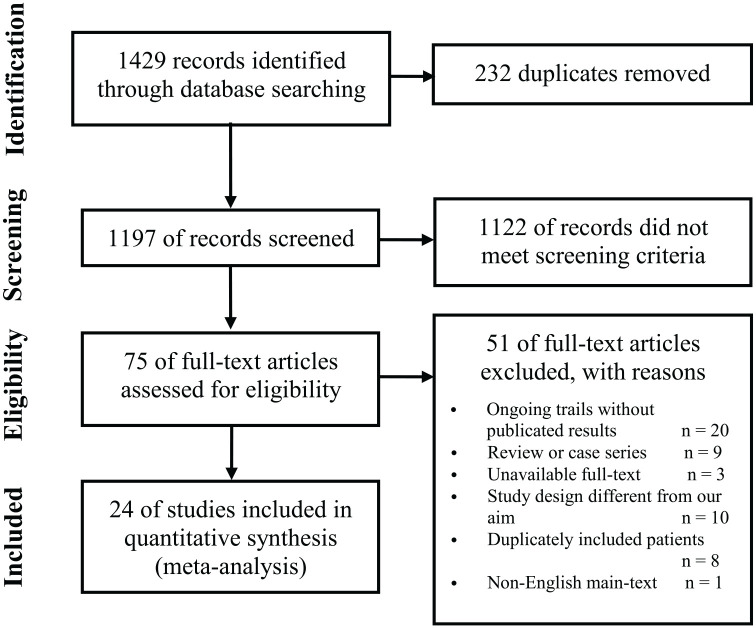
We searched PubMed, Embase, and the Cochrane Central Register of randomized controlled trials (RCTs) and observational studies of HFNC in patients with COVID-19 published in English from January 1st, 2020 to August 15th, 2021. The primary aim was to assess intubation, mortality, and failure rates in COVID-19 patients supported by HFNC. Secondary aims were to compare HFNC success and failure groups and to describe the risk factors for HFNC failure.
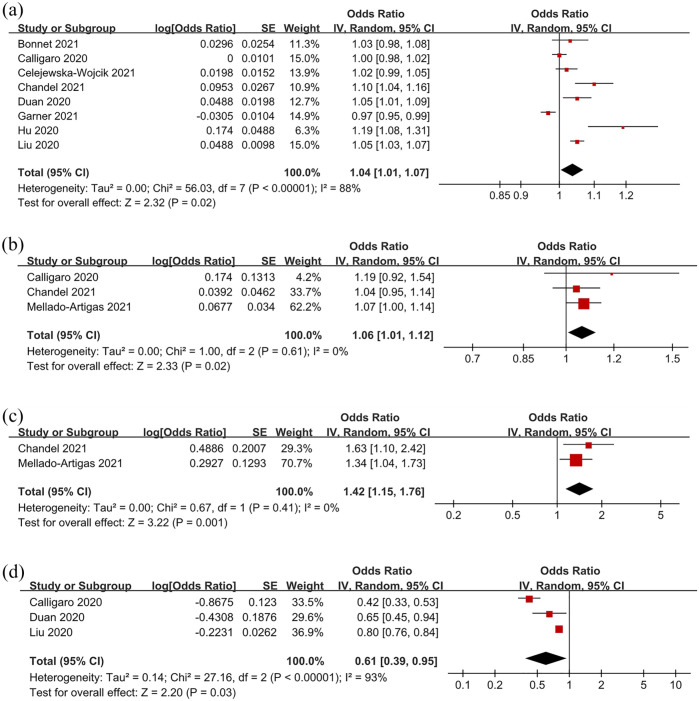
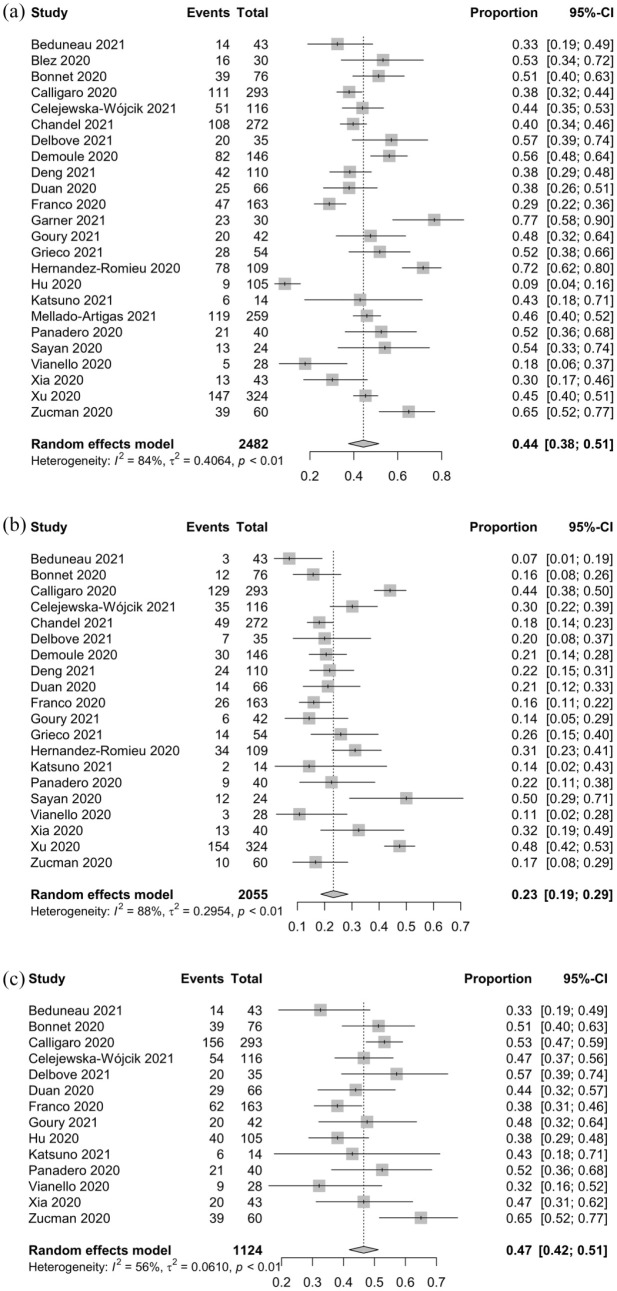
A total of 25 studies fulfilled selection criteria and included 2851 patients. The intubation, mortality, and failure rates were 0.44 (95% confidence interval (CI): 0.38-0.51, I = 84%), 0.23 (95% CI: 0.19-0.29, I = 88%), and 0.47 (95% CI: 0.42-0.51, I = 56%), respectively. Compared to the success group, age, body mass index (BMI), Sequential Organ Failure Assessment (SOFA) score, Acute Physiology and Chronic Health Evaluation (APACHE) II score, D-dimer, lactate, heart rate, and respiratory rate were higher and PaO, PaO/FiO, ROX index (the ratio of SpO/FiO to respiratory rate), ROX index after the initiation of HFNC, and duration of HFNC were lower in the failure group (all Ps < 0.05). There were also more smokers and more comorbidities in the failure group (all Ps < 0.05). Pooled odds ratios (ORs) revealed that older age (OR: 1.04, 95% CI: 1.01-1.07, P = 0.02, I = 88%), a higher white blood cell (WBC) count (OR: 1.06, 95% CI: 1.01-1.12, P = 0.02, I = 0%), a higher heart rate (OR: 1.42, 95% CI: 1.15-1.76, P < 0.01, I = 0%), and a lower ROX index(OR: 0.61, 95% CI: 0.39-0.95, P = 0.03, I = 93%) after the initiation of HFNC were all significant risk factors for HFNC failure.
HFNC is an effective way of providing respiratory support in the treatment of COVID-19 patients. Older age, a higher WBC count, a higher heart rate, and a lower ROX index after the initiation of HFNC are associated with an increased risk of HFNC failure.
2019 年冠状病毒病(COVID-19)在全球范围内传播,许多重症患者通过高流量鼻导管(HFNC)接受氧疗。
我们评估 HFNC 治疗 COVID-19 患者的疗效和 HFNC 失败的危险因素。
我们检索了 2020 年 1 月 1 日至 2021 年 8 月 15 日期间发表的关于 HFNC 在 COVID-19 患者中应用的英文随机对照试验(RCT)和观察性研究的 PubMed、Embase 和 Cochrane 中心随机对照试验注册库。主要目的是评估 HFNC 支持的 COVID-19 患者的插管、死亡率和失败率。次要目的是比较 HFNC 成功和失败组,并描述 HFNC 失败的危险因素。
共有 25 项研究符合入选标准,包括 2851 例患者。插管、死亡率和失败率分别为 0.44(95%置信区间:0.38-0.51,I=84%)、0.23(95%置信区间:0.19-0.29,I=88%)和 0.47(95%置信区间:0.42-0.51,I=56%)。与成功组相比,年龄、体重指数(BMI)、序贯器官衰竭评估(SOFA)评分、急性生理学和慢性健康评估(APACHE)Ⅱ评分、D-二聚体、乳酸、心率和呼吸频率更高,而 PaO、PaO/FiO、ROX 指数(SpO/FiO 与呼吸率的比值)、HFNC 开始后的 ROX 指数和 HFNC 持续时间更低(均 P<0.05)。失败组吸烟者和合并症更多(均 P<0.05)。汇总优势比(OR)显示,年龄较大(OR:1.04,95%置信区间:1.01-1.07,P=0.02,I=88%)、白细胞计数较高(OR:1.06,95%置信区间:1.01-1.12,P=0.02,I=0%)、心率较高(OR:1.42,95%置信区间:1.15-1.76,P<0.01,I=0%)和 HFNC 开始后 ROX 指数较低(OR:0.61,95%置信区间:0.39-0.95,P=0.03,I=93%)是 HFNC 失败的显著危险因素。
HFNC 是治疗 COVID-19 患者的一种有效的呼吸支持方法。年龄较大、白细胞计数较高、心率较高和 HFNC 开始后 ROX 指数较低与 HFNC 失败的风险增加相关。