Materials Science Division, Lawrence Berkeley National Laboratory, Berkeley, CA, 94720, USA.
National Center for Electron Microscopy, Molecular Foundry, Lawrence Berkeley National Laboratory, Berkeley, CA, 94720, USA.
Nat Commun. 2022 Apr 25;13(1):2211. doi: 10.1038/s41467-022-29847-8.
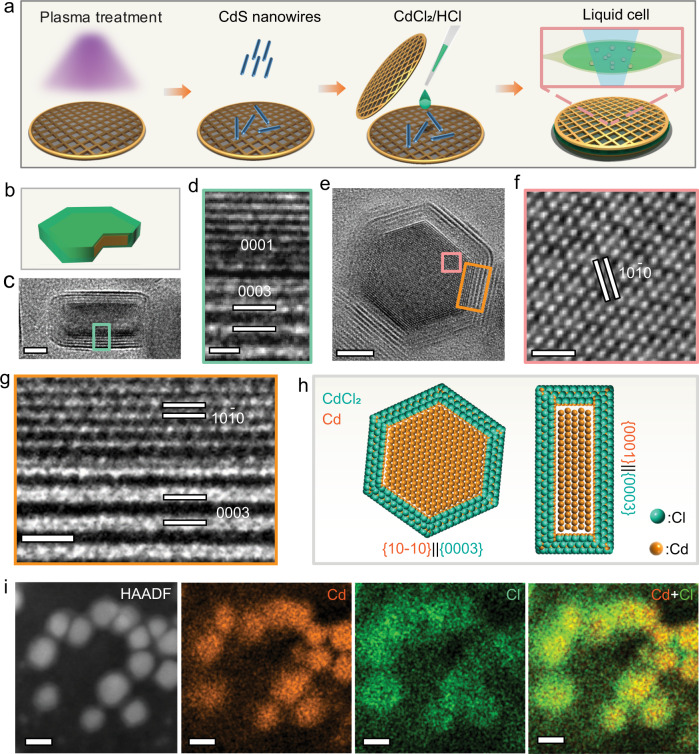
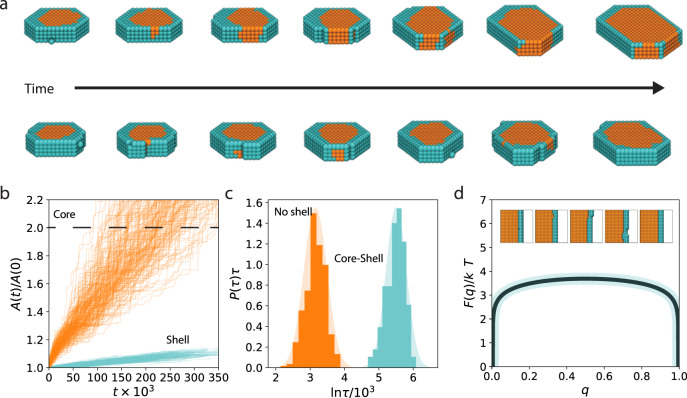
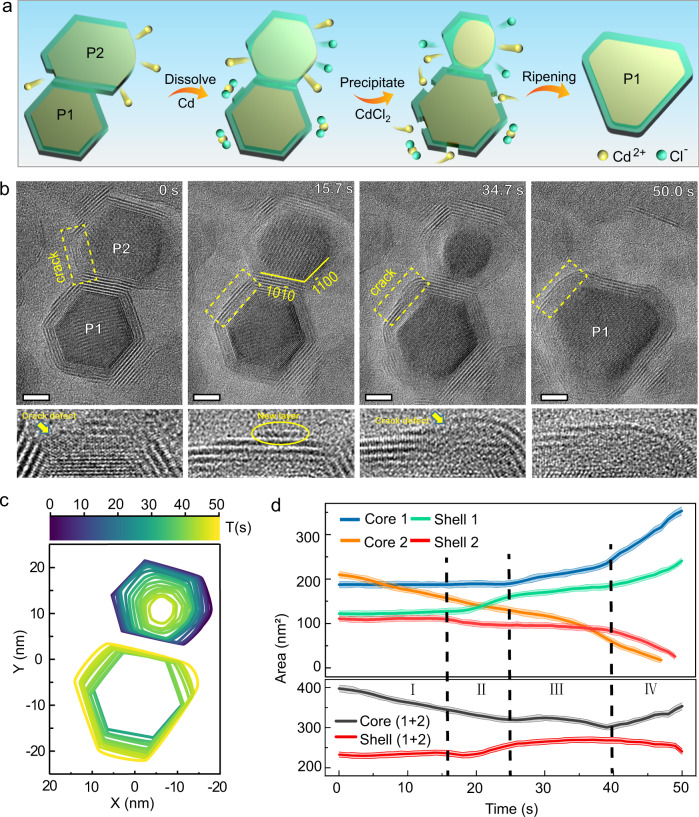
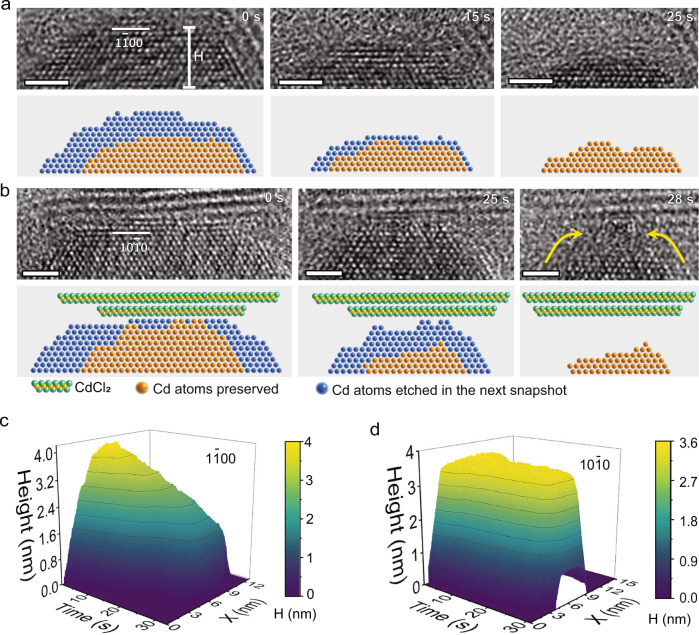
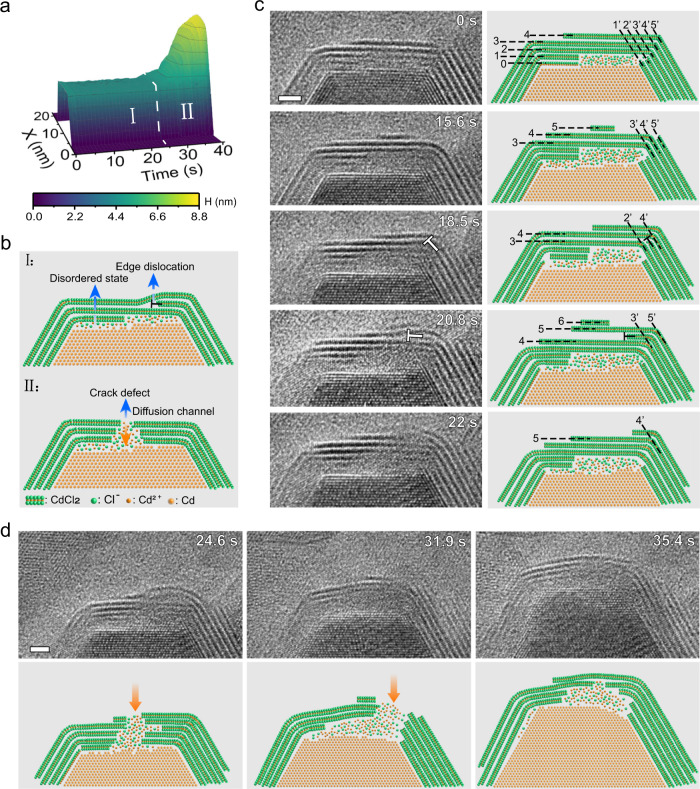
Understanding nanostructure ripening mechanisms is desirable for gaining insight on the growth and potential applications of nanoscale materials. However, the atomic pathways of nanostructure ripening in solution have rarely been observed directly. Here, we report defect-mediated ripening of Cd-CdCl core-shell nanoparticles (CSN) revealed by in-situ atomic resolution imaging with liquid cell transmission electron microscopy. We find that ripening is initiated by dissolution of the nanoparticle with an incomplete CdCl shell, and that the areas of the Cd core that are exposed to the solution are etched first. The growth of the other nanoparticles is achieved by generating crack defects in the shell, followed by ion diffusion through the cracks. Subsequent healing of crack defects leads to a highly crystalline CSN. The formation and annihilation of crack defects in the CdCl shell, accompanied by disordering and crystallization of the shell structure, mediate the ripening of Cd-CdCl CSN in the solution.
了解纳米结构的熟化机制对于深入了解纳米材料的生长和潜在应用是必要的。然而,纳米结构在溶液中熟化的原子途径很少被直接观察到。在这里,我们通过液体电池透射电子显微镜的原位原子分辨率成像报告了 Cd-CdCl 核壳纳米粒子 (CSN) 的缺陷介导熟化。我们发现,熟化是由具有不完全 CdCl 壳的纳米粒子的溶解引发的,并且暴露于溶液的 Cd 核的区域首先被蚀刻。其他纳米粒子的生长是通过在壳中产生裂纹缺陷来实现的,然后是通过裂纹的离子扩散。裂纹缺陷的随后愈合导致 CSN 具有高结晶度。CdCl 壳中裂纹缺陷的形成和消除,伴随着壳结构的无序和结晶,在溶液中调节了 Cd-CdCl CSN 的熟化。