
紫外氧化下单个InP/ZnSe/ZnS量子点中结构缺陷形成的见解。
Insights into structural defect formation in individual InP/ZnSe/ZnS quantum dots under UV oxidation.
作者信息
Baek Hayeon, Kang Sungsu, Heo Junyoung, Choi Soonmi, Kim Ran, Kim Kihyun, Ahn Nari, Yoon Yeo-Geon, Lee Taekjoon, Chang Jae Bok, Lee Kyung Sig, Park Young-Gil, Park Jungwon
机构信息
School of Chemical and Biological Engineering, Institute of Chemical Processes, Seoul National University, Seoul, Republic of Korea.
Center for Nanoparticle Research, Institute for Basic Science (IBS), Seoul, Republic of Korea.
出版信息
Nat Commun. 2024 Feb 23;15(1):1671. doi: 10.1038/s41467-024-45944-2.
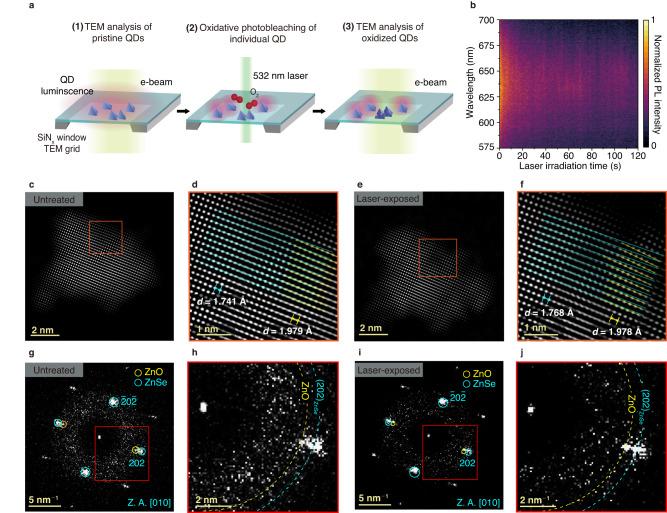
InP/ZnSe/ZnS quantum dots (QDs) stand as promising candidates for advancing QD-organic light-emitting diodes (QLED), but low emission efficiency due to their susceptibility to oxidation impedes applications. Structural defects play important roles in the emission efficiency degradation of QDs, but the formation mechanism of defects in oxidized QDs has been less investigated. Here, we investigated the impact of diverse structural defects formation on individual QDs and propagation during UV-facilitated oxidation using high-resolution (scanning) transmission electron microscopy. UV-facilitated oxidation of the QDs alters shell morphology by the formation of surface oxides, leaving ZnSe surfaces poorly passivated. Further oxidation leads to the formation of structural defects, such as dislocations, and induces strain at the oxide-QD interfaces, facilitating In diffusion from the QD core. These changes in the QD structures result in emission quenching. This study provides insight into the formation of structural defects through photo-oxidation, and their effects on emission properties of QDs.
磷化铟/硒化锌/硫化锌量子点(QDs)是推动量子点有机发光二极管(QLED)发展的有潜力的候选材料,但由于其易氧化导致的低发射效率阻碍了其应用。结构缺陷在量子点发射效率降低中起重要作用,但氧化量子点中缺陷的形成机制研究较少。在此,我们使用高分辨率(扫描)透射电子显微镜研究了在紫外光促进氧化过程中,各种结构缺陷的形成对单个量子点及其传播的影响。量子点的紫外光促进氧化通过形成表面氧化物改变了壳层形态,使得硒化锌表面的钝化效果不佳。进一步氧化会导致结构缺陷的形成,如位错,并在氧化物-量子点界面处产生应变,促进铟从量子点核心扩散。量子点结构的这些变化导致发射猝灭。本研究深入了解了通过光氧化形成结构缺陷及其对量子点发射特性的影响。


 Zotero 插件