Walia Bhavneet, Kim Jeeyoon, Ijere Ignatius, Sanders Shane
Department of Public Health, Falk College, Syracuse University, Syracuse, NY, United States.
Department of Sport Management, Falk College, Syracuse University, Syracuse, NY, United States.
JMIR Serious Games. 2022 Jun 9;10(2):e33661. doi: 10.2196/33661.
The effects of behavioral addiction to video games has received increasing attention in the literature, given increased use intensity among subgroups of video game players.
This study seeks to empirically determine the relationship between intensity of video gaming and hedonic experience of the player.
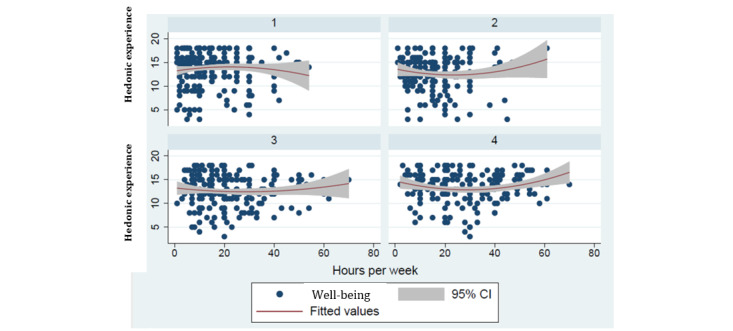
We conducted a survey of 835 individuals who regularly play video games to determine the relationship between intensity of use and hedonic experience. We divided the sample into quartiles by self-reported video game addictive symptom level (from the Internet Gaming Disorder Scale) and conducted polynomial regressions separately for each quartile.
We found that the higher video game addictive symptom level groups experienced a U-shaped (curvilinear) relationship between hedonic experience and intensity of play, whereas groups with lower video game addictive symptom levels exhibited no such relationship. The coefficients for the highest addictive symptom level group (quartile 4) for marginal effects for hours played per week and hours played per week squared were significantly negative (P=.005) and significantly positive (P=.004), respectively.
Our results are consistent with sensitization and tolerance theories, which suggest that high-symptom groups experience frustration and disappointment until they achieve excessive dopamine release, at which point their hedonic experience is expected to improve with additional play. Conversely, low-symptom groups experience no such fall-and-rise pattern. This result is consistent with the outcome that members of the latter group play the game for the direct experience, such that their hedonic experience is more directly related to events occurring in the game than to the increasingly elusive pursuit of excessive dopamine release. We also find that high-symptom groups spend substantially more time and money to support video game use and are much more likely to engage in video game use at the expense of other important activities, such as working, sleeping, and eating.
鉴于电子游戏玩家亚群体的使用强度增加,行为成瘾对电子游戏的影响在文献中受到越来越多的关注。
本研究旨在通过实证确定电子游戏强度与玩家享乐体验之间的关系。
我们对835名经常玩电子游戏的个体进行了一项调查,以确定使用强度与享乐体验之间的关系。我们根据自我报告的电子游戏成瘾症状水平(来自互联网游戏障碍量表)将样本分为四分位数,并对每个四分位数分别进行多项式回归。
我们发现,电子游戏成瘾症状水平较高的组在享乐体验和游戏强度之间呈现出U形(曲线)关系,而电子游戏成瘾症状水平较低的组则没有这种关系。成瘾症状水平最高的组(四分位数4)中,每周游戏时长的边际效应系数和每周游戏时长平方的边际效应系数分别显著为负(P = 0.005)和显著为正(P = 0.004)。
我们的结果与敏化和耐受理论一致,该理论表明,高症状组在达到多巴胺过度释放之前会经历挫折和失望,此时他们的享乐体验预计会随着更多游戏而改善。相反,低症状组没有这种先下降后上升的模式。这一结果与后一组成员为了直接体验而玩游戏的结果一致,即他们的享乐体验与游戏中发生的事件更直接相关,而不是与对多巴胺过度释放的日益难以捉摸的追求相关。我们还发现,高症状组花费大量的时间和金钱来支持电子游戏使用,并且更有可能以牺牲其他重要活动(如工作、睡眠和饮食)为代价进行电子游戏使用。