Zebhauser Paul Theo, Berthele Achim, Goldhardt Oliver, Diehl-Schmid Janine, Priller Josef, Ortner Marion, Grimmer Timo
Department of Neurology, School of Medicine, Technical University of Munich, Munich, Germany.
Department of Psychiatry and Psychotherapy, School of Medicine, Technical University of Munich, Munich, Germany.
Alzheimers Res Ther. 2022 Apr 26;14(1):61. doi: 10.1186/s13195-022-01004-9.
Cerebrospinal fluid (CSF) lactate levels have been suggested to be associated with disease severity and progression in several neurological diseases as an indicator of impaired energy metabolism, neuronal death, or microglial activation. Few studies have examined CSF lactate levels in dementia due to Alzheimer's disease (AD) and found higher values in AD patients compared to healthy controls (HC). However, these studies were mostly small in size, the inclusion criteria were not always well defined, and the diagnostic value and pathophysiological significance of CSF lactate in AD remain unclear.
We examined CSF lactate levels and potentially associated factors in a large (n=312), biologically and clinically well-defined sample of patients with AD at the stage of mild cognitive impairment (MCI-AD) and dementia (ADD), HC, and patients with frontotemporal lobar degeneration (FTLD).
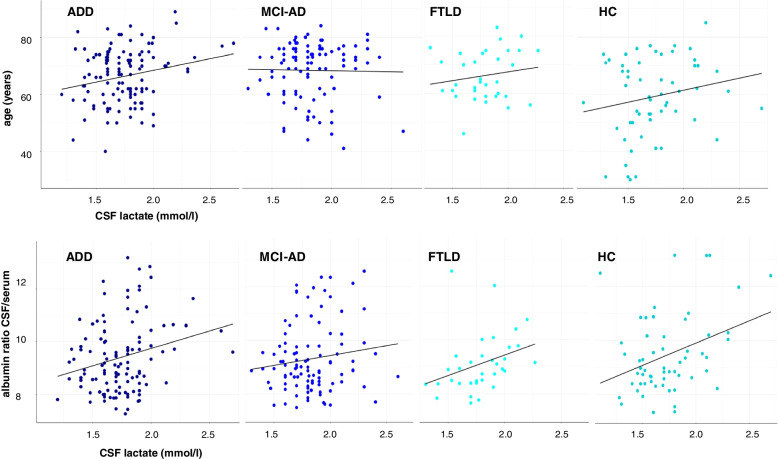
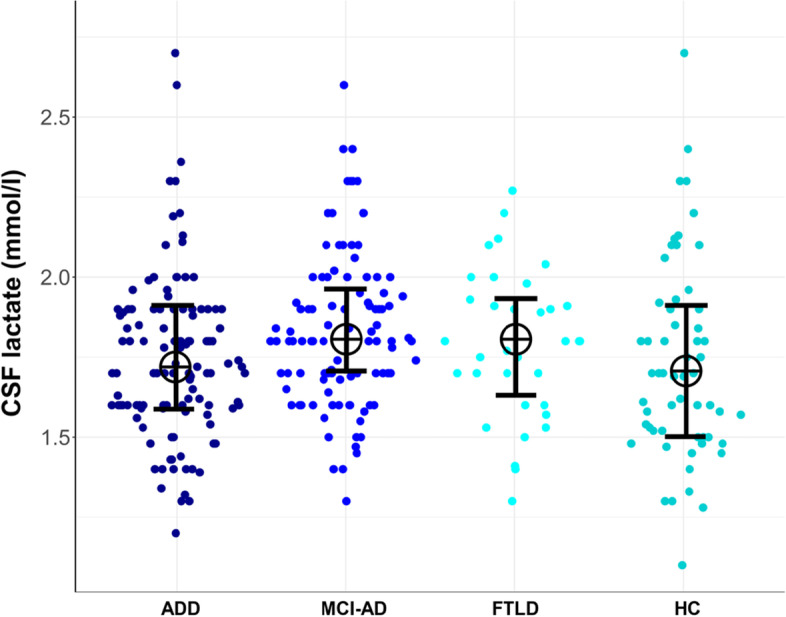
Contrary to previous studies, patients with ADD and HC did not differ in CSF lactate levels. However, we found higher values for patients with MCI-AD compared to those with ADD and to HC in univariate analysis, as well as for MCI-AD compared to ADD when controlling for age and blood-brain barrier integrity. CSF lactate levels were associated with age and blood-brain barrier integrity but not with clinical severity or CSF biomarkers of AD.
CSF lactate does not indicate biological or clinical disease severity in AD, nor does it differentiate between patients with AD and HC or patients with FTLD. However, higher CSF lactate levels were found in earlier stages of AD, which might be interpreted in the context of inflammatory processes.
脑脊液(CSF)乳酸水平被认为与多种神经系统疾病的疾病严重程度和进展相关,可作为能量代谢受损、神经元死亡或小胶质细胞激活的指标。很少有研究检测阿尔茨海默病(AD)所致痴呆患者的脑脊液乳酸水平,且发现AD患者的乳酸水平高于健康对照(HC)。然而,这些研究大多规模较小,纳入标准并不总是明确界定,脑脊液乳酸在AD中的诊断价值和病理生理意义仍不清楚。
我们检测了大量(n = 312)处于轻度认知障碍(MCI-AD)和痴呆(ADD)阶段的AD患者、HC以及额颞叶变性(FTLD)患者的脑脊液乳酸水平及潜在相关因素,这些患者在生物学和临床上均有明确界定。
与先前研究相反,ADD患者和HC的脑脊液乳酸水平并无差异。然而,在单因素分析中,我们发现MCI-AD患者的乳酸水平高于ADD患者和HC,在控制年龄和血脑屏障完整性后,MCI-AD患者的乳酸水平也高于ADD患者。脑脊液乳酸水平与年龄和血脑屏障完整性相关,但与AD的临床严重程度或脑脊液生物标志物无关。
脑脊液乳酸水平既不能表明AD的生物学或临床疾病严重程度,也无法区分AD患者与HC或FTLD患者。然而,在AD的早期阶段发现脑脊液乳酸水平较高,这可能在炎症过程的背景下得到解释。