Okuyama Yoshiharu, Hatakeyama Shingo, Numakura Kazuyuki, Narita Takuma, Tanaka Toshikazu, Miura Yuki, Sasaki Daichi, Noro Daisuke, Tokui Noriko, Okamoto Teppei, Yamamoto Hayato, Narita Shintaro, Yoneyama Takahiro, Hashimoto Yasuhiro, Habuchi Tomonori, Ohyama Chikara
Department of Urology Hirosaki University Graduate School of Medicine Hirosaki Japan.
Department of Urology Akita University Graduate School of Medicine Akita Japan.
BJUI Compass. 2021 Oct 8;3(2):154-161. doi: 10.1002/bco2.118. eCollection 2022 Mar.
To evaluate the effects of the concomitant use of proton pump inhibitors (PPIs) and/or antibiotics (Abs) on oncological outcomes in patients with advanced urothelial carcinoma.
We retrospectively evaluated 155 patients with advanced urothelial carcinoma who were treated with immune checkpoint inhibitors (ICIs) between August 2015 and April 2021. The concomitant use of PPI or Abs was defined as any PPI or Abs administered within 30 days before ICI initiation and during ICI therapy. The primary outcomes were the effect of PPI and/or Abs use on the objective response rate (ORR) and immune-related adverse events (irAEs). The secondary outcomes were the effects of PPI and/or Abs use on progression-free survival (PFS) and overall survival (OS) after ICI therapy analyzed using the inverse probability of treatment weighting-adjusted Cox regression analysis.
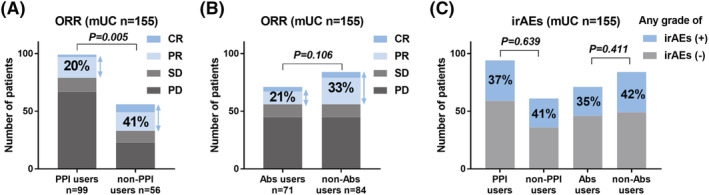
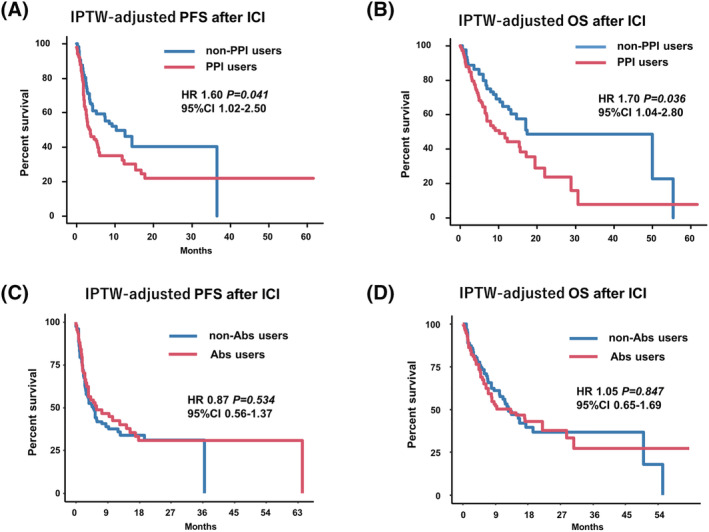
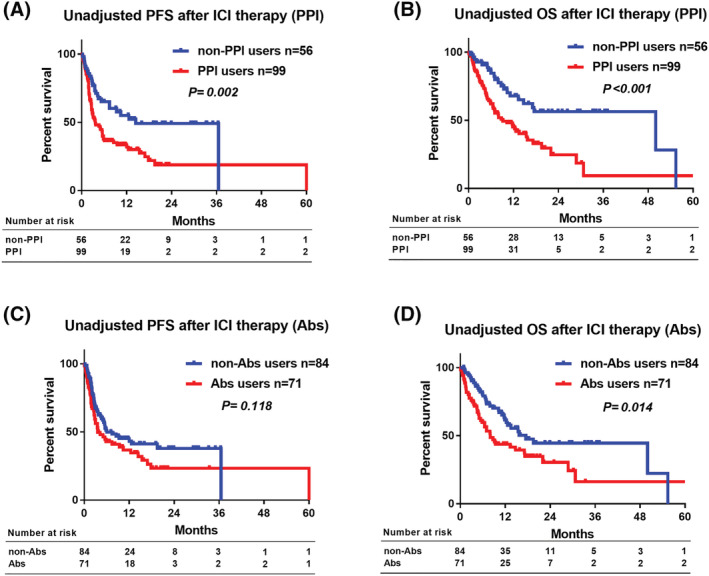
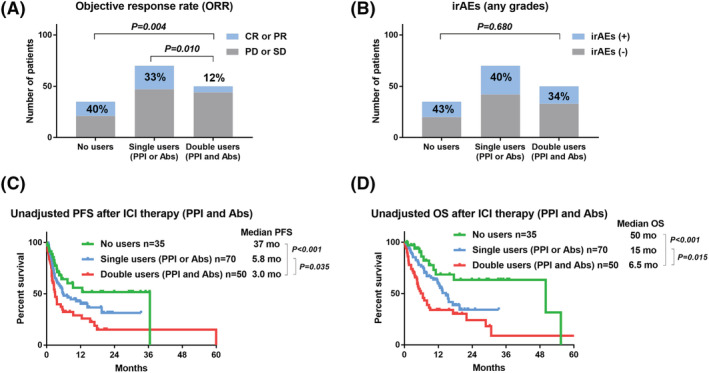
Of the 155 patients enrolled in the study, 99 (64%) were PPI users and 56 (36%) Abs users. PPI users were associated with a significantly poorer ORR than non-PPI users (41% vs. 20%, respectively), whereas Abs use was not significantly associated with changes in ORR. The rate of irAEs was not significantly associated with the use of PPIs or Abs. Multivariate inverse probability of treatment weighting-adjusted Cox regression analysis revealed significantly poorer PFS and OS in PPI users than in non-PPI users, whereas Abs use was not associated with poorer outcomes.
The concomitant use of PPI may adversely affect oncological outcomes in patients with locally advanced or metastatic urothelial carcinoma treated with ICI therapy.
评估质子泵抑制剂(PPI)和/或抗生素(Ab)联合使用对晚期尿路上皮癌患者肿瘤学结局的影响。
我们回顾性评估了2015年8月至2021年4月期间接受免疫检查点抑制剂(ICI)治疗的155例晚期尿路上皮癌患者。PPI或Ab的联合使用定义为在ICI开始前30天内及ICI治疗期间使用的任何PPI或Ab。主要结局是PPI和/或Ab使用对客观缓解率(ORR)和免疫相关不良事件(irAE)的影响。次要结局是使用PPI和/或Ab对ICI治疗后无进展生存期(PFS)和总生存期(OS)的影响,采用逆概率加权调整Cox回归分析进行分析。
在纳入研究的155例患者中,99例(64%)使用PPI,56例(36%)使用Ab。PPI使用者的ORR显著低于非PPI使用者(分别为41%和20%),而使用Ab与ORR的变化无显著相关性。irAE的发生率与PPI或Ab的使用无显著相关性。多变量逆概率加权调整Cox回归分析显示,PPI使用者的PFS和OS显著低于非PPI使用者,而使用Ab与较差的结局无关。
PPI的联合使用可能对接受ICI治疗的局部晚期或转移性尿路上皮癌患者的肿瘤学结局产生不利影响。