Chang Yu, Lin Wan-Ying, Chang Yu-Cheng, Huang Chin-Hsuan, Tzeng Huey-En, Abdul-Lattif Eahab, Wang Tsu-Hsien, Tseng Tzu-Hsuan, Kang Yi-No, Chi Kuan-Yu
Section of Neurosurgery, Department of Surgery, National Cheng Kung University Hospital, College of Medicine, National Cheng Kung University, Tainan 701401, Taiwan.
Department of Family Medicine, Taipei Medical University Hospital, Taipei 100229, Taiwan.
Cancers (Basel). 2022 Dec 31;15(1):284. doi: 10.3390/cancers15010284.
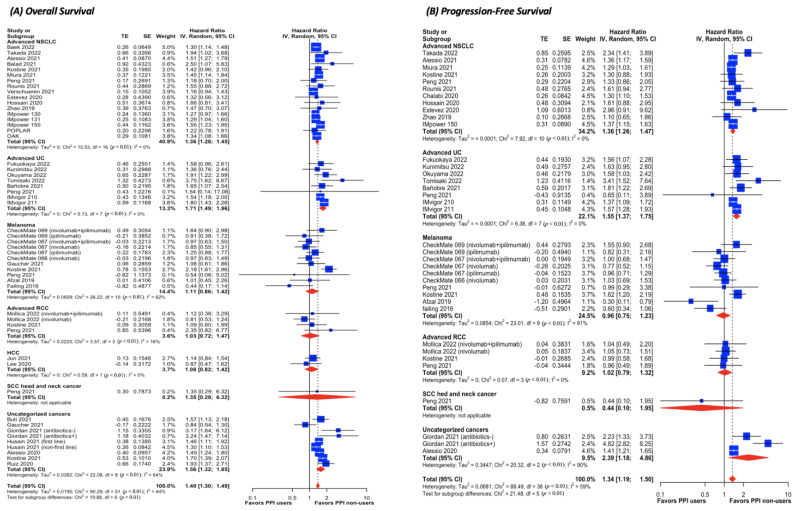
(1) Although emerging evidence suggests that proton pump inhibitor (PPI)-induced dysbiosis negatively alters treatment response to immune checkpoint inhibitors (ICIs) in cancer patients, no study systematically investigates the association between PPIs, ICIs, and chemotherapy; (2) Cochrane Library, Embase, Medline, and PubMed were searched from inception to 20 May 2022, to identify relevant studies involving patients receiving ICIs or chemotherapy and reporting survival outcome between PPI users and non-users. Survival outcomes included overall survival (OS) and progression-free survival (PFS). Network meta-analyses were performed using random-effects models. -scores, with a value between 0 and 1, were calculated to quantify the treatment ranking, with a higher score suggesting a higher probability of greater effectiveness. We also conducted pairwise meta-analyses of observational studies to complement our network meta-analysis; (3) We identified 62 studies involving 26,484 patients (PPI = 8834; non-PPI = 17,650), including non-small cell lung cancer (NSCLC), urothelial carcinoma (UC), melanoma, renal cell carcinoma (RCC), hepatocellular carcinoma (HCC), and squamous cell carcinoma (SCC) of the neck and head. Eight post-hoc analyses from 18 randomized-controlled trials were included in our network, which demonstrated that, in advanced NSCLC and UC, patients under ICI treatment with concomitant PPI (-score: 0.2016) are associated with both poorer OS (HR, 1.49; 95% CI, 1.37 to 1.67) and poorer PFS (HR, 1.41; 95% CI, 1.25 to 1.61) than those without PPIs (-score: 1.000). Patients under ICI treatment with concomitant PPI also had poorer OS (HR, 1.18; 95% CI, 1.07 to 1.31) and poorer PFS (HR, 1.30; 95% CI, 1.14 to 1.48) in comparison with those receiving chemotherapy (-score: 0.6664), implying that PPIs may compromise ICI's effectiveness, making it less effective than chemotherapy. Our pairwise meta-analyses also supported this association. Conversely, PPI has little effect on patients with advanced melanoma, RCC, HCC, and SCC of the neck and head who were treated with ICIs; (4) "PPI-induced dysbiosis" serves as a significant modifier of treatment response in both advanced NSCLC and UC that are treated with ICIs, compromising the effectiveness of ICIs to be less than that of chemotherapy. Thus, clinicians should avoid unnecessary PPI prescription in these patients. "PPI-induced dysbiosis", on the other hand, does not alter the treatment response to ICIs in advanced melanoma, RCC, HCC, and SCC of the head and neck.
(1) 尽管新出现的证据表明质子泵抑制剂(PPI)引起的微生物群失调会对癌症患者免疫检查点抑制剂(ICI)的治疗反应产生负面影响,但尚无研究系统地调查PPI、ICI和化疗之间的关联;(2) 检索了Cochrane图书馆、Embase、Medline和PubMed自创建至2022年5月20日的文献,以确定涉及接受ICI或化疗的患者并报告PPI使用者和非使用者生存结局的相关研究。生存结局包括总生存期(OS)和无进展生存期(PFS)。使用随机效应模型进行网络荟萃分析。计算了介于0和1之间的-scores值以量化治疗排名,分数越高表明疗效更佳的可能性越高。我们还对观察性研究进行了成对荟萃分析以补充我们的网络荟萃分析;(3) 我们确定了62项研究,涉及26484例患者(PPI使用者=8834例;非PPI使用者=17650例),包括非小细胞肺癌(NSCLC)、尿路上皮癌(UC)、黑色素瘤、肾细胞癌(RCC)、肝细胞癌(HCC)以及头颈鳞状细胞癌(SCC)。我们的网络纳入了18项随机对照试验中的8项事后分析,结果表明,在晚期NSCLC和UC中,接受ICI治疗同时使用PPI的患者(-score:0.2016)与未使用PPI的患者(-score:1.000)相比,OS更差(风险比[HR],1.49;95%置信区间[CI],1.37至1.67),PFS也更差(HR,1.41;95%CI,1.25至1.61)。与接受化疗的患者(-score:0.6664)相比,接受ICI治疗同时使用PPI的患者OS也更差(HR,1.18;95%CI,1.07至1.31),PFS也更差(HR,1.30;95%CI,1.14至1.48),这意味着PPI可能会削弱ICI的疗效,使其不如化疗有效。我们的成对荟萃分析也支持这种关联。相反,PPI对接受ICI治疗的晚期黑色素瘤、RCC、HCC和头颈SCC患者几乎没有影响;(4) “PPI引起的微生物群失调”是接受ICI治疗的晚期NSCLC和UC治疗反应的重要调节因素,会削弱ICI的疗效,使其低于化疗。因此,临床医生应避免在这些患者中不必要地开具PPI处方。另一方面,“PPI引起的微生物群失调”不会改变晚期黑色素瘤、RCC、HCC和头颈SCC对ICI的治疗反应。