Guzman Michael S, Iyer Jaisree, Kim Paul, Kopp Daniel, Dong Ziye, Foroughi Paniz, Yung Mimi C, Riman Richard E, Jiao Yongqin
Physical and Life Sciences Directorate, Lawrence Livermore National Laboratory, Livermore, California 94550, United States.
Department of Materials Science & Engineering, Rutgers-The State University of New Jersey, Piscataway, New Jersey 08854, United States.
ACS Omega. 2022 Apr 6;7(15):12524-12535. doi: 10.1021/acsomega.1c05264. eCollection 2022 Apr 19.
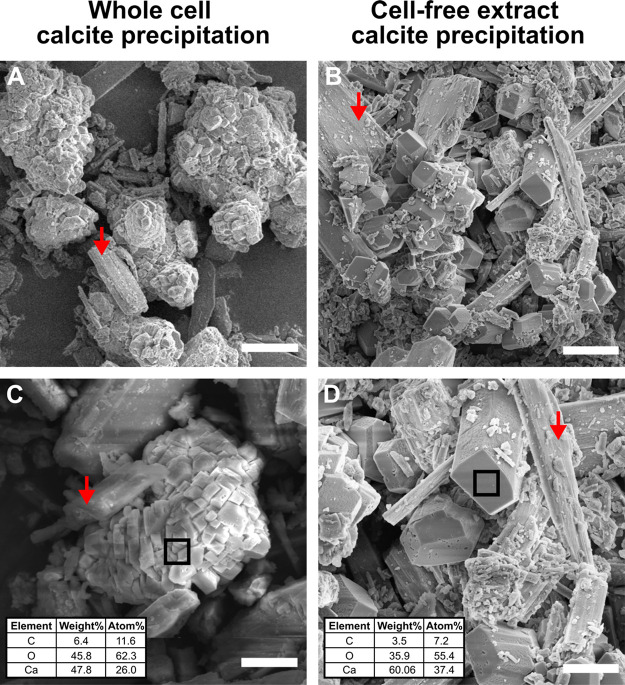
Biocement formed through microbially induced calcium carbonate precipitation (MICP) is an emerging biotechnology focused on reducing the environmental impact of concrete production. In this system, CO species are provided via ureolysis by () to carbonate monocalcium silicate for MICP. This is one of the first studies of its kind that uses a solid-state calcium source, while prior work has used highly soluble forms. Our study focuses on microbial physiological, chemical thermodynamic, and kinetic studies of MICP. Monocalcium silicate incongruently dissolves to form soluble calcium, which must be coupled with CO release to form calcium carbonate. Chemical kinetic modeling shows that calcium solubility is the rate-limiting step, but the addition of organic acids significantly increases the solubility, enabling extensive carbonation to proceed up to 37 mol %. The microbial urease activity by is active up to pH 11, 70 °C, and 1 mol L CaCl, producing calcite as a means of solidification. Cell-free extracts are also effective albeit less robust at extreme pH, producing calcite with different physical properties. Together, these data help determine the chemical, biological, and thermodynamic parameters critical for scaling microbial carbonation of monocalcium silicate to high-density cement and concrete.
通过微生物诱导碳酸钙沉淀(MICP)形成的生物水泥是一种新兴的生物技术,致力于降低混凝土生产对环境的影响。在该系统中,CO物种通过()的尿素分解作用提供给偏硅酸钙进行MICP。这是同类研究中首批使用固态钙源的研究之一,而此前的工作使用的是高溶解性形式。我们的研究聚焦于MICP的微生物生理学、化学热力学和动力学研究。偏硅酸钙不一致溶解形成可溶性钙,其必须与CO释放相结合以形成碳酸钙。化学动力学模型表明钙的溶解度是限速步骤,但添加有机酸会显著增加溶解度,使广泛的碳酸化反应能够进行至37 mol%。()的微生物脲酶活性在pH值为11、70°C和1 mol/L CaCl条件下仍具有活性,产生方解石作为固化手段。无细胞提取物同样有效,尽管在极端pH条件下稳定性较差,会产生具有不同物理性质的方解石。这些数据共同有助于确定将偏硅酸钙的微生物碳酸化扩展至高密度水泥和混凝土的关键化学、生物学和热力学参数。