Chung Hoyin, Noh Ji Yeong, Koo Bon-Sang, Hong Jung Joo, Kim Hye Kwon
Department of Biological Sciences and Biotechnology, College of Natural Sciences, Chungbuk National University, Cheongju 28644, Republic of Korea.
National Primate Research Center, Korea Research Institute of Bioscience and Biotechnology, Cheongju, Republic of Korea.
Comput Struct Biotechnol J. 2022;20:1925-1934. doi: 10.1016/j.csbj.2022.04.022. Epub 2022 Apr 21.
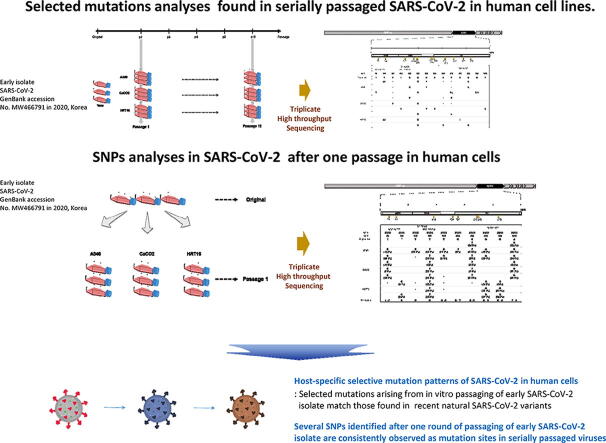
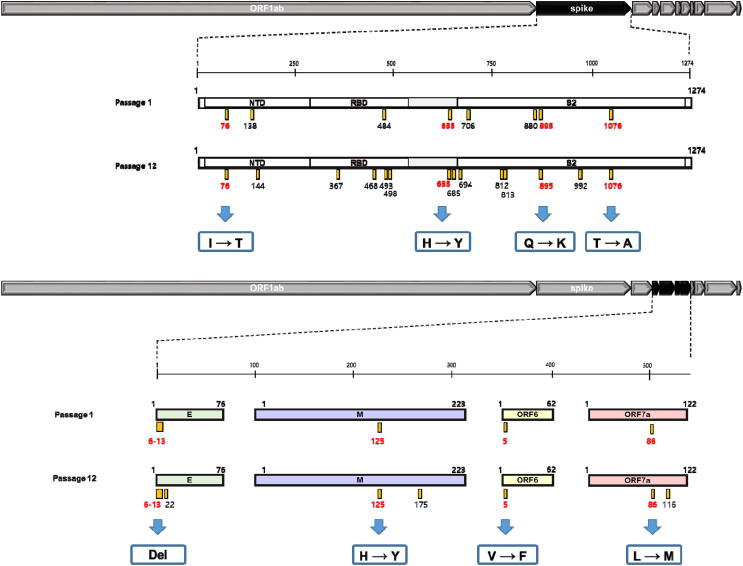
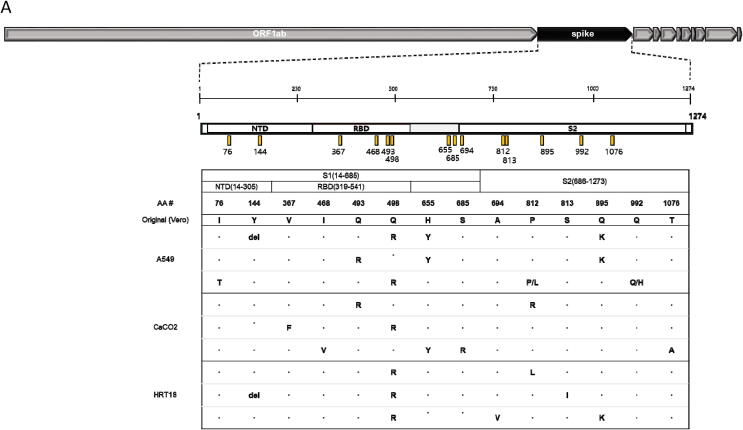
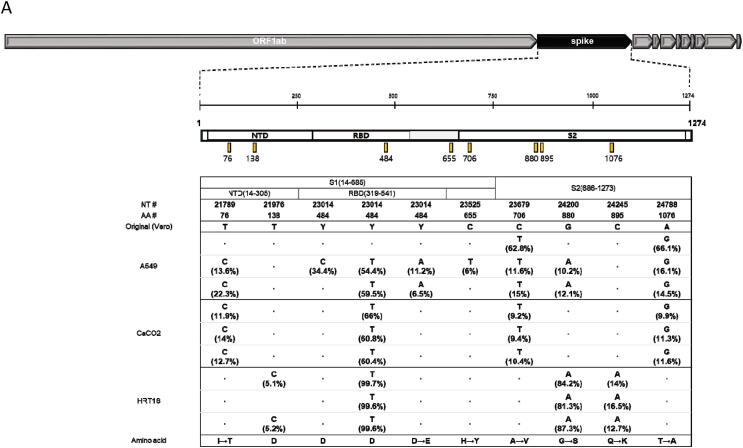
Since the outbreak of coronavirus disease (COVID-19) in 2019, severe acute respiratory syndrome coronavirus 2 (SARS-CoV-2) has evolved into diverse variants. Here, an early isolate of SARS-CoV-2 was serially passaged in multiple cell lines of human origin in triplicate, and selected mutations were compared to those found in natural SARS-CoV-2 variants. In the spike protein, Q493R and Q498R substitutions from passaged viruses were consistent with those in the B.1.1.529 (Omicron) variant. Y144del and H655Y substitutions from passaged viruses were also reported in B.1.1.7 (Alpha), P.1 (Gamma), and B.1.1.529 (Omicron) variants. Several single nucleotide polymorphisms (SNPs) found in first-passaged viruses have also been identified as selected mutation sites in serially passaged viruses. Considering the consistent mutations found between serially passaged SARS-CoV-2 and natural variants, there may be host-specific selective mutation patterns of viral evolution in humans. Additional studies on the selective mutations in SARS-CoV-2 experiencing diverse host environments will help elucidate the direction of SARS-CoV-2 evolution.
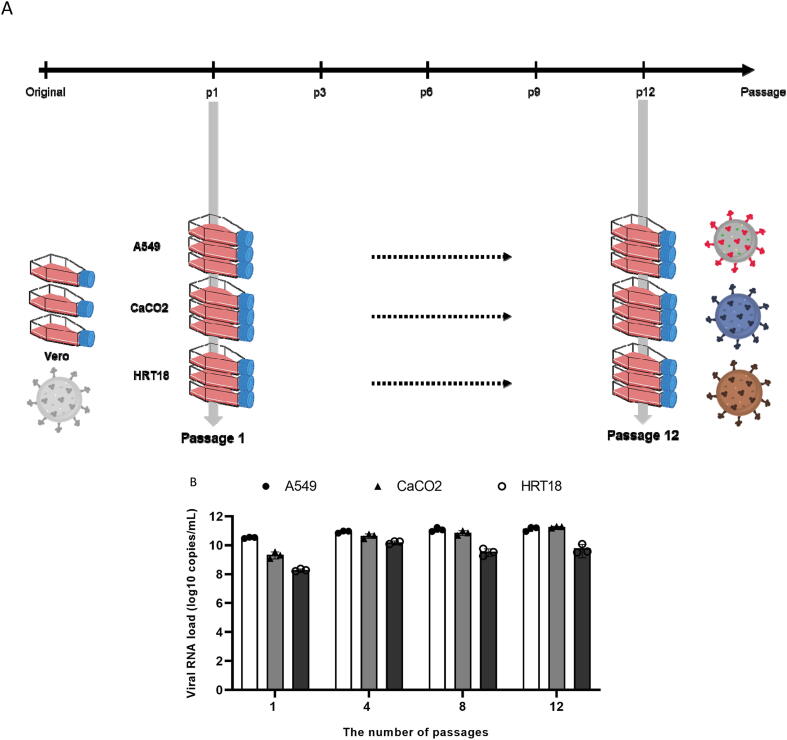
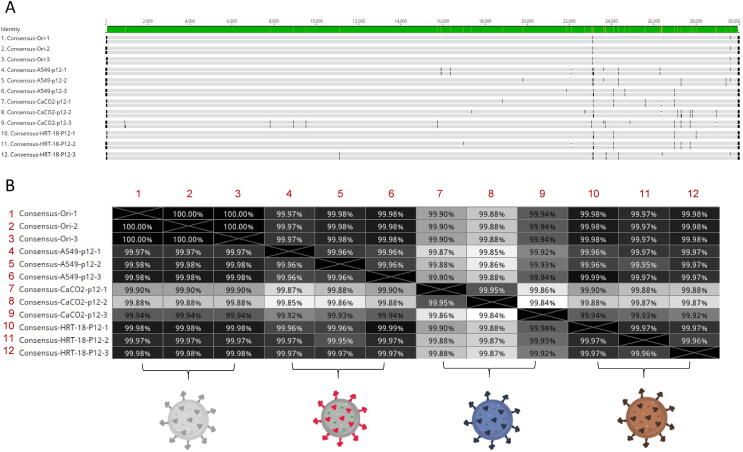
SARS-CoV-2 isolate (SARS-CoV-2/human/KOR/KCDC03-NCCP43326/2020) was serially passaged in A549, CaCO2, and HRT-18 cells in triplicate. After 12 times of serial passages in each cell lines, several consistent selected mutations were found on spike protein between the serially passaged SARS-CoV-2 in human cell lines and recent natural variants of SARS-CoV-2 like omicron. On the non-spike protein genes, selected mutations were more frequent in viruses passaged in Caco-2 and HRT-18 cells (Colon epithelial-like) than in those passaged in A549 cells (Lung epithelial-like). In addition, several SNPs identified after one round of passaging were consistently identified as the selected mutation sites in serially passaged viruses. Thus, mutation patterns of SARS-CoV-2 in certain host environments may provide researchers information to understand and predict future SARS-CoV-2 variants.
自2019年冠状病毒病(COVID-19)爆发以来,严重急性呼吸综合征冠状病毒2(SARS-CoV-2)已演变成多种变体。在此,一株早期的SARS-CoV-2分离株在多种人类来源的细胞系中进行了三次重复传代,并将筛选出的突变与天然SARS-CoV-2变体中的突变进行了比较。在刺突蛋白中,传代病毒中的Q493R和Q498R替换与B.1.1.529(奥密克戎)变体中的替换一致。传代病毒中的Y144del和H655Y替换在B.1.1.7(阿尔法)、P.1(伽马)和B.1.1.529(奥密克戎)变体中也有报道。在首次传代病毒中发现的几个单核苷酸多态性(SNP)也被确定为连续传代病毒中的筛选突变位点。考虑到连续传代的SARS-CoV-2与天然变体之间发现的一致突变,可能存在人类中病毒进化的宿主特异性选择突变模式。对经历不同宿主环境的SARS-CoV-2中的选择突变进行的更多研究将有助于阐明SARS-CoV-2的进化方向。
SARS-CoV-2分离株(SARS-CoV-2/人类/韩国/KCDC03-NCCP43326/2020)在A549、CaCO2和HRT-18细胞中进行了三次重复传代。在每个细胞系中连续传代12次后,在人类细胞系中连续传代的SARS-CoV-2与最近的SARS-CoV-2天然变体(如奥密克戎)的刺突蛋白上发现了几个一致的筛选突变。在非刺突蛋白基因上,在Caco-2和HRT-18细胞(结肠上皮样)中传代的病毒比在A549细胞(肺上皮样)中传代的病毒中筛选突变更频繁。此外,一轮传代后鉴定出的几个SNP在连续传代病毒中被一致确定为筛选突变位点。因此,SARS-CoV-2在特定宿主环境中的突变模式可能为研究人员提供信息,以了解和预测未来的SARS-CoV-2变体。