University of Nebraska Medical Centergrid.266813.8, Department of Pathology and Microbiology, Omaha, Nebraska, USA.
Multidrug-Resistant Organism Repository and Surveillance Network (MRSN), Walter Reed Army Institute of Research, Silver Spring, Maryland, USA.
mBio. 2022 Jun 28;13(3):e0039522. doi: 10.1128/mbio.00395-22. Epub 2022 Apr 27.
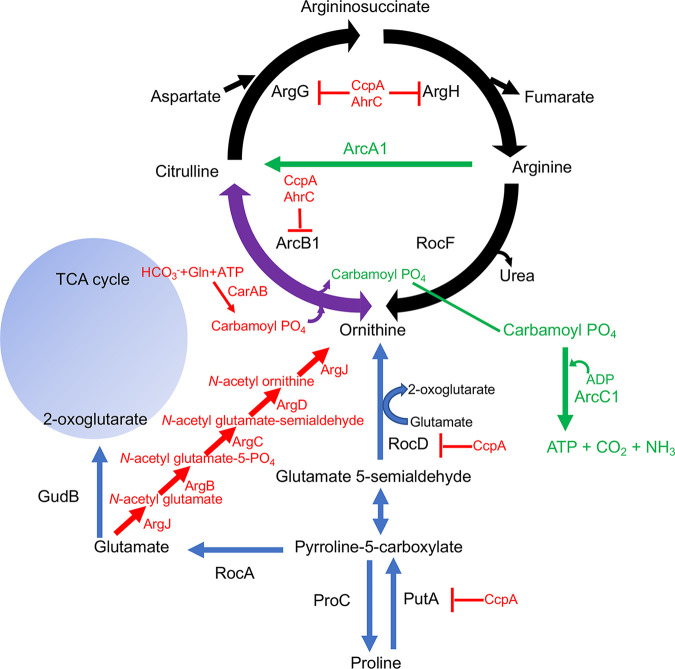
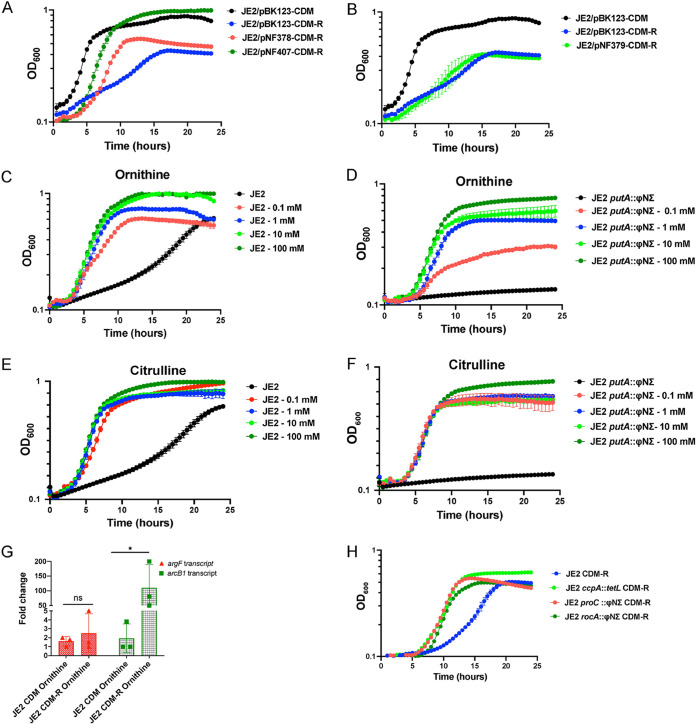
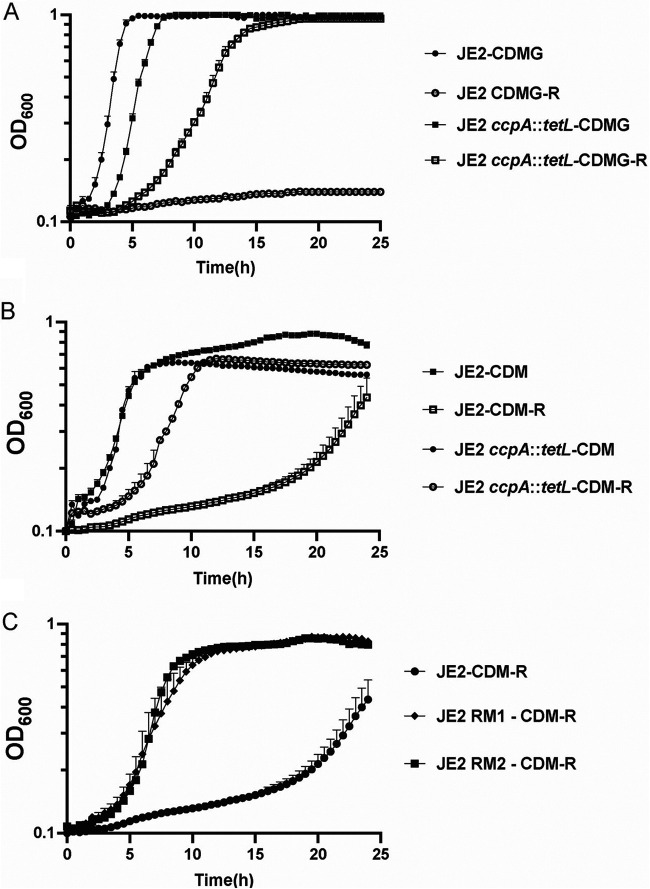
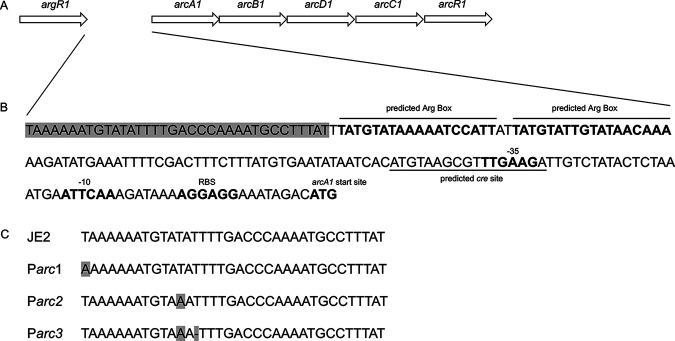
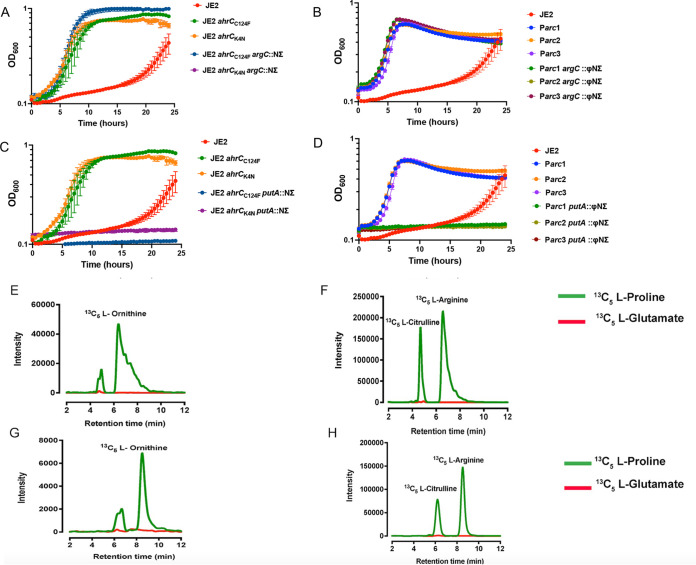
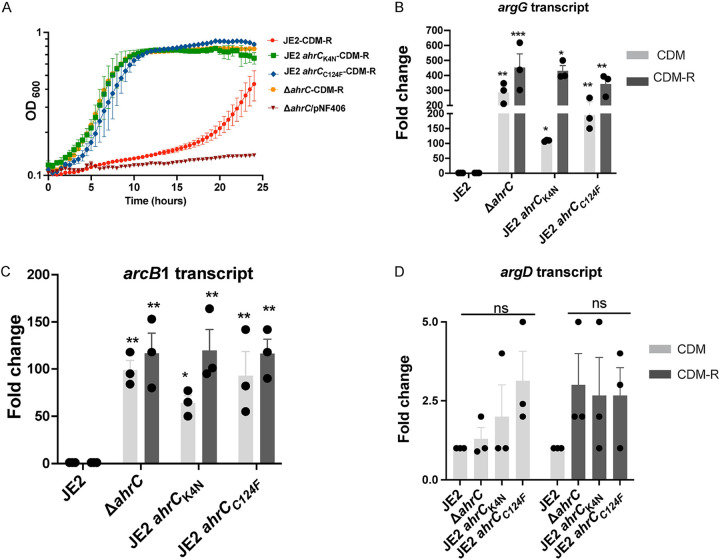
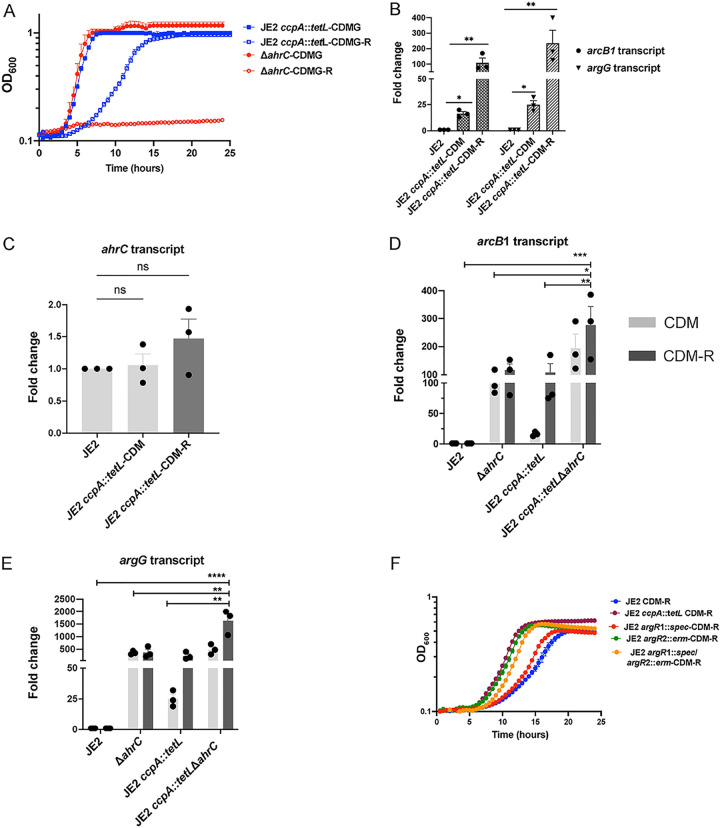
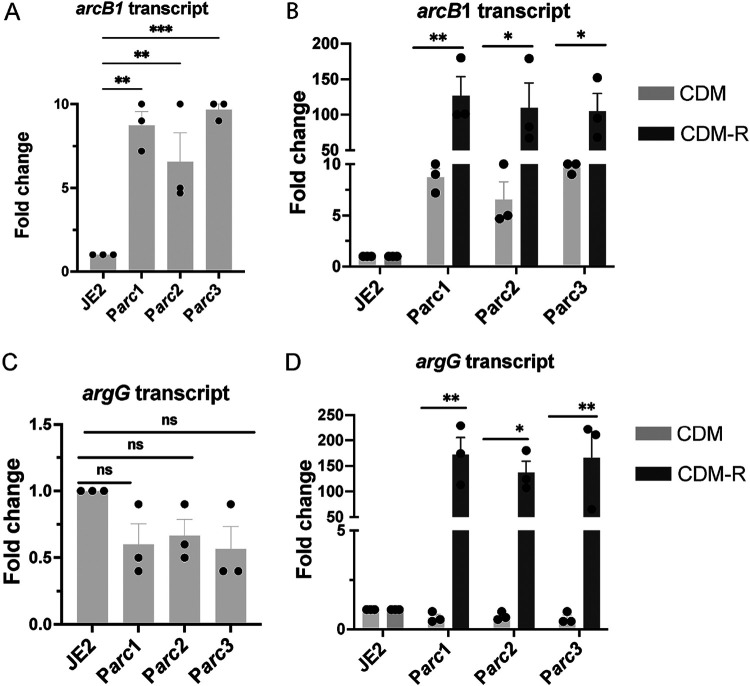
Previous studies have found that arginine biosynthesis in Staphylococcus aureus is repressed via carbon catabolite repression (CcpA), and proline is used as a precursor. Unexpectedly, however, robust growth of S. aureus is not observed in complete defined medium lacking both glucose and arginine (CDM-R). Mutants able to grow on agar-containing defined medium lacking arginine (CDM-R) were selected and found to contain mutations within , encoding the canonical arginine biosynthesis pathway repressor (AhrC), or single nucleotide polymorphisms (SNPs) upstream of the native arginine deiminase (ADI) operon . Reverse transcription-PCR (RT-PCR) studies found that mutations within or or SNPs identified upstream of increased the transcription of both and , encoding ornithine carbamoyltransferase and argininosuccinate synthase/lyase, respectively, facilitating arginine biosynthesis. Furthermore, mutations within the AhrC homologue facilitated robust growth within CDM-R. Complementation with or , but not , rescued growth in CDM-R. Finally, supplementation of CDM-R with ornithine stimulated growth, as did mutations in genes ( and ) that presumably increased the pyrroline-5-carboxylate and ornithine pools. Collectively, these data suggest that the transcriptional regulation of ornithine carbamoyltransferase and, in addition, the availability of intracellular ornithine pools regulate arginine biosynthesis in S. aureus in the absence of glucose. Surprisingly, ~50% of clinical S. aureus isolates were able to grow in CDM-R. These data suggest that S. aureus is selected to repress arginine biosynthesis in environments with or without glucose; however, mutants may be readily selected that facilitate arginine biosynthesis and growth in specific environments lacking arginine. Staphylococcus aureus can cause infection in virtually any niche of the human host, suggesting that it has significant metabolic versatility. Indeed, bioinformatic analysis suggests that it has the biosynthetic capability to synthesize all 20 amino acids. Paradoxically, however, it is conditionally auxotrophic for several amino acids, including arginine. Studies in our laboratory are designed to assess the biological function of amino acid auxotrophy in this significant pathogen. This study reveals that the metabolic block repressing arginine biosynthesis in media lacking glucose is the transcriptional repression of ornithine carbamoyltransferase encoded by within the native arginine deiminase operon in addition to limited intracellular pools of ornithine. Surprisingly, approximately 50% of S. aureus clinical isolates can grow in media lacking arginine, suggesting that mutations are selected in S. aureus that allow growth in particular niches of the human host.
先前的研究发现,金黄色葡萄球菌中的精氨酸生物合成通过碳分解代谢物阻遏(CcpA)受到抑制,脯氨酸被用作前体。然而,出人意料的是,在缺乏葡萄糖和精氨酸的完全定义培养基(CDM-R)中,金黄色葡萄球菌并没有观察到旺盛的生长。筛选能够在含有琼脂的缺乏精氨酸的定义培养基(CDM-R)上生长的突变体,发现它们在编码典型精氨酸生物合成途径抑制剂(AhrC)的 内或其上游的单核苷酸多态性(SNP)中存在突变,或在天然精氨酸脱亚氨酶(ADI)操纵子的上游 。逆转录-PCR(RT-PCR)研究发现,或中发现的突变或 上游鉴定的 SNPs 增加了分别编码鸟氨酸氨甲酰转移酶和精氨酸琥珀酸合酶/裂解酶的 和 的转录,从而促进精氨酸生物合成。此外,AhrC 同源物 内的突变促进了 CDM-R 内的旺盛生长。与 或 互补,但不是 ,挽救了 CDM-R 中的生长。最后,在 CDM-R 中添加鸟氨酸刺激了生长,而假定增加吡咯啉-5-羧酸和鸟氨酸池的基因(和 )的突变也是如此。总的来说,这些数据表明,在没有葡萄糖的情况下,金黄色葡萄球菌中鸟氨酸氨甲酰转移酶的转录调控以及细胞内鸟氨酸池的可用性调节了精氨酸生物合成。令人惊讶的是,大约 50%的临床金黄色葡萄球菌分离株能够在 CDM-R 中生长。这些数据表明,金黄色葡萄球菌被选择在有或没有葡萄糖的环境中抑制精氨酸生物合成;然而,在特定缺乏精氨酸的环境中,可能很容易选择促进精氨酸生物合成和生长的突变体。金黄色葡萄球菌几乎可以在人体宿主的任何部位引起感染,这表明它具有显著的代谢多功能性。事实上,生物信息学分析表明,它具有合成所有 20 种氨基酸的生物合成能力。然而,矛盾的是,它对包括精氨酸在内的几种氨基酸是条件性营养缺陷型。我们实验室的研究旨在评估这种重要病原体中氨基酸营养缺陷型的生物学功能。这项研究揭示了在缺乏葡萄糖的培养基中抑制精氨酸生物合成的代谢阻断是编码鸟氨酸氨甲酰转移酶的 的转录抑制,此外还有细胞内鸟氨酸池的有限。令人惊讶的是,大约 50%的金黄色葡萄球菌临床分离株可以在缺乏精氨酸的培养基中生长,这表明金黄色葡萄球菌中选择了突变,使其能够在人体宿主的特定小生境中生长。