Carrilero Laura, Urwin Lucy, Ward Ezra, Choudhury Naznin R, Monk Ian R, Turner Claire E, Stinear Timothy P, Corrigan Rebecca M
The Florey Institute, School of Biosciences, University of Sheffield, Sheffield, United Kingdom.
Department of Microbiology and Immunology, Doherty Institute for Infection and Immunity, University of Melbourne, Melbourne, Victoria, Australia.
Microbiol Spectr. 2023 Mar 6;11(2):e0044723. doi: 10.1128/spectrum.00447-23.
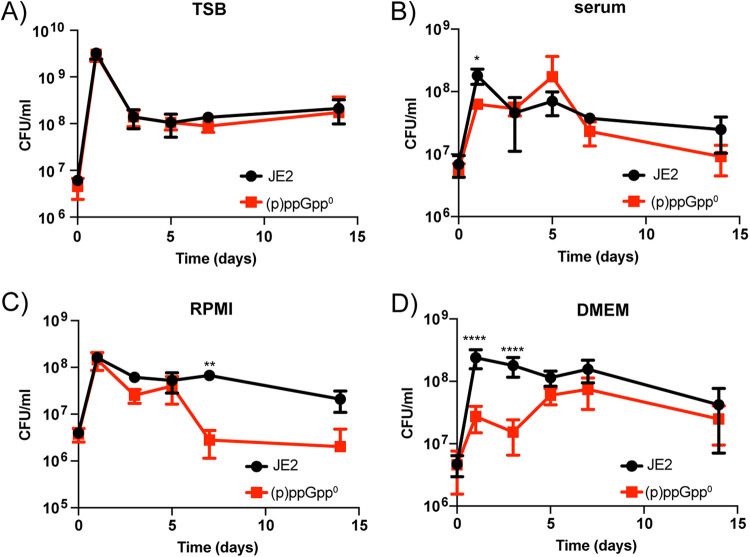
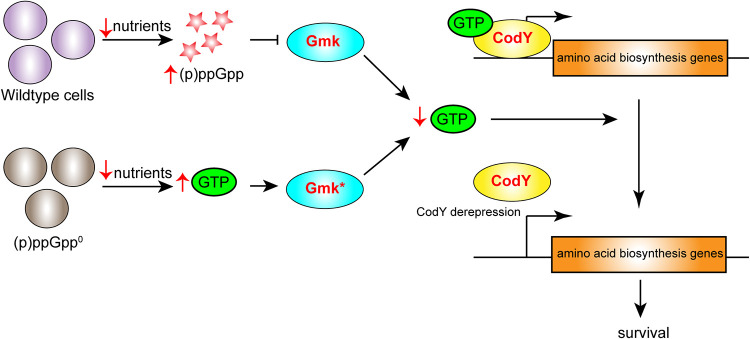
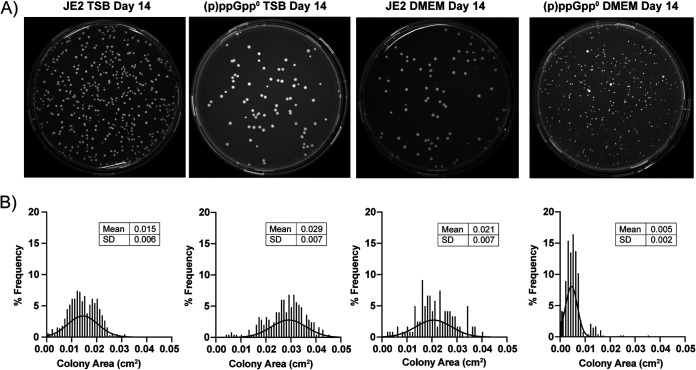
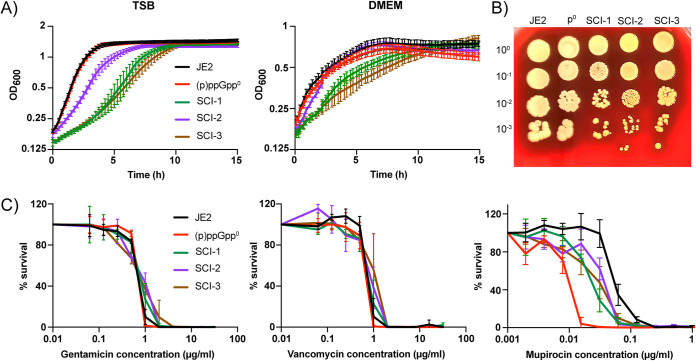
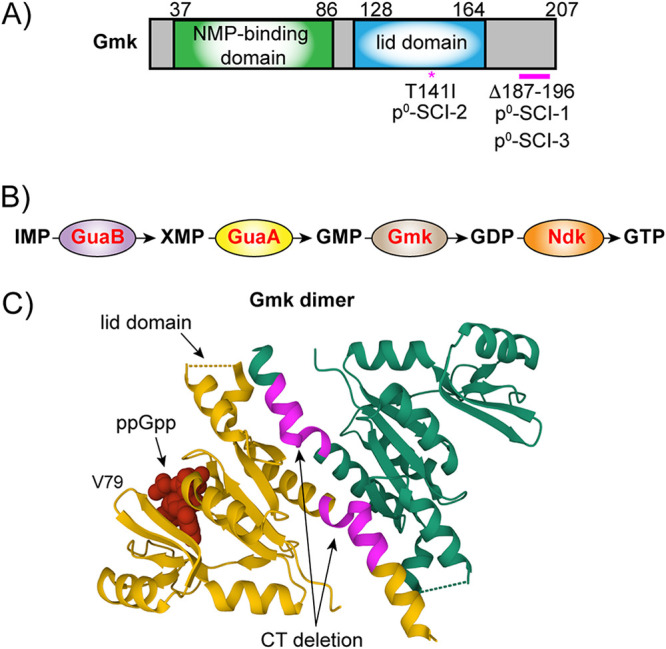
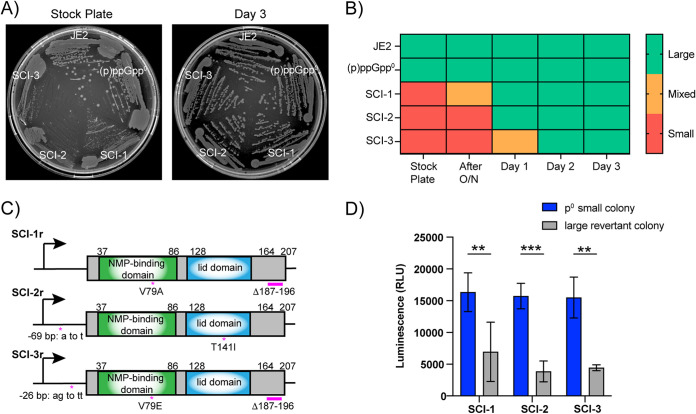
Staphylococcus aureus is an opportunistic bacterial pathogen that often results in difficult-to-treat infections. One mechanism used by S. aureus to enhance survival during infection is the stringent response. This is a stress survival pathway that utilizes the nucleotides (p)ppGpp to reallocate bacterial resources, shutting down growth until conditions improve. Small colony variants (SCVs) of S. aureus are frequently associated with chronic infections, and this phenotype has previously been linked to a hyperactive stringent response. Here, we examine the role of (p)ppGpp in the long-term survival of S. aureus under nutrient-restricted conditions. When starved, a (p)ppGpp-null S. aureus mutant strain ((p)ppGpp) initially had decreased viability. However, after 3 days we observed the presence and dominance of a population of small colonies. Similar to SCVs, these small colony isolates (p-SCIs) had reduced growth but remained hemolytic and sensitive to gentamicin, phenotypes that have been tied to SCVs previously. Genomic analysis of the p-SCIs revealed mutations arising within , encoding an enzyme in the GTP synthesis pathway. We show that a (p)ppGpp strain has elevated levels of GTP, and that the mutations in the p-SCIs all lower Gmk enzyme activity and consequently cellular GTP levels. We further show that in the absence of (p)ppGpp, cell viability can be rescued using the GuaA inhibitor decoyinine, which artificially lowers the intracellular GTP concentration. Our study highlights the role of (p)ppGpp in GTP homeostasis and underscores the importance of nucleotide signaling for long-term survival of S. aureus in nutrient-limiting conditions, such as those encountered during infections. Staphylococcus aureus is a human pathogen that upon invasion of a host encounters stresses, such as nutritional restriction. The bacteria respond by switching on a signaling cascade controlled by the nucleotides (p)ppGpp. These nucleotides function to shut down bacterial growth until conditions improve. Therefore, (p)ppGpp are important for bacterial survival and have been implicated in promoting chronic infections. Here, we investigate the importance of (p)ppGpp for long-term survival of bacteria in nutrient-limiting conditions similar to those in a human host. We discovered that in the absence of (p)ppGpp, bacterial viability decreases due to dysregulation of GTP homeostasis. However, the (p)ppGpp-null bacteria were able to compensate by introducing mutations in the GTP synthesis pathway that led to a reduction in GTP build-up and a rescue of viability. This study therefore highlights the importance of (p)ppGpp for the regulation of GTP levels and for long-term survival of S. aureus in restricted environments.
金黄色葡萄球菌是一种机会性细菌病原体,常导致难以治疗的感染。金黄色葡萄球菌在感染期间用于提高存活率的一种机制是严谨反应。这是一种应激生存途径,利用核苷酸(p)ppGpp重新分配细菌资源,停止生长直到条件改善。金黄色葡萄球菌的小菌落变体(SCV)常与慢性感染相关,且这种表型此前已与过度活跃的严谨反应联系起来。在这里,我们研究了(p)ppGpp在营养受限条件下金黄色葡萄球菌长期存活中的作用。饥饿时,一种缺乏(p)ppGpp的金黄色葡萄球菌突变株((p)ppGpp⁻)最初活力下降。然而,3天后我们观察到一群小菌落的出现并占主导地位。与SCV相似,这些小菌落分离株(p-SCI)生长减缓,但仍具有溶血活性且对庆大霉素敏感,这些表型此前已与SCV相关联。对p-SCI的基因组分析揭示了在编码GTP合成途径中一种酶的基因内出现的突变。我们表明,(p)ppGpp⁻菌株的GTP水平升高,且p-SCI中的突变均降低了Gmk酶活性,从而降低了细胞内GTP水平。我们进一步表明,在缺乏(p)ppGpp的情况下,使用GuaA抑制剂脱氧野尻霉素可挽救细胞活力,该抑制剂可人为降低细胞内GTP浓度。我们的研究突出了(p)ppGpp在GTP稳态中的作用,并强调了核苷酸信号传导对金黄色葡萄球菌在营养限制条件下(如感染期间遇到的条件)长期存活的重要性。金黄色葡萄球菌是一种人类病原体,侵入宿主后会遇到诸如营养限制等应激。细菌通过开启由核苷酸(p)ppGpp控制的信号级联反应做出反应。这些核苷酸的作用是停止细菌生长直到条件改善。因此,(p)ppGpp对细菌存活很重要,并与促进慢性感染有关。在这里,我们研究了(p)ppGpp在类似于人类宿主中营养限制条件下细菌长期存活的重要性。我们发现,在缺乏(p)ppGpp的情况下,由于GTP稳态失调,细菌活力下降。然而,缺乏(p)ppGpp⁻的细菌能够通过在GTP合成途径中引入突变来进行补偿,这些突变导致GTP积累减少并挽救了活力。因此,这项研究突出了(p)ppGpp对调节GTP水平以及金黄色葡萄球菌在受限环境中长期存活的重要性。