School of Medicine, Iwate Medical University, Yahaba-cho, Iwate, Japan.
Department of Biomedical Statistics and Bioinformatics, Kyoto University Graduate School of Medicine, Kyoto, Japan.
PLoS One. 2022 Apr 27;17(4):e0267430. doi: 10.1371/journal.pone.0267430. eCollection 2022.
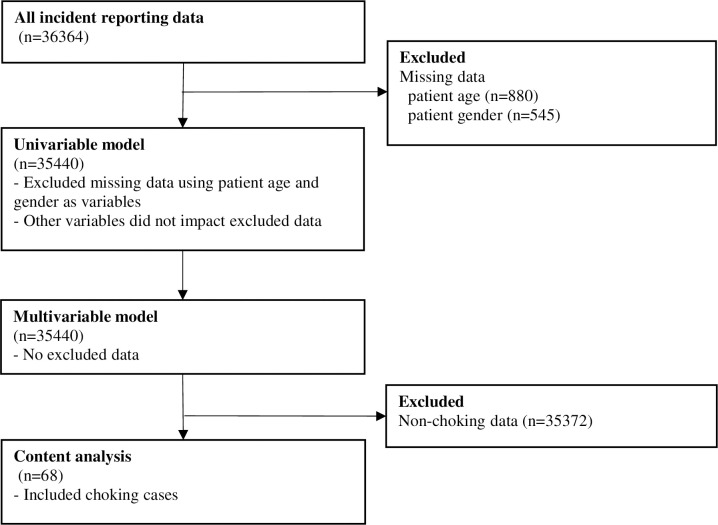
Choking can lead to mortality and residual impairments. This study aimed to determine the factors associated with choking among acute hospital patients and examine error-producing conditions to suggest choking-prevention policies. Among 36,364 cases reported by hospital staff at an acute university hospital from 2012 to 2018 were examined using a retrospective study, 35,440 were analysis as the number of cases analysed for the study. We used descriptive statistics to present patient characteristics and conducted univariable and multivariable logistic regression analyses to identify factors associated with choking. Additionally, we conducted content analysis (root cause analysis) to examine error-producing conditions and prevention policies. Sixty-eight cases were related to choking injuries; of these, 43 patients (63.2%) were male, and 38 (55.9%) were aged 65 years and older. Choking cases had a high percent of adverse outcomes involving residual impairment or death (n = 23, 33.8%). Mental illness (adjusted odds ratio [95% confidence interval]: 3.14 [1.39-7.08]), and hospitalisation in the general wards (adjusted odds ratio [95% confidence interval]: 3.13 [1.70-5.76]) were associated with an increased probability of choking. Error production was caused by food (n = 25, 36.8%) and medical devices or supplies (n = 13, 19.1%). Almost all contributory factors were associated with inadequate checking (n = 66, 97.1%) and misperception of risk (n = 65, 95.6%). Choking poses a highly significant burden on patients, and hospital administrators should minimise the risk of choking to prevent related injuries. Hospital administrators should provide training and education to their staff and develop adequate protocols and procedures to prevent choking.
窒息可导致死亡和残留损伤。本研究旨在确定与急性医院患者窒息相关的因素,并研究导致窒息的错误条件,以提出预防窒息的政策。使用回顾性研究对 2012 年至 2018 年期间医院工作人员报告的 36364 例病例进行了检查,分析了 35440 例作为本研究的病例数。我们使用描述性统计方法呈现患者特征,并进行单变量和多变量逻辑回归分析,以确定与窒息相关的因素。此外,我们还进行了内容分析(根本原因分析),以检查导致窒息的错误条件和预防政策。68 例与窒息损伤有关;其中,43 例(63.2%)为男性,38 例(55.9%)年龄在 65 岁及以上。窒息病例不良结局发生率较高,涉及残留损伤或死亡(n=23,33.8%)。精神疾病(调整后优势比[95%置信区间]:3.14[1.39-7.08])和普通病房住院(调整后优势比[95%置信区间]:3.13[1.70-5.76])与窒息发生的概率增加相关。食物(n=25,36.8%)和医疗器械或用品(n=13,19.1%)是导致错误的主要原因。几乎所有的促成因素都与不充分检查(n=66,97.1%)和风险感知错误(n=65,95.6%)有关。窒息对患者造成了巨大的负担,医院管理者应尽量降低窒息风险,以预防相关损伤。医院管理者应向其员工提供培训和教育,并制定适当的协议和程序以预防窒息。