Akiyama Naomi, Kajiwara Shihoko, Uozumi Ryuji, Akiyama Tomoya, Hayashida Kenshi, Sim Jasmine, Morikawa Mie
School of Nursing, Nagoya City University, Nagoya, JPN.
School of Nursing, Gifu University of Health Sciences, Gifu, JPN.
Cureus. 2024 Mar 2;16(3):e55418. doi: 10.7759/cureus.55418. eCollection 2024 Mar.
Medical care is impacted by uncertainty caused by various factors. The uncertainty that exists in medical care can cause patient distrust and lead to conflict. This study compared the tolerance of uncertainty in medical care between non-medical professionals and nurses.
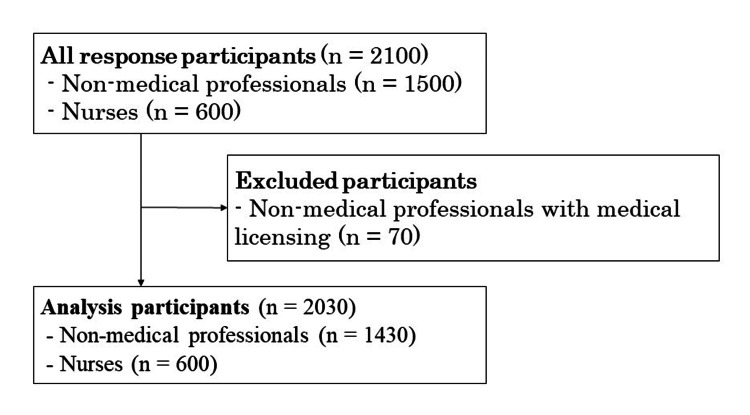
We conducted a cross-sectional Internet-based survey. Participants included 2,100 individuals (600 nurses and 1,500 non-medical professionals; aged ≥ 20 years) from different parts of Japan. Of these, we excluded 70 participants who were classified as non-medical professionals but were registered nurses. Finally, we analyzed data from 2,030 participants (600 nurses and 1,430 non-medical professionals). Three registered nurses and nursing researchers developed an original questionnaire on tolerance of uncertainty in medical care. Data regarding participants' characteristics (age, sex, education level, marital status, having children, population size of the residential area, medical care usage, and occupation) were obtained. We performed a one-way analysis of variance (ANOVA) to compare the data between non-medical professionals and nurses. Additionally, we employed a multiple regression model to investigate factors related to tolerance of uncertainty in medical care scores.
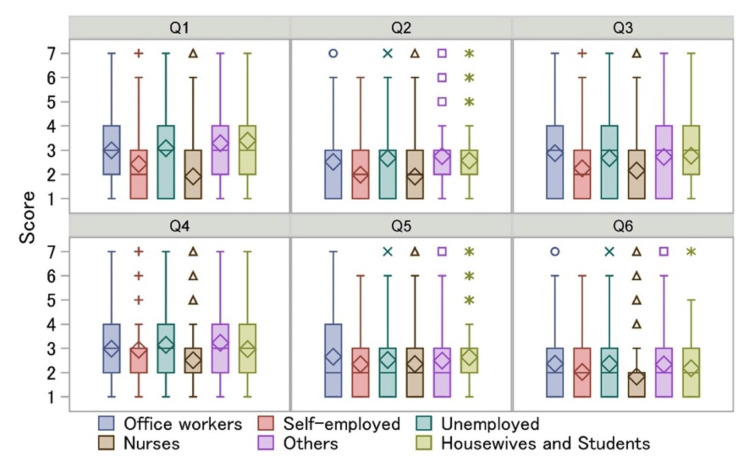
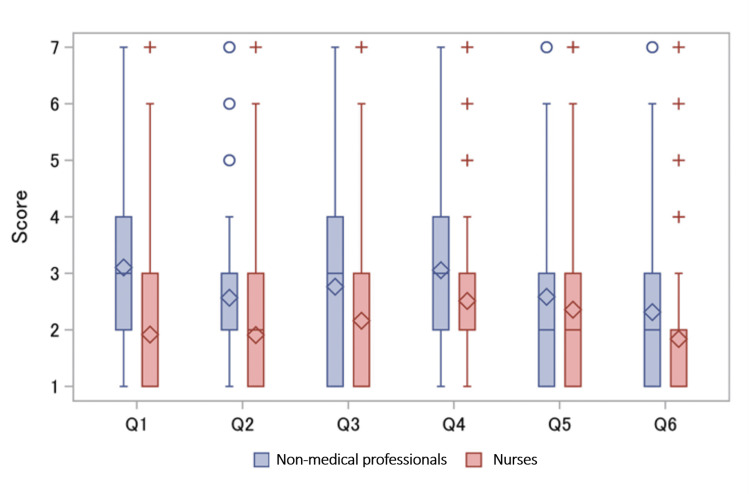
A significant portion of participants (36.7%) were aged 40-50 years (n = 745). Most were women (n = 1,210, 59.6%), and a considerable percentage were medical care users (n = 1,309, 64.5%). Non-medical professionals were less tolerant of uncertainty than nurses, and uncertainty scores were associated with medical care usage, occupation, and population size of the residential area.
Our findings revealed variations in perceptions of uncertainty in medical care between non-medical professionals and medical care providers. To mitigate conflicts related to medical issues, medical care providers should enhance non-medical professionals' education regarding perceptions of uncertainty in medical care.
医疗护理受到各种因素导致的不确定性的影响。医疗护理中存在的不确定性会导致患者不信任并引发冲突。本研究比较了非医学专业人员和护士对医疗护理中不确定性的耐受性。
我们进行了一项基于互联网的横断面调查。参与者包括来自日本不同地区的2100人(600名护士和1500名非医学专业人员;年龄≥20岁)。其中,我们排除了70名被归类为非医学专业人员但为注册护士的参与者。最后,我们分析了2030名参与者(600名护士和1430名非医学专业人员)的数据。三名注册护士和护理研究人员编制了一份关于医疗护理中不确定性耐受性的原创问卷。获取了参与者的特征数据(年龄、性别、教育水平、婚姻状况、是否有子女、居住地区人口规模、医疗护理使用情况和职业)。我们进行了单因素方差分析(ANOVA)以比较非医学专业人员和护士之间的数据。此外,我们采用多元回归模型来研究与医疗护理中不确定性耐受性得分相关的因素。
很大一部分参与者(36.7%)年龄在40至50岁之间(n = 745)。大多数是女性(n = 1210,59.6%),相当一部分是医疗护理使用者(n = 1309,64.5%)。非医学专业人员对不确定性的耐受性低于护士,并且不确定性得分与医疗护理使用情况、职业和居住地区人口规模相关。
我们的研究结果揭示了非医学专业人员和医疗护理提供者在医疗护理中对不确定性认知的差异。为了减轻与医疗问题相关的冲突,医疗护理提供者应加强非医学专业人员关于医疗护理中不确定性认知的教育。