Wang Chenyan, Li Xiaona, Guo Yuan, He Rui, Guo Hongmei, Chen Weiyi
College of Biomedical Engineering, Taiyuan University of Technology, Taiyuan, China.
Department of Excimer Laser, Shanxi Eye Hospital, Taiyuan, China.
Front Bioeng Biotechnol. 2022 Apr 11;10:855367. doi: 10.3389/fbioe.2022.855367. eCollection 2022.
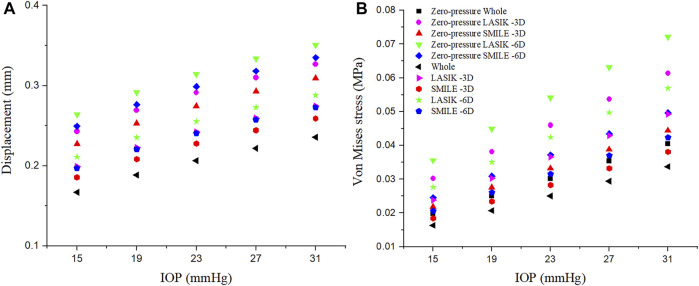
Myopia, which is the result of the uncoordinated development of the eyeball, has become a major public health focus worldwide. Laser keratomileusis (LASIK) and small-incision lenticule extraction (SMILE) have been successfully used in modern corneal refractive surgery. However, there are still controversies about postoperative results of LASIK and SMILE. In this study, a three-dimensional finite element model of the cornea was constructed based on the elevation and pachymetry data of a female volunteer. Surgical parameters, magnitudes of myopic correction, and intraocular pressure (IOP) were varied. Furthermore, an iterative algorithm was applied to retrieve the free-stress state of the intact corneal model, LASIK model, and SMILE model. To better evaluate the differences between LASIK and SMILE procedures, the displacement and Von Mises stress on the anterior and posterior corneal surface along the and -axes were analyzed. Results for the zero-pressure model showed larger displacement compared to the image-based corneal model, suggesting that the initial corneal pre-stress stiffens the response of the cornea, both in the intact cornea and under refractive surgery. In addition, the displacement on the corneal surface in LASIK (both zero-pressure and image-based model) was obviously higher than that of the SMILE model. In contrast, SMILE increased Von Mises stress in the corneal cap and reduced Von Mises stress in the residual stromal bed compared with the LASIK model. However, the maximum Von Mises stress in the SMILE model was still smaller than that of the LASIK model. Moreover, the displacement and Von Mises stress on the residual stromal bed increased linearly with IOP. Overall, LASIK and SMILE refractive surgery could change biomechanical behaviors of the cornea. Compared to LASIK refractive surgery, SMILE may present a lower risk of ectasia. Creating a corneal cap rather than a corneal flap may have an advantage in improving corneal biomechanical stability.
近视是眼球发育不协调的结果,已成为全球主要的公共卫生关注点。准分子激光原位角膜磨镶术(LASIK)和小切口基质透镜切除术(SMILE)已成功应用于现代角膜屈光手术。然而,LASIK和SMILE的术后效果仍存在争议。在本研究中,基于一名女性志愿者的角膜地形图和角膜厚度测量数据构建了角膜三维有限元模型。改变手术参数、近视矫正量和眼内压(IOP)。此外,应用迭代算法来获取完整角膜模型、LASIK模型和SMILE模型的自由应力状态。为了更好地评估LASIK和SMILE手术之间的差异,分析了角膜前后表面沿x轴和y轴的位移和冯·米塞斯应力。零压力模型的结果显示,与基于图像的角膜模型相比,位移更大,这表明初始角膜预应力增强了完整角膜和屈光手术下角膜的反应。此外,LASIK(零压力和基于图像的模型)角膜表面的位移明显高于SMILE模型。相比之下,与LASIK模型相比,SMILE增加了角膜瓣的冯·米塞斯应力,降低了剩余基质床的冯·米塞斯应力。然而,SMILE模型中的最大冯·米塞斯应力仍小于LASIK模型。此外,剩余基质床上的位移和冯·米塞斯应力随眼压呈线性增加。总体而言,LASIK和SMILE屈光手术会改变角膜的生物力学行为。与LASIK屈光手术相比,SMILE可能具有较低的扩张风险。制作角膜帽而非角膜瓣可能在改善角膜生物力学稳定性方面具有优势。