NeuroMuscularFunction | Research Group, School of Exercise and Sport Sciences, SUISM, Department of Medical Sciences, University of Torino, Turin, Italy.
School of Exercise & Sport Sciences, SUISM, University of Torino, Turin, Italy.
PLoS One. 2018 Apr 19;13(4):e0196253. doi: 10.1371/journal.pone.0196253. eCollection 2018.
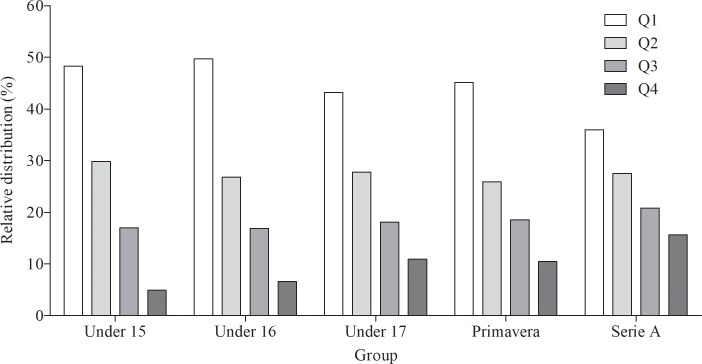
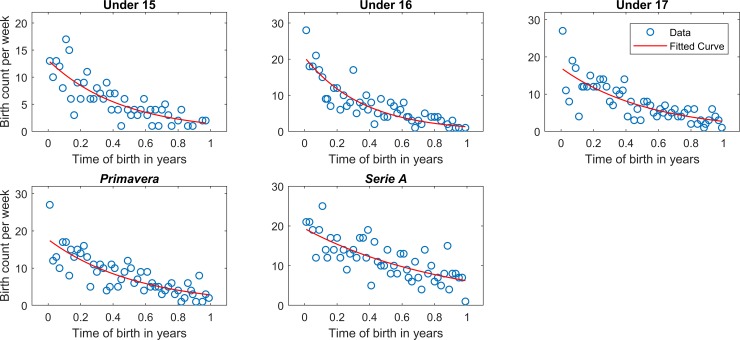
The relative age effect (RAE; i.e., an asymmetry in the birth distribution) is a bias observed in sport competitions that may favour relatively older athletes in talent identification. Therefore, the aim of this study was to investigate the presence of RAE in elite soccer players competing in the Italian championships, even considering the discriminations of younger and older Serie A players (in relation to the median age of the sample), and different positional roles (i.e., goalkeeper, defender, midfielder, forward) for each observed category. A total of 2051 players competing into the 2017-2018 Italian under-15 (n = 265), under-16 (n = 362), under-17 (n = 403), Primavera (n = 421) and Serie A (n = 600) championships were analysed. The birth-date distributions, grouped in four quartiles (i.e., January-March, Q1; April-June, Q2; July-September, Q3; October-December, Q4), were compared to a uniform distribution using Chi-squared analysis. The week of birth was analysed using Poisson regression. The results showed a large over-representation of players born in Q1 in all soccer player categories. However, the effect size of this trend resulted smaller as age increased. Individuals born in Q1 have about two-folds more chances to become a Serie A player compared to those born in Q4. The Poisson regression analysis showed that RAE was greater for defenders than for forwards among all categories. Therefore, a strongly biased selection emerged among elite soccer players competing in Italian championships, highlighting how young individuals born in the first three months have many more chances to become elite players compared to the others.
相对年龄效应(RAE;即出生分布的不对称性)是运动竞赛中观察到的一种偏差,可能有利于相对较年长的运动员在人才选拔中脱颖而出。因此,本研究的目的是调查在意大利锦标赛中竞争的精英足球运动员中是否存在 RAE,即使考虑到年轻和年长的意甲球员(与样本的中位数年龄有关)以及不同位置角色(即守门员、后卫、中场、前锋)的歧视。共有 2051 名参加 2017-2018 年意大利 U-15(n = 265)、U-16(n = 362)、U-17(n = 403)、青年队(n = 421)和意甲(n = 600)锦标赛的球员参加了分析。将出生日期分布按四个四分位数(即 1 月至 3 月,Q1;4 月至 6 月,Q2;7 月至 9 月,Q3;10 月至 12 月,Q4)分组,使用卡方分析与均匀分布进行比较。使用泊松回归分析出生周。结果表明,在所有足球运动员类别中,出生在 Q1 的球员人数过多。然而,随着年龄的增长,这种趋势的效应大小会减小。与出生在 Q4 的球员相比,出生在 Q1 的球员成为意甲球员的几率大约高出两倍。泊松回归分析表明,在所有类别中,防守球员的 RAE 大于前锋。因此,在参加意大利锦标赛的精英足球运动员中出现了强烈的选择性偏差,这表明与其他球员相比,出生在头三个月的年轻个体有更多机会成为精英球员。