Ningbo Technology University, Ningbo, China.
Ningbo Research Institute, Zhejiang University, Ningbo, China.
PLoS One. 2022 Apr 28;17(4):e0265954. doi: 10.1371/journal.pone.0265954. eCollection 2022.
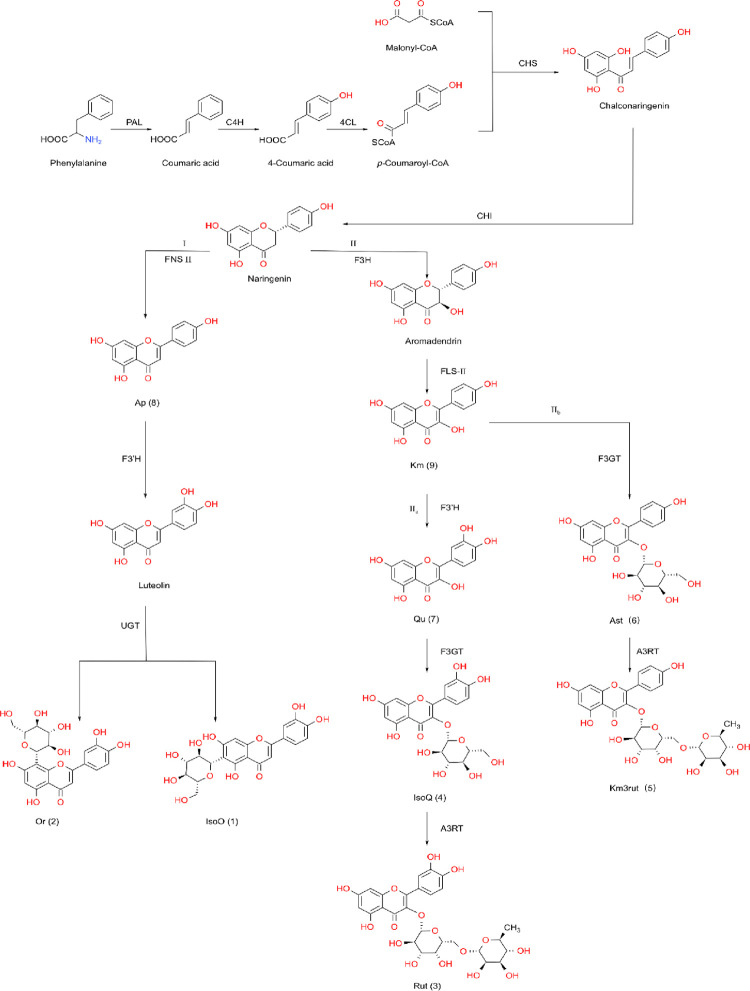
Environmental conditions contribute to plant growth and metabolism. This study aimed to determine a suitable environment and climate for large-scale artificial cultivation of an endangered plant, Tetrastigma hemsleyanum, by investigating the seasonal variations influencing the flavonoid biosynthetic selectivity and antioxidant activity of its major metabolites. Under conditions of precipitation (2.06.6 mm), temperature (17.524.1°C), humidity (67.380.2%), and sunshine duration (3.45.8 h) from April to May, the total flavonoid content in T. hemsleyanum reached higher levels between 281.3 and 392.8 μg/g. In the second half of April, the production selectivity (PS) of isoorientin (IsoO), orientin (Or), rutin (Rut), isoquercitin (IsoQ), kaempferol-3-O-rutinoside (Km3rut), astragalin (Ast), quercetin (Qu), apigenin (Ap), and kaempferol (Km) were 0.30, 0.06, 0.07, 0.07, 0.00, 0.04, 0.38, 0.05, and 0.03, respectively. Naringenin was dehydrogenated or hydroxylated to initiate two parallel reaction pathways for flavonoid biosynthesis in T. hemsleyanum: path I subsequently generated flavone derivatives including apigenin, luteolin, orientin, and isoorientin, and path II subsequently generated flavonol derivatives including Km, Qu, IsoQ, Rut, Ast, and Km3rut. The reaction selectivity of path II (RPSII) from January 1 to September 30 was considerably higher than that of path I (RPSI), except for March 16-31. In addition, either the content or antioxidant activity of three major metabolites in T. hemsleyanum followed the order of phenolic compounds > polysaccharides > sterols, and exhibited dynamic correlations with environmental factors. Naringenin favored hydroxylation and derived six flavonol compounds from January to September, and favored dehydrogenation and derived three flavone compounds from October to December. In most months of a year, Km preferentially favored hydroxylation rather than glucosylation.
环境条件影响植物的生长和代谢。本研究旨在通过调查影响其主要代谢物黄酮类生物合成选择性和抗氧化活性的季节性变化,确定大规模人工栽培濒危植物藤茶的适宜环境和气候。在 4 月至 5 月期间,降水(2.0-6.6 毫米)、温度(17.5-24.1°C)、湿度(67.3-80.2%)和日照时间(3.4-5.8 小时)的条件下,藤茶的总黄酮含量在 281.3-392.8μg/g 之间达到较高水平。在 4 月下半月,异荭草苷(IsoO)、荭草苷(Or)、芦丁(Rut)、异槲皮苷(IsoQ)、山奈酚-3-O-芸香糖苷(Km3rut)、杨梅素(Ast)、槲皮素(Qu)、芹菜素(Ap)和山奈酚(Km)的生产选择性(PS)分别为 0.30、0.06、0.07、0.07、0.00、0.04、0.38、0.05 和 0.03。柚皮素在藤茶中被脱氢或羟化,从而启动黄酮类生物合成的两条平行反应途径:途径 I 随后生成包括芹菜素、木犀草素、荭草苷和异荭草苷在内的黄酮衍生物,途径 II 随后生成包括 Km、Qu、异槲皮苷、芦丁、杨梅素和 Km3rut 在内的黄酮醇衍生物。从 1 月 1 日至 9 月 30 日,途径 II(RPSII)的反应选择性明显高于途径 I(RPSI),除了 3 月 16 日至 31 日。此外,藤茶中三种主要代谢物的含量或抗氧化活性均遵循酚类化合物>多糖>甾体的顺序,并与环境因素呈动态相关。柚皮素在 1 月至 9 月有利于羟化,生成 6 种黄酮醇化合物,在 10 月至 12 月有利于脱氢,生成 3 种黄酮化合物。在一年中的大多数月份,Km 更倾向于羟化而不是糖化。