Translational Research Program, Public Health Sciences Division, Fred Hutchinson Cancer Research Center, Seattle, Washington.
Department of Chemistry, Hunter College, City University of New York, New York, New York.
J Nucl Med. 2022 Nov;63(11):1701-1707. doi: 10.2967/jnumed.121.263511. Epub 2022 Apr 28.
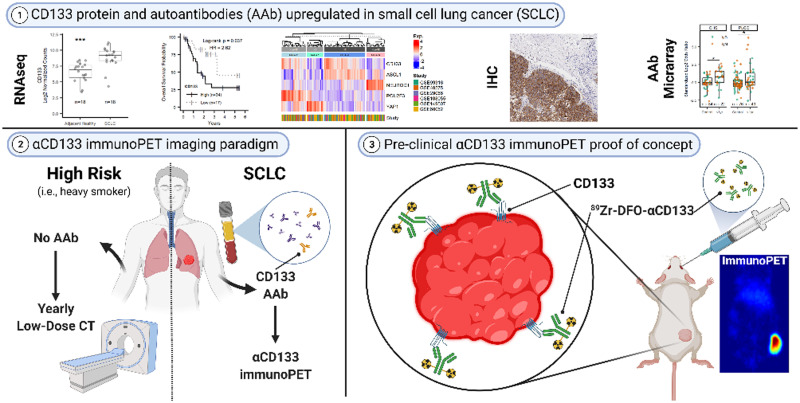
Small cell lung cancer (SCLC) is a deadly neuroendocrine tumor for which there are no screening methods sensitive enough to facilitate early, effective intervention. We propose targeting the neuroendocrine tumor neoantigen CD133 via antibody-based early detection and PET (immunoPET) to facilitate earlier and more accurate detection of SCLC. RNA sequencing datasets, immunohistochemistry, flow cytometry, and Western blots were used to quantify CD133 expression in healthy and SCLC patients. CD133 was imaged using near-infrared fluorescence (NIRF) immunoimaging, and Zr immunoPET. Anti(α)-CD133 autoantibody levels were measured in SCLC patient plasma using antibody microarrays. Across 6 publicly available datasets, CD133 messenger RNA was found to be higher in SCLC tumors than in other tissues, including healthy or normal adjacent lung and non-SCLC samples. Critically, the upregulation of CD133 messenger RNA in SCLC was associated with a significant increase (hazard ratio, 2.62) in death. CD133 protein was expressed in primary human SCLC, in SCLC patient-derived xenografts, and in both SCLC cell lines tested (H82 and H69). Using an H82 xenograft mouse model, we first imaged CD133 expression with NIRF. Both and NIRF clearly showed that a fluorophore-tagged αCD133 homed to lung tumors. Next, we validated the noninvasive visualization of subcutaneous and orthotopic H82 xenografts via immunoPET. An αCD133 antibody labeled with the positron-emitting radiometal Zr demonstrated significant accumulation in tumor tissue while producing minimal uptake in healthy organs. Finally, plasma αCD133 autoantibodies were found in subjects from cohort studies up to 1 year before SCLC diagnosis. In light of these findings, we conclude that the presence of αCD133 autoantibodies in a blood sample followed by CD133-targeted Zr-immunoPET could be an effective early detection screening strategy for SCLC.
小细胞肺癌 (SCLC) 是一种致命的神经内分泌肿瘤,目前尚无足够敏感的筛查方法来促进早期、有效的干预。我们提出通过基于抗体的早期检测和正电子发射断层扫描(immunoPET)来靶向神经内分泌肿瘤新生抗原 CD133,以促进 SCLC 的更早、更准确的检测。使用 RNA 测序数据集、免疫组织化学、流式细胞术和 Western blot 来量化健康人和 SCLC 患者中 CD133 的表达。使用近红外荧光 (NIRF) 免疫成像和 Zr immunoPET 对 CD133 进行成像。使用抗体微阵列测量 SCLC 患者血浆中的抗(α)-CD133 自身抗体水平。在 6 个公开可用的数据集上,发现 SCLC 肿瘤中的 CD133 信使 RNA 高于其他组织,包括健康或正常相邻肺和非 SCLC 样本。至关重要的是,SCLC 中 CD133 信使 RNA 的上调与死亡风险显著增加(危险比,2.62)相关。CD133 蛋白在原发性人 SCLC、SCLC 患者来源的异种移植物和测试的两种 SCLC 细胞系(H82 和 H69)中表达。使用 H82 异种移植小鼠模型,我们首先使用 NIRF 对 CD133 表达进行成像。NIRF 都清楚地表明,荧光标记的αCD133 归巢到肺部肿瘤。接下来,我们通过 immunoPET 验证了皮下和原位 H82 异种移植的非侵入性可视化。用正电子发射放射性金属 Zr 标记的αCD133 抗体在肿瘤组织中表现出明显的积聚,而在健康器官中产生最小的摄取。最后,在队列研究中,在 SCLC 诊断前长达 1 年的时间里,在研究对象的血浆中发现了αCD133 自身抗体。有鉴于此,我们得出结论,血液样本中存在αCD133 自身抗体,然后进行靶向 CD133 的 Zr-immunoPET,可能是 SCLC 的一种有效的早期检测筛查策略。