Department of Thoracic Surgery, National Cancer Center/National Clinical Research Center for Cancer/Cancer Hospital, Chinese Academy of Medical Sciences and Peking Union Medical College, Beijing, 100021, P. R. China.
State Key Laboratory of Molecular Oncology, National Cancer Center/National Clinical Research Center for Cancer/Cancer Hospital, Chinese Academy of Medical Sciences and Peking Union Medical College, Beijing, 100021, P. R. China.
Cancer Commun (Lond). 2022 Oct;42(10):1008-1027. doi: 10.1002/cac2.12351. Epub 2022 Aug 16.
Maintenance of cancer stem-like cell (CSC) stemness supported by aberrantly regulated cancer cell metabolism is critical for CSC self-renewal and tumor progression. As a key glycolytic enzyme, hexokinase 2 (HK2) plays an instrumental role in aerobic glycolysis and tumor progression. However, whether HK2 directly contribute to CSC stemness maintenance in small cell lung cancer (SCLC) is largely unclear. In this study, we aimed to investgate whether HK2 independent of its glycolytic activity is directly involved in stemness maintenance of CSC in SCLC.
Immunoblotting analyses were conducted to determine the expression of HK2 in SCLC CSCs and their differentiated counterparts. CSC-like properties and tumorigenesis of SCLC cells with or without HK2 depletion or overexpression were examined by sphere formation assay and xenograft mouse model. Immunoprecipitation and mass spectrometry analyses were performed to identify the binding proteins of CD133. The expression levels of CD133-associated and CSC-relevant proteins were evaluated by immunoblotting, immunoprecipitation, immunofluorescence, and immunohistochemistry assay. RNA expression levels of Nanog, POU5F1, Lin28, HK2, Prominin-1 were analyzed through quantitative reverse transcription PCR. Polyubiquitination of CD133 was examined by in vitro or in vivo ubiquitination assay. CD133 cells were sorted by flow cytometry using an anti-CD133 antibody.
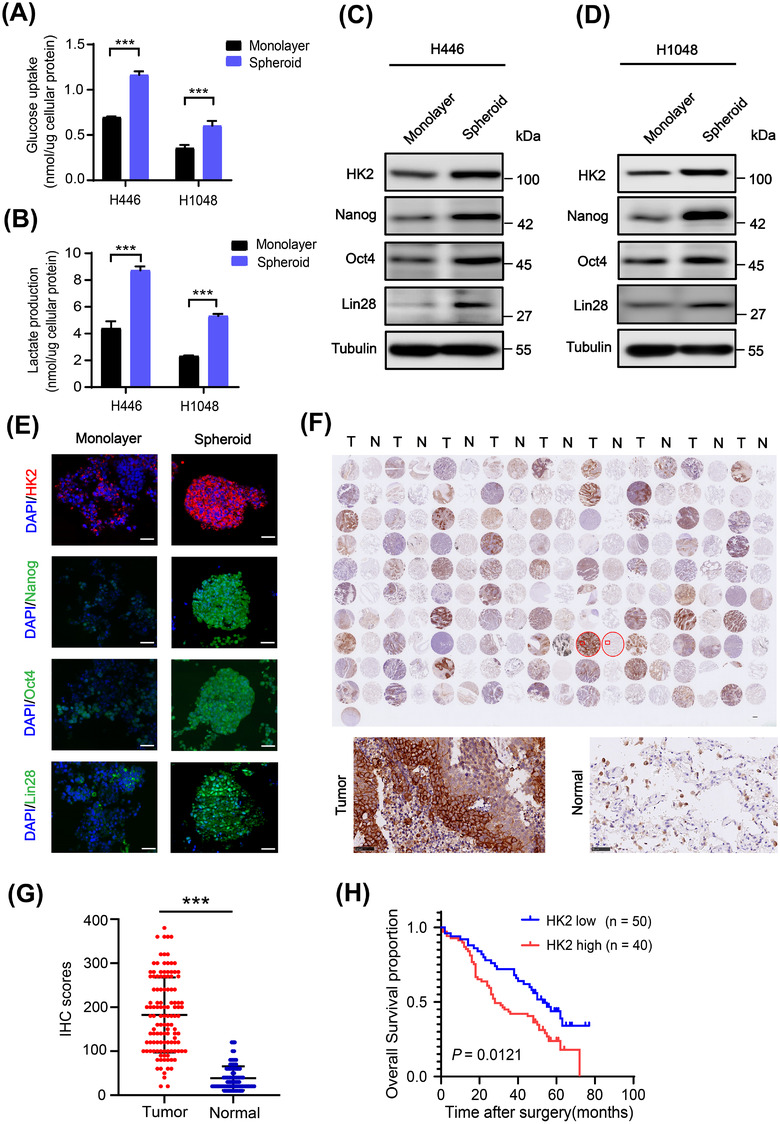
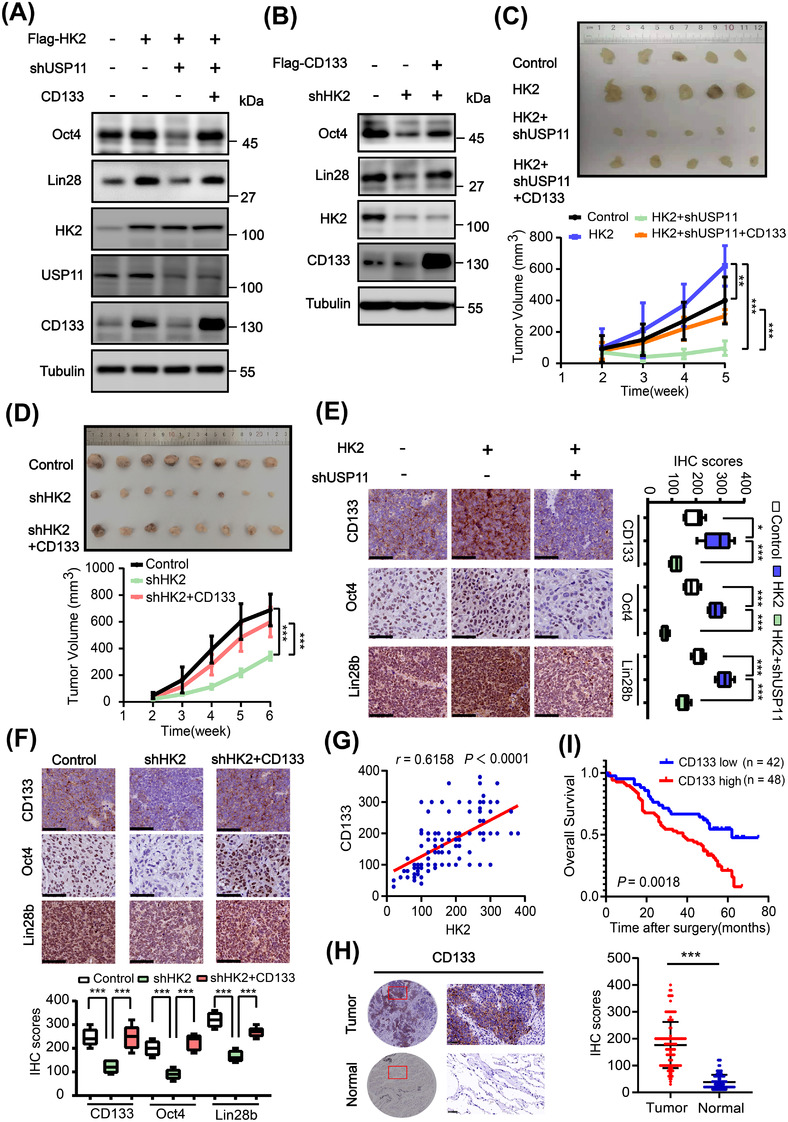
We demonstrated that HK2 expression was much higher in CSCs of SCLC than in their differentiated counterparts. HK2 depletion inhibited CSC stemness and promoted CSC differentiation. Mechanistically, non-mitochondrial HK2 directly interacted with CD133 and enhanced CD133 expression without affecting CD133 mRNA levels. The interaction of HK2 and CD133 promoted the binding of the deubiquitinase ubiquitin-specific protease 11 (USP11) to CD133, thereby inhibiting CD133 polyubiquitylation and degradation. HK2-mediated upregulation of CD133 expression enhanced the expression of cell renewal regulators, SCLC cell stemness, and tumor growth in mice. In addition, HK2 expression was positively correlated with CD133 expression in human SCLC specimens, and their expression levels were associated with poor prognosis of SCLC patients.
These results revealed a critical non-metabolic function of HK2 in promotion of cancer cell stemness. Our findings provided new insights into the multifaceted roles of HK2 in tumor development.
由异常调节的癌细胞代谢支持的癌症干细胞样细胞(CSC)干性的维持对于 CSC 的自我更新和肿瘤进展至关重要。作为关键的糖酵解酶,己糖激酶 2(HK2)在有氧糖酵解和肿瘤进展中发挥重要作用。然而,HK2 是否直接有助于小细胞肺癌(SCLC)中 CSC 干性的维持在很大程度上尚不清楚。在这项研究中,我们旨在研究 HK2 是否独立于其糖酵解活性直接参与 SCLC 中 CSC 的干性维持。
通过免疫印迹分析确定 SCLC CSCs 及其分化对应物中 HK2 的表达。通过球体形成测定和异种移植小鼠模型研究 SCLC 细胞中 HK2 缺失或过表达对 CSC 样特性和肿瘤发生的影响。通过免疫沉淀和质谱分析鉴定 CD133 的结合蛋白。通过免疫印迹、免疫沉淀、免疫荧光和免疫组织化学分析评估 CD133 相关和 CSC 相关蛋白的表达水平。通过定量逆转录 PCR 分析 Nanog、POU5F1、Lin28、HK2、Prominin-1 的 RNA 表达水平。通过体外或体内泛素化测定研究 CD133 的多泛素化。通过使用抗 CD133 抗体通过流式细胞术分选 CD133 细胞。
我们证明 SCLC 的 CSCs 中 HK2 的表达明显高于其分化对应物。HK2 缺失抑制了 CSC 干性并促进了 CSC 分化。在机制上,非线粒体 HK2 直接与 CD133 相互作用,增强 CD133 的表达,而不影响 CD133 mRNA 水平。HK2 和 CD133 的相互作用促进去泛素酶泛素特异性蛋白酶 11(USP11)与 CD133 的结合,从而抑制 CD133 的多泛素化和降解。HK2 介导的 CD133 表达上调增强了细胞更新调节剂的表达,增强了 SCLC 细胞的干性,并促进了小鼠肿瘤的生长。此外,HK2 表达与人 SCLC 标本中的 CD133 表达呈正相关,其表达水平与 SCLC 患者的预后不良相关。
这些结果揭示了 HK2 在促进癌细胞干性中的关键非代谢功能。我们的研究结果为 HK2 在肿瘤发展中的多方面作用提供了新的见解。