King's College London, London, SE5 9RJ, UK.
Department of Diabetes, King's College Hospital NHS Foundation Trust, London, SE5 9RS, UK.
Nat Commun. 2022 Apr 28;13(1):2229. doi: 10.1038/s41467-022-29488-x.
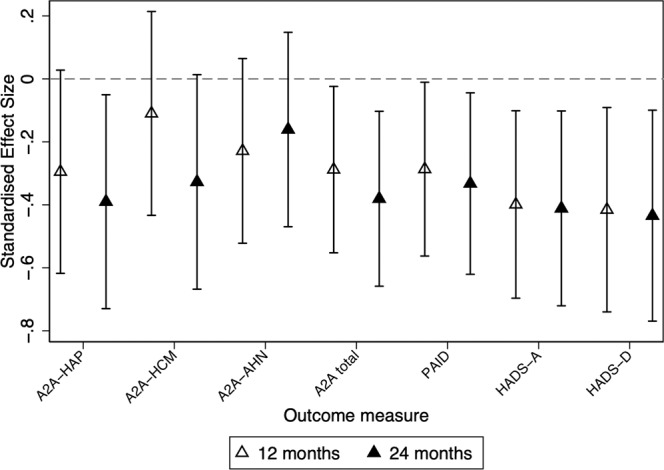
Impaired awareness of hypoglycaemia (IAH) is a major risk for severe hypoglycaemia in insulin treatment of type 1 diabetes (T1D). To explore the hypothesis that unhelpful health beliefs create barriers to regaining awareness, we conducted a multi-centre, randomised, parallel, two-arm trial (ClinicalTrials.gov NCT02940873) in adults with T1D and treatment-resistant IAH and severe hypoglycaemia, with blinded analysis of 12-month recall of severe hypoglycaemia at 12 and/or 24 months the primary outcome. Secondary outcomes included cognitive and emotional measures. Adults with T1D, IAH and severe hypoglycaemia despite structured education in insulin adjustment, +/- diabetes technologies, were randomised to the "Hypoglycaemia Awareness Restoration Programme despite optimised self-care" (HARPdoc, n = 49), a psychoeducation programme uniquely focussing on changing cognitive barriers to avoiding hypoglycaemia, or the evidence-based "Blood Glucose Awareness Training" (BGAT, n = 50), both delivered over six weeks. Median [IQR] severe hypoglycaemia at baseline was 5[2-12] per patient/year, 1[0-5] at 12 months and 0[0-2] at 24 months, with no superiority for HARPdoc (HARPdoc vs BGAT incident rate ratios [95% CI] 1.25[0.51, 3.09], p = 0.62 and 1.26[0.48, 3.35], p = 0.64 respectively), nor for changes in hypoglycaemia awareness scores or fear. Compared to BGAT, HARPdoc significantly reduced endorsement of unhelpful cognitions (Estimated Mean Difference for Attitudes to Awareness scores at 24 months, -2.07 [-3.37,-0.560], p = 0.01) and reduced scores for diabetes distress (-6.70[-12.50,-0.89], p = 0.02); depression (-1.86[-3.30, -0.43], p = 0.01) and anxiety (-1.89[-3.32, -0.47], p = 0.01). Despite positive impact on cognitive barriers around hypoglycaemia avoidance and on diabetes-related and general emotional distress scores, HARPdoc was not more effective than BGAT at reducing severe hypoglycaemia.
低血糖意识受损(IAH)是 1 型糖尿病(T1D)胰岛素治疗中发生严重低血糖的主要风险。为了探索这样一种假说,即无益的健康信念会阻碍恢复意识,我们在 T1D 成人中进行了一项多中心、随机、平行、双臂试验(ClinicalTrials.gov NCT02940873),这些患者伴有治疗抵抗性 IAH 和严重低血糖,以及在 12 个月和/或 24 个月时对严重低血糖进行 12 个月的盲法分析,主要结局。次要结局包括认知和情绪测量。患有 T1D、IAH 和严重低血糖的患者,尽管进行了胰岛素调整方面的结构化教育,加上/减去糖尿病技术,但随机分为“尽管进行了优化自我保健,但仍要恢复低血糖意识”(HARPdoc,n=49)组,这是一种独特的心理教育方案,重点是改变避免低血糖的认知障碍,或基于证据的“血糖意识培训”(BGAT,n=50),均在六周内完成。基线时每名患者/年严重低血糖的中位数[IQR]为 5[2-12],12 个月时为 1[0-5],24 个月时为 0[0-2],HARPdoc 并无优势(HARPdoc 与 BGAT 的发生率比[95%CI]分别为 1.25[0.51,3.09],p=0.62 和 1.26[0.48,3.35],p=0.64),低血糖意识评分或恐惧的变化也没有优势。与 BGAT 相比,HARPdoc 显著降低了对无益认知的认可(24 个月时对意识评分的态度的估计平均差异为-2.07[-3.37,-0.560],p=0.01),并降低了糖尿病困扰评分(-6.70[-12.50,-0.89],p=0.02);抑郁评分(-1.86[-3.30, -0.43],p=0.01)和焦虑评分(-1.89[-3.32, -0.47],p=0.01)。尽管 HARPdoc 在降低严重低血糖方面的效果不如 BGAT,但它在避免低血糖的认知障碍以及糖尿病相关和一般情绪困扰评分方面有积极影响。