Department of Thoracic Surgery, The First Affiliated Hospital, Xi'an Jiaotong University, Xi'an, 710061, Shaanxi, China.
Department of Oncology, The Second Affiliated Hospital, Xi'an Jiaotong University, Xi'an, China.
Sci Rep. 2022 Apr 28;12(1):6946. doi: 10.1038/s41598-022-10561-w.
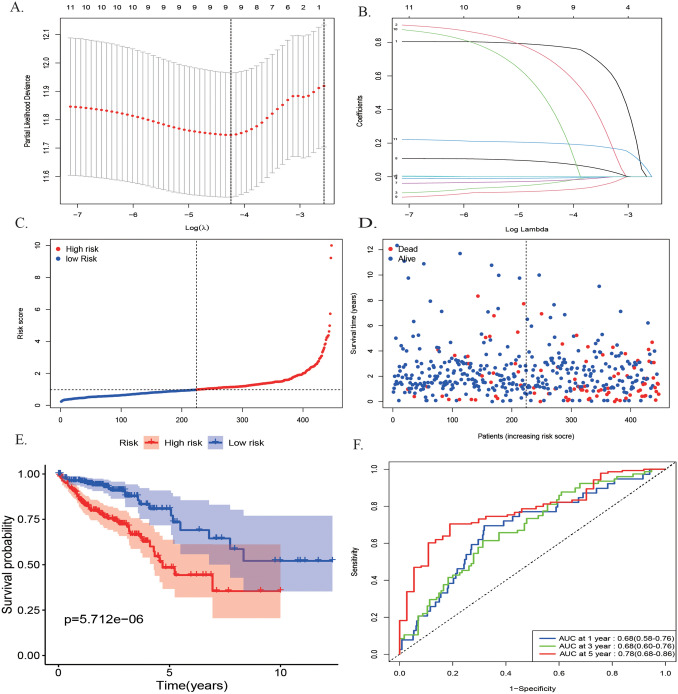
Colorectal cancer (CRC) is the third most common malignant tumor. DNA damage plays a crucial role in tumorigenesis, and abnormal DNA repair pathways affect the occurrence and progression of CRC. In the current study, we aimed to construct a DNA repair-related gene (DRG) signature to predict the overall survival (OS) of patients with CRC patients. The differentially expressed DRGs (DE-DRGs) were analyzed using The Cancer Genome Atlas (TCGA) and Gene Expression Omnibus (GEO) databases. The prognostic gene signature was identified by univariate Cox regression and least absolute shrinkage and selection operator (LASSO)-penalized Cox proportional hazards regression analysis. The predictive ability of the model was evaluated using the Kaplan-Meier curves and time-dependent receiver operating characteristic (ROC) curves. The gene set enrichment analysis (GSEA) was performed to explore the underlying biological processes and signaling pathways. ESTIMATE and CIBERSORT were implemented to estimate the tumor immune score and immune cell infiltration status between the different risk group. The half-maximal inhibitory concentration (IC50) was evaluated to representing the drug response of this signature. Nine DE-DRGs (ESCO2, AXIN2, PLK1, CDC25C, IGF1, TREX2, ALKBH2, ESR1 and MC1R) signatures was constructed to classify patients into high- and low-risk groups. The risk score was an independent prognostic indicator of OS (hazard ratio > 1, P < 0.001). The genetic alteration analysis indicated that the nine DE-DRGs in the signature were changed in 63 required samples (100%), and the major alteration was missense mutation. Function enrichment analysis revealed that the immune response and mtotic sister chromatid segregation were the main biological processes. The high-risk group had higher immune score than the low-risk group. What's more, low-risk patients were more sensitive to selumetinib and dasatinib. The nine DE-DRGs signature was significantly associated with OS and provided a new insight for the diagnosis and treatment of CRC.
结直肠癌(CRC)是第三大常见恶性肿瘤。DNA 损伤在肿瘤发生中起着关键作用,异常的 DNA 修复途径影响 CRC 的发生和发展。在本研究中,我们旨在构建一个与 DNA 修复相关的基因(DRG)特征,以预测 CRC 患者的总生存期(OS)。使用癌症基因组图谱(TCGA)和基因表达综合数据库(GEO)分析差异表达的 DRG(DE-DRGs)。通过单变量 Cox 回归和最小绝对收缩和选择算子(LASSO)惩罚 Cox 比例风险回归分析确定预后基因特征。通过 Kaplan-Meier 曲线和时间依赖性接收者操作特征(ROC)曲线评估模型的预测能力。进行基因集富集分析(GSEA)以探索潜在的生物学过程和信号通路。使用 ESTIMATE 和 CIBERSORT 估计不同风险组之间的肿瘤免疫评分和免疫细胞浸润状态。评估半最大抑制浓度(IC50)以代表该特征的药物反应。构建了 9 个 DE-DRGs(ESCO2、AXIN2、PLK1、CDC25C、IGF1、TREX2、ALKBH2、ESR1 和 MC1R)特征,将患者分为高风险和低风险组。风险评分是 OS 的独立预后指标(风险比>1,P<0.001)。遗传改变分析表明,特征中 9 个 DE-DRGs 在 63 个必需样本(100%)中发生改变,主要改变是错义突变。功能富集分析表明,免疫反应和有丝分裂姐妹染色单体分离是主要的生物学过程。高危组的免疫评分高于低危组。更重要的是,低危患者对 selumetinib 和 dasatinib 更敏感。九个 DE-DRGs 特征与 OS 显著相关,为 CRC 的诊断和治疗提供了新的见解。