Department of Animal Medicine (Infectious Diseases), Faculty of Veterinary Medicine, Benha University, Toukh, 13736, Egypt.
Department of Animal Medicine (Internal Medicine), Faculty of Veterinary Medicine, Benha University, Moshtohor-Toukh, Kalyobiya, 13736, Egypt.
Sci Rep. 2022 Apr 28;12(1):6988. doi: 10.1038/s41598-022-11079-x.
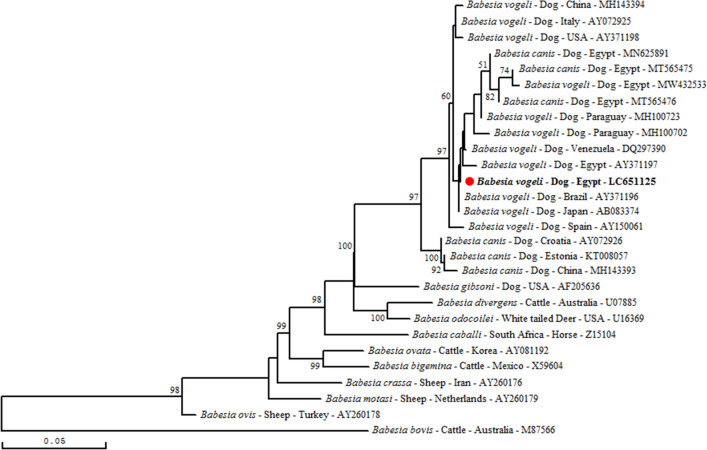
Canine babesiosis is a life-threatening haemoparasitic disease in dogs that is prevalent worldwide. In this study, the prevalence of Babesia vogeli (B. vogeli) was investigated in dogs from Egypt by using Polymerase Chain Reaction (PCR) assay, and associated risk factors were evaluated. In addition, phylogenetic position of B. vogeli Egyptian isolate was determined by sequencing. A total of 275 blood samples were taken from dogs located in four governorates belonging to the north of Egypt. Samples were examined by PCR targeting the B. vogeli 18S rRNA gene and this species was also confirmed by sequencing. Overall, the prevalence of B. vogeli was 5.1% among the studied dogs and the highest prevalence rate was found in the Giza governorate. Univariate logistic regression was used to evaluate each variable individually. The results revealed a significant association between the prevalence of B. vogeli infection and whether or not dogs were infested with ticks and the type of floor used in dog shelters. Additionally, tick infestation (OR 6.1, 95% CI 1.2-31.4), and living in shelters with soil floors (OR 3.8, 95% CI 0.8-17.8) were identified as potential risk factors for B. vogeli infection. Phylogenetic analysis was performed using B. vogeli 18S rRNA partial sequences with the hypervariable V4 region from GenBank. The Egyptian isolate was assigned to second sub-cluster with B. vogeli isolates from Japan, Venezuela and Paraguay within the B. vogeli/B. canis cluster. The present data will be useful to improve the understanding of canine babesiosis epidemiology and ways to control the disease in companion dogs.
犬巴贝斯虫病是一种危及生命的犬血液寄生虫病,在全球范围内普遍存在。本研究通过聚合酶链反应(PCR)检测,调查了埃及犬巴贝斯虫(B. vogeli)的流行情况,并评估了相关的危险因素。此外,还通过测序确定了埃及分离株的系统发育位置。从埃及北部四个省的犬身上采集了 275 份血液样本。使用针对 B. vogeli 18S rRNA 基因的 PCR 检测样本,并用测序证实了该物种的存在。总的来说,研究犬中 B. vogeli 的流行率为 5.1%,其中吉萨省的流行率最高。单变量逻辑回归用于单独评估每个变量。结果表明,B. vogeli 感染的流行率与犬是否有蜱虫感染以及犬舍地板类型之间存在显著关联。此外,蜱虫感染(OR 6.1,95%CI 1.2-31.4)和生活在有土壤地板的犬舍(OR 3.8,95%CI 0.8-17.8)被确定为 B. vogeli 感染的潜在危险因素。使用从 GenBank 获得的 18S rRNA 部分序列和高变区 V4 区进行了 B. vogeli 的系统发育分析。埃及分离株被分配到第二个亚群,与来自日本、委内瑞拉和巴拉圭的 B. vogeli 分离株一起属于 B. vogeli/B. canis 群。本数据将有助于提高对犬巴贝斯虫病流行病学的认识,并为控制伴侣犬疾病提供依据。