Department of Physics, University of Idaho, Moscow, ID, USA.
Electrical and Computer Engineering, University of Delaware, Newark, DE, USA.
Commun Biol. 2022 Apr 28;5(1):397. doi: 10.1038/s42003-022-03348-2.
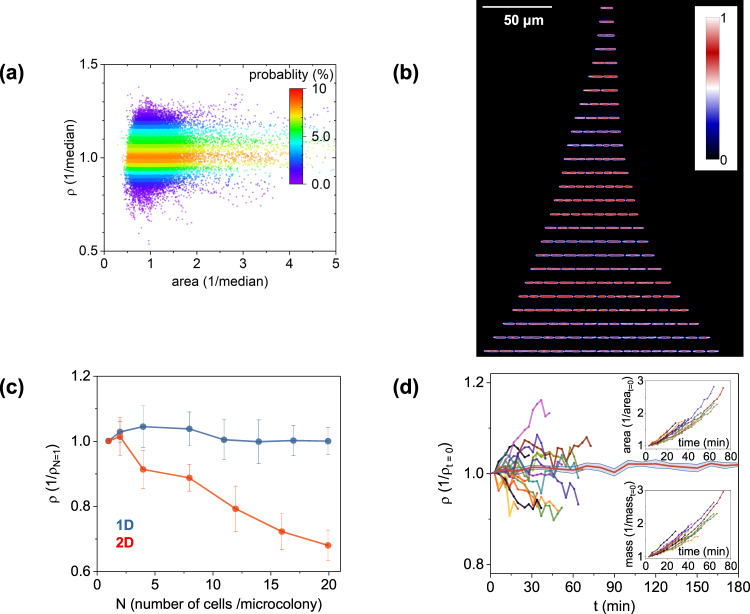
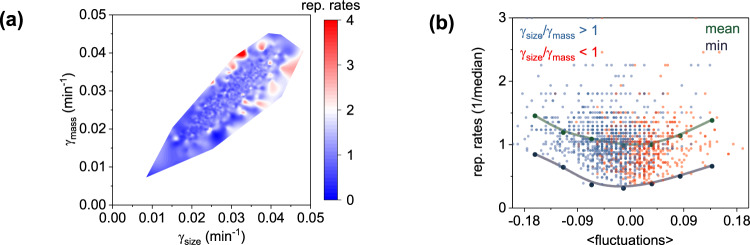
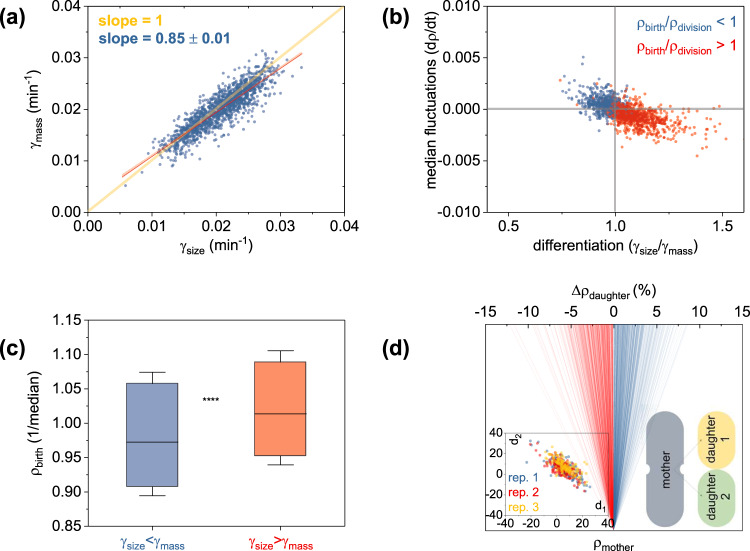
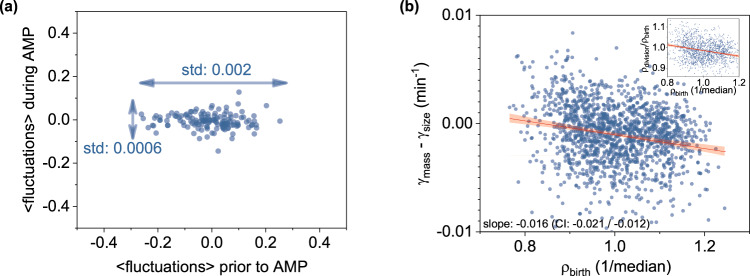
Single-cells grow by increasing their biomass and size. Here, we report that while mass and size accumulation rates of single Escherichia coli cells are exponential, their density and, thus, the levels of macromolecular crowding fluctuate during growth. As such, the average rates of mass and size accumulation of a single cell are generally not the same, but rather cells differentiate into increasing one rate with respect to the other. This differentiation yields a density homeostasis mechanism that we support mathematically. Further, we observe that density fluctuations can affect the reproduction rates of single cells, suggesting a link between the levels of macromolecular crowding with metabolism and overall population fitness. We detail our experimental approach and the "invisible" microfluidic arrays that enabled increased precision and throughput. Infections and natural communities start from a few cells, thus, emphasizing the significance of density-fluctuations when taking non-genetic variability into consideration.
单细胞通过增加其生物量和大小来生长。在这里,我们报告说,虽然单个大肠杆菌细胞的质量和大小积累率呈指数增长,但它们的密度,因此,大分子拥挤程度在生长过程中波动。因此,单个细胞的质量和大小积累的平均速率通常并不相同,而是细胞分化为相对于另一个速率的增加。这种分化产生了一种密度动态平衡机制,我们用数学方法支持这种机制。此外,我们观察到密度波动会影响单个细胞的繁殖率,这表明大分子拥挤程度与新陈代谢和总体种群适应性之间存在联系。我们详细介绍了我们的实验方法和“隐形”微流控阵列,这提高了精度和通量。感染和自然群落从少数细胞开始,因此,在考虑非遗传变异性时,强调了密度波动的重要性。