Cognitive Neuroscience Laboratory, Brain Injury Research, Shirley Ryan AbilityLab, Chicago, IL, USA.
Feinberg School of Medicine, Northwestern University, Chicago, IL, USA.
Behav Brain Funct. 2022 Apr 28;18(1):6. doi: 10.1186/s12993-022-00193-5.
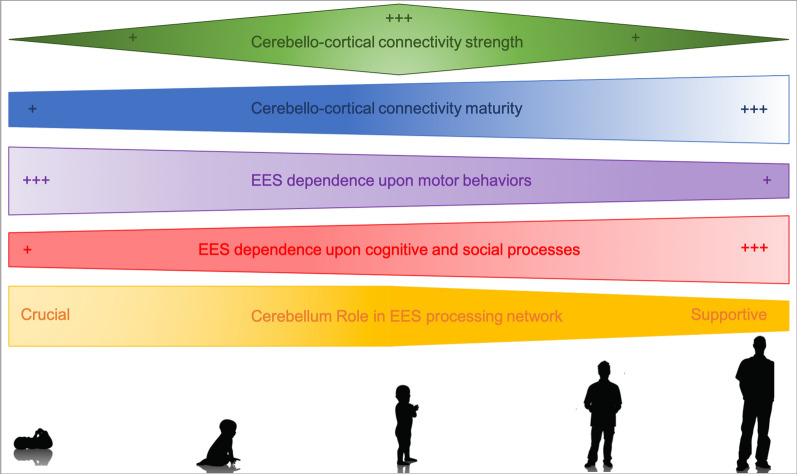
The cerebellum's anatomical and functional organization and network interactions between the cerebellum and the cerebral cortex and subcortical structures are dynamic across the lifespan. Executive, emotional and social (EES) functions have likewise evolved during human development from contributing to primitive behaviors during infancy and childhood to being able to modulate complex actions in adults. In this review, we address how the importance of the cerebellum in the processing of EES functions might change across development. This evolution is driven by the macroscopic and microscopic modifications of the cerebellum that are occurring during development including its increasing connectivity with distant supra-tentorial cortical and sub-cortical regions. As a result of anatomical and functional changes, neuroimaging and clinical data indicate that the importance of the role of the cerebellum in human EES-related networks shifts from being crucial in newborns and young children to being only supportive later in life. In early life, given the immaturity of cortically mediated EES functions, EES functions and motor control and perception are more closely interrelated. At that time, the cerebellum due to its important role in motor control and sequencing makes EES functions more reliant on these computational properties that compute spatial distance, motor intent, and assist in the execution of sequences of behavior related to their developing EES expression. As the cortical brain matures, EES functions and decisions become less dependent upon these aspects of motor behavior and more dependent upon high-order cognitive and social conceptual processes. At that time, the cerebellum assumes a supportive role in these EES-related behaviors by computing their motor and sequential features. We suspect that this evolving role of the cerebellum has complicated the interpretation of its contribution to EES computational demands.
小脑的解剖和功能组织以及小脑与大脑皮层和皮质下结构之间的网络相互作用在整个生命周期中都是动态的。执行、情感和社会(EES)功能在人类发展过程中也从对婴儿期和儿童期原始行为的贡献演变而来,能够调节成年人的复杂行为。在这篇综述中,我们探讨了小脑在 EES 功能处理中的重要性在发育过程中是如何变化的。这种进化是由小脑在发育过程中发生的宏观和微观变化驱动的,包括其与远距离大脑皮质和皮质下区域的连接不断增加。由于解剖和功能的变化,神经影像学和临床数据表明,小脑在人类 EES 相关网络中的作用重要性从新生儿和幼儿期的关键作用转变为生命后期的支持作用。在生命早期,由于皮质介导的 EES 功能不成熟,EES 功能与运动控制和感知更加密切相关。此时,小脑由于在运动控制和排序方面的重要作用,使得 EES 功能更加依赖于这些计算特性,这些特性计算空间距离、运动意图,并协助执行与 EES 表达相关的行为序列。随着大脑皮质的成熟,EES 功能和决策变得不那么依赖于这些运动行为方面,而更多地依赖于高阶认知和社会概念过程。此时,小脑在这些 EES 相关行为中发挥支持作用,计算它们的运动和序列特征。我们怀疑小脑的这种不断演变的作用使得其对 EES 计算需求的贡献的解释变得复杂。