School of Biomedical Engineering & Imaging Sciences, King's College London, UK.
School of Biomedical Engineering & Imaging Sciences, King's College London, UK; Guy's and St Thomas' Hospital, London, UK.
Med Image Anal. 2022 Jul;79:102465. doi: 10.1016/j.media.2022.102465. Epub 2022 Apr 20.
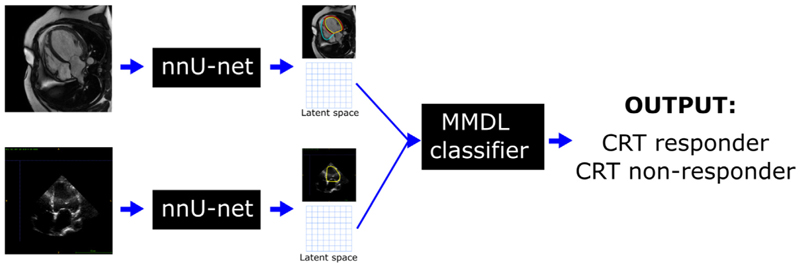
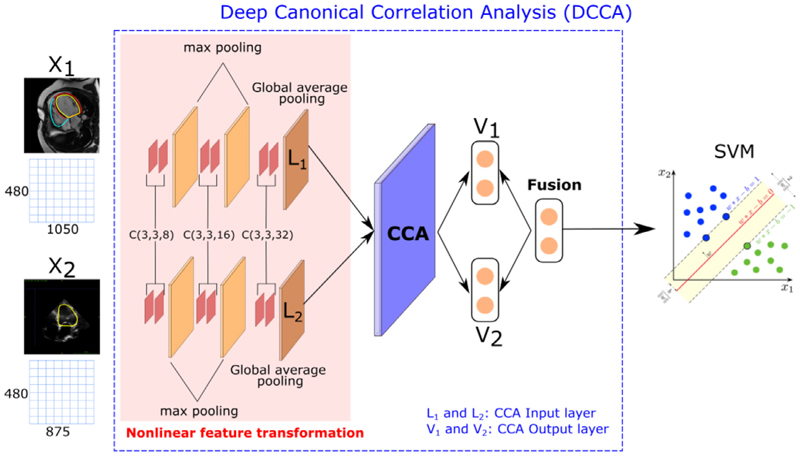
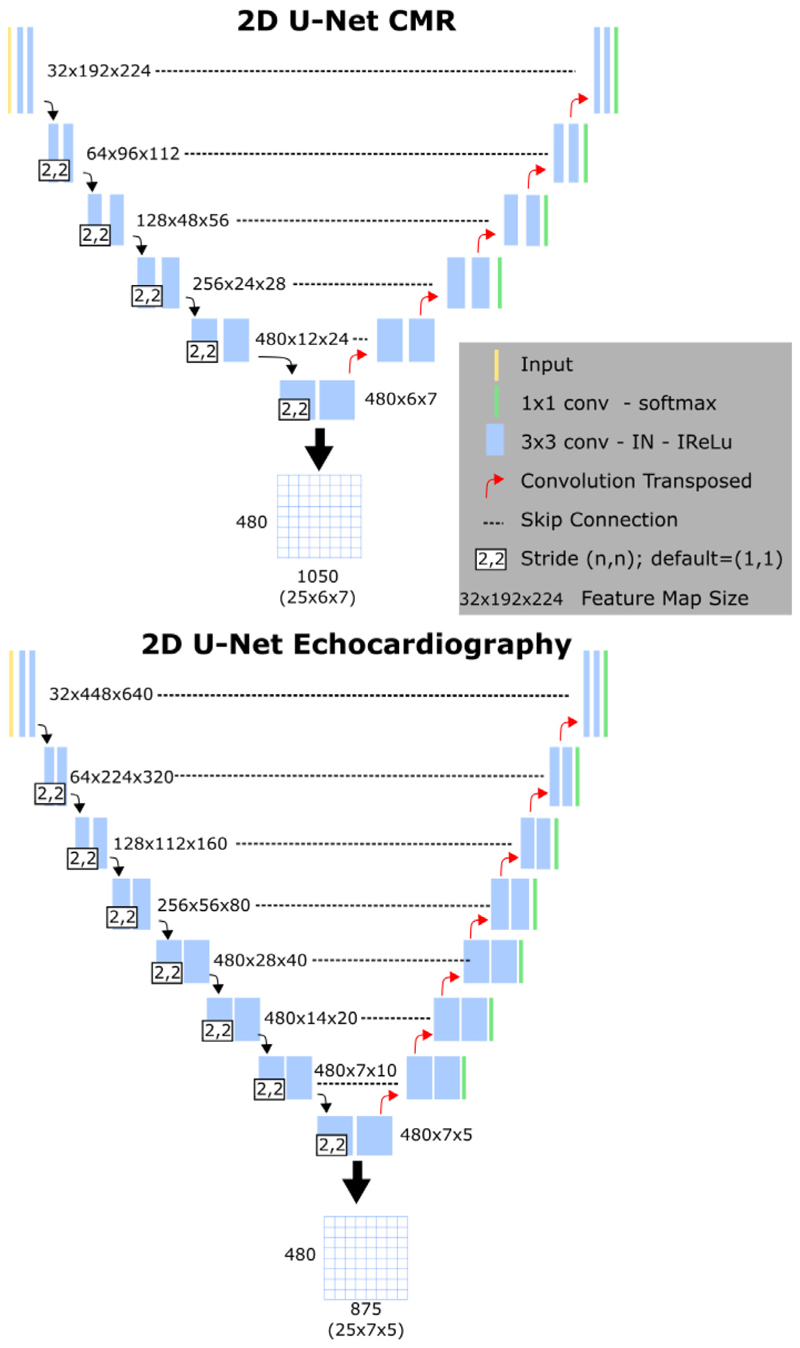
We present a novel multimodal deep learning framework for cardiac resynchronisation therapy (CRT) response prediction from 2D echocardiography and cardiac magnetic resonance (CMR) data. The proposed method first uses the 'nnU-Net' segmentation model to extract segmentations of the heart over the full cardiac cycle from the two modalities. Next, a multimodal deep learning classifier is used for CRT response prediction, which combines the latent spaces of the segmentation models of the two modalities. At test time, this framework can be used with 2D echocardiography data only, whilst taking advantage of the implicit relationship between CMR and echocardiography features learnt from the model. We evaluate our pipeline on a cohort of 50 CRT patients for whom paired echocardiography/CMR data were available, and results show that the proposed multimodal classifier results in a statistically significant improvement in accuracy compared to the baseline approach that uses only 2D echocardiography data. The combination of multimodal data enables CRT response to be predicted with 77.38% accuracy (83.33% sensitivity and 71.43% specificity), which is comparable with the current state-of-the-art in machine learning-based CRT response prediction. Our work represents the first multimodal deep learning approach for CRT response prediction.
我们提出了一种新颖的多模态深度学习框架,用于从 2D 超声心动图和心脏磁共振(CMR)数据预测心脏再同步治疗(CRT)的反应。该方法首先使用 'nnU-Net' 分割模型从两种模式中提取整个心动周期的心脏分割。接下来,使用多模态深度学习分类器进行 CRT 反应预测,该分类器结合了两种模式的分割模型的潜在空间。在测试时,该框架可以仅使用 2D 超声心动图数据,但可以利用从模型中学习到的 CMR 和超声心动图特征之间的隐含关系。我们在一个 50 名 CRT 患者的队列上评估了我们的流水线,这些患者有配对的超声心动图/CMR 数据,结果表明,与仅使用 2D 超声心动图数据的基线方法相比,所提出的多模态分类器在准确性方面有统计学上的显著提高。多模态数据的结合可以以 77.38%的准确率(83.33%的灵敏度和 71.43%的特异性)预测 CRT 反应,这与基于机器学习的 CRT 反应预测的最新技术水平相当。我们的工作代表了 CRT 反应预测的第一个多模态深度学习方法。