Grupo de Física Nuclear and IPARCOS, Facultad de CC. Físicas, Universidad Complutense de Madrid, CEI Moncloa, 28040, Madrid, Spain.
Instituto de Investigación Sanitaria del Hospital Clínico San Carlos (IdISSC), Ciudad Universitaria, Madrid, Spain.
Sci Rep. 2022 Apr 30;12(1):7075. doi: 10.1038/s41598-022-11037-7.
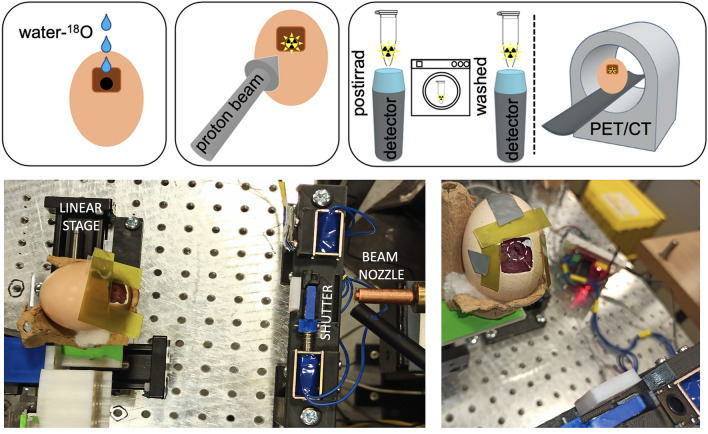
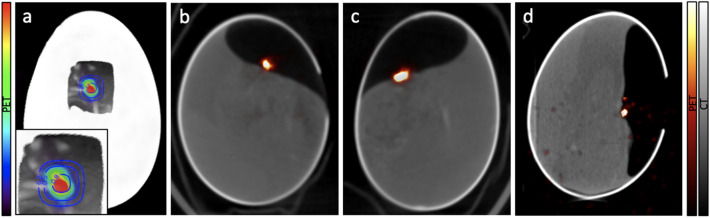
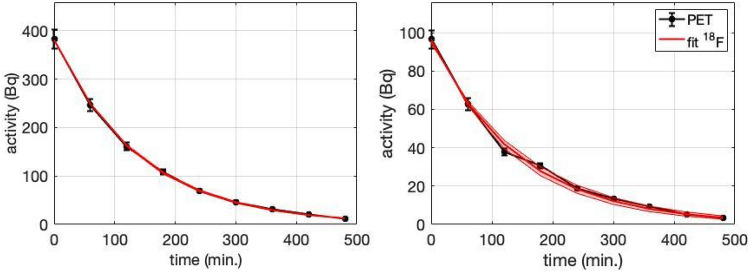
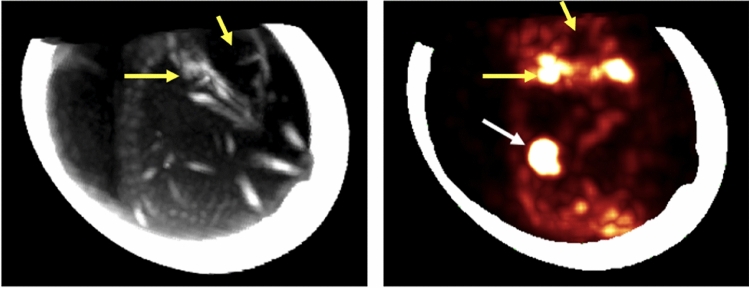
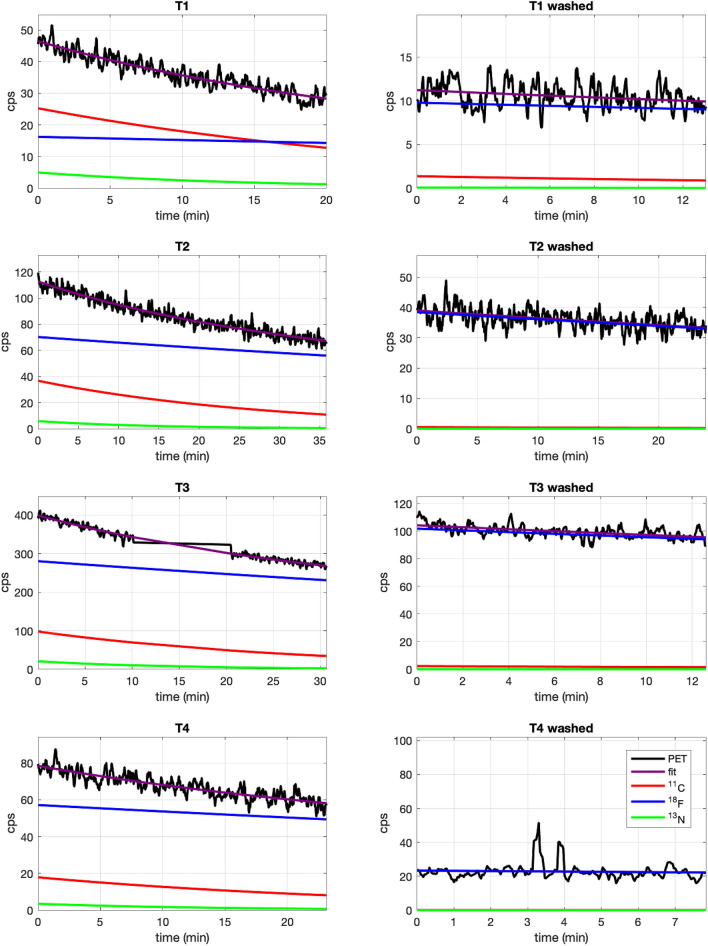
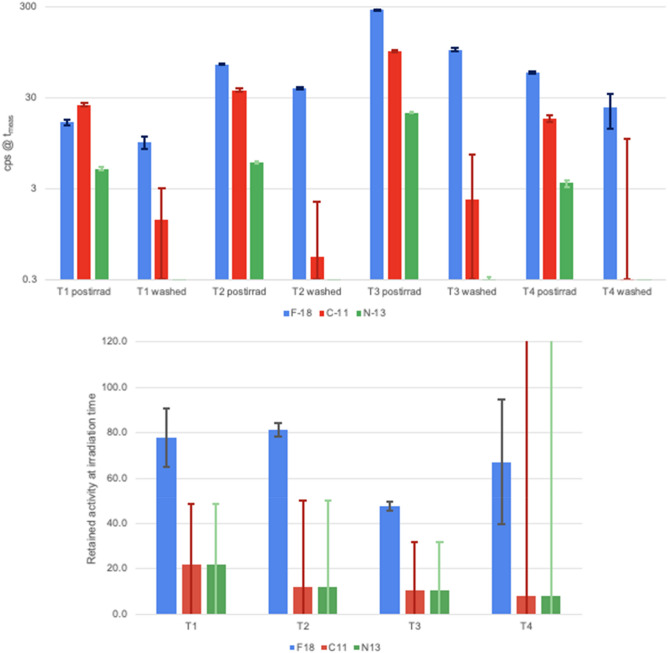
Range verification of clinical protontherapy systems via positron-emission tomography (PET) is not a mature technology, suffering from two major issues: insufficient signal from low-energy protons in the Bragg peak area and biological washout of PET emitters. The use of contrast agents including O, Zn or Cu, isotopes with a high cross section for low-energy protons in nuclear reactions producing PET emitters, has been proposed to enhance the PET signal in the last millimeters of the proton path. However, it remains a challenge to achieve sufficient concentrations of these isotopes in the target volume. Here we investigate the possibilities of O-enriched water (18-W), a potential contrast agent that could be incorporated in large proportions in live tissues by replacing regular water. We hypothesize that 18-W could also mitigate the problem of biological washout, as PET (F) isotopes created inside live cells would remain trapped in the form of fluoride anions (F-), allowing its signal to be detected even hours after irradiation. To test our hypothesis, we designed an experiment with two main goals: first, prove that 18-W can incorporate enough O into a living organism to produce a detectable signal from F after proton irradiation, and second, determine the amount of activity that remains trapped inside the cells. The experiment was performed on a chicken embryo chorioallantoic membrane tumor model of head and neck cancer. Seven eggs with visible tumors were infused with 18-W and irradiated with 8-MeV protons (range in water: 0.74 mm), equivalent to clinical protons at the end of particle range. The activity produced after irradiation was detected and quantified in a small-animal PET-CT scanner, and further studied by placing ex-vivo tumours in a gamma radiation detector. In the acquired images, specific activity of F (originating from 18-W) could be detected in the tumour area of the alive chicken embryo up to 9 h after irradiation, which confirms that low-energy protons can indeed produce a detectable PET signal if a suitable contrast agent is employed. Moreover, dynamic PET studies in two of the eggs evidenced a minimal effect of biological washout, with 68% retained specific F activity at 8 h after irradiation. Furthermore, ex-vivo analysis of 4 irradiated tumours showed that up to 3% of oxygen atoms in the targets were replaced by O from infused 18-W, and evidenced an entrapment of 59% for specific activity of F after washing, supporting our hypothesis that F- ions remain trapped within the cells. An infusion of 18-W can incorporate O in animal tissues by replacing regular water inside cells, producing a PET signal when irradiated with low-energy protons that could be used for range verification in protontherapy. F produced inside cells remains entrapped and suffers from minimal biological washout, allowing for a sharper localization with longer PET acquisitions. Further studies must evaluate the feasibility of this technique in dosimetric conditions closer to clinical practice, in order to define potential protocols for its use in patients.
临床质子治疗系统的射程验证通过正电子发射断层扫描(PET)不是一项成熟的技术,它存在两个主要问题:在布拉格峰区域内低能质子的信号不足和 PET 发射体的生物洗脱。使用包括 O、Zn 或 Cu 在内的造影剂,这些同位素在核反应中具有与产生 PET 发射体的低能质子的高横截面,被提议用于增强质子路径最后几毫米处的 PET 信号。然而,在靶体积中实现这些同位素的足够浓度仍然是一个挑战。在这里,我们研究了富含氧的水(18-W)的可能性,这是一种潜在的造影剂,可以通过替代普通水来大量掺入活组织中。我们假设 18-W 还可以减轻生物洗脱的问题,因为在活细胞内产生的 PET(F)同位素将以氟化物阴离子(F-)的形式被捕获,即使在辐照后数小时也可以检测到其信号。为了验证我们的假设,我们设计了一个具有两个主要目标的实验:首先,证明 18-W 可以将足够的 O 掺入生物体中,以便在质子辐照后从 F 中产生可检测的信号;其次,确定留在细胞内的活性量。该实验是在头颈部癌症的鸡胚绒毛尿囊膜肿瘤模型上进行的。用 18-W 灌注了七个可见肿瘤的鸡蛋,并以 8-MeV 质子照射(水中射程:0.74 毫米),相当于粒子射程末端的临床质子。用小动物 PET-CT 扫描仪检测和定量辐照后产生的放射性活度,并通过将离体肿瘤置于伽马辐射探测器中进一步研究。在获得的图像中,在辐照后 9 小时,在活着的鸡胚的肿瘤区域可以检测到源自 18-W 的 F 的特异性活度,这证实了如果使用合适的造影剂,低能质子确实可以产生可检测的 PET 信号。此外,两个鸡蛋中的动态 PET 研究表明,生物洗脱的影响很小,辐照后 8 小时保留了 68%的特定 F 活度。此外,对 4 个辐照肿瘤的离体分析表明,靶标中的多达 3%的氧原子被灌注的 18-W 中的 O 取代,并在洗涤后证明 F 的特异性活度有 59%被捕获,这支持了我们的假设,即 F-离子在细胞内被捕获。18-W 的输注可以通过在细胞内用普通水替代来将 O 掺入动物组织中,并用低能质子照射产生 PET 信号,该信号可用于质子治疗中的射程验证。在细胞内产生的 F 仍然被捕获,并且生物洗脱最小化,从而可以通过更长时间的 PET 采集实现更精确的定位。必须进一步研究该技术在更接近临床实践的剂量学条件下的可行性,以便为其在患者中的使用定义潜在方案。