Department of Psychology, Southern Methodist University, 6116 N. Central Expressway, Suite 1300, Dallas, TX, USA.
Department of Psychology, Southern Methodist University, 6116 N. Central Expressway, Suite 1300, Dallas, TX, USA.
J Affect Disord. 2022 Aug 15;311:17-30. doi: 10.1016/j.jad.2022.04.130. Epub 2022 Apr 28.
Social anxiety is highly prevalent and has increased in young adults during the COVID-19 pandemic. Since social anxiety negatively impacts interpersonal functioning, identifying aspects of social cognition that may be impaired can increase our understanding of the development and maintenance of social anxiety disorder. However, to date, studies examining associations between social anxiety and social cognition have resulted in mixed findings.
The aim of this systematic review was to summarize the literature on the association between social anxiety and social cognition, while also considering several potential moderators and covariates that may influence findings.
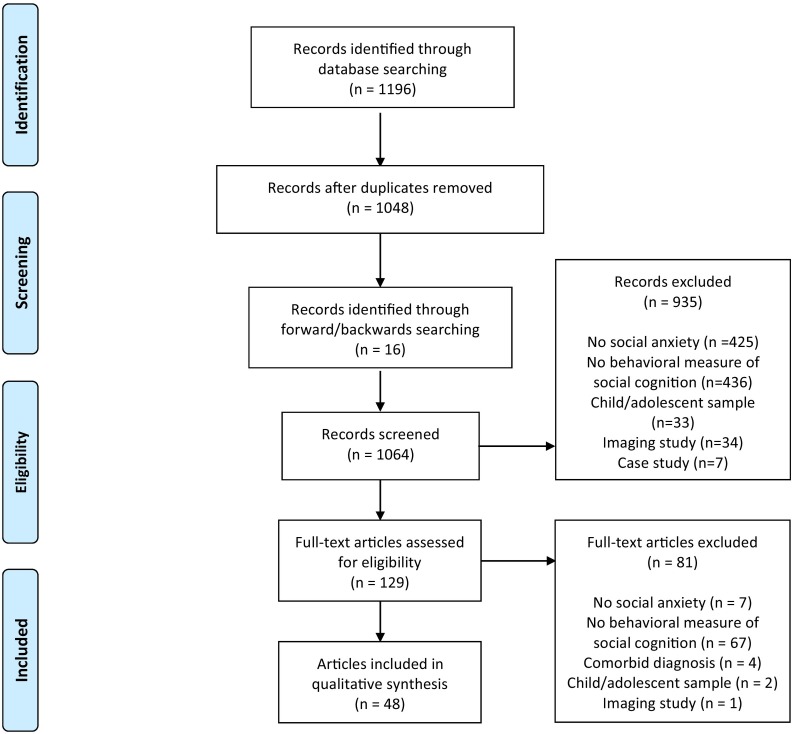
A systematic search identified 52 studies. Results showed mixed evidence for the association between social anxiety and lower-level social cognitive processes (emotion recognition and affect sharing) and a trend for a negative association with higher-level social cognitive processes (theory of mind and empathic accuracy). Most studies examining valence-specific effects found a significant negative association for positive and neutral stimuli.
Not all aspects of social cognition were included (e.g., attributional bias) and we focused on adults and not children, limiting the scope of the review.
Future studies would benefit from the inclusion of relevant moderators and covariates, multiple well-validated measures within the same domain of social cognition, and assessments of interpersonal functioning outside of the laboratory. Additional research examining the moderating role of attention or interpretation biases on social cognitive performance, and the potential benefit of social cognitive skills training for social anxiety, could inform and improve existing cognitive behavioral interventions.
社交焦虑在年轻人中非常普遍,并且在 COVID-19 大流行期间有所增加。由于社交焦虑会对人际交往产生负面影响,因此确定可能受损的社交认知方面可以帮助我们更好地理解社交焦虑障碍的发展和维持。但是,迄今为止,研究社交焦虑与社交认知之间的关系的研究结果却存在差异。
本系统评价的目的是总结社交焦虑与社交认知之间关联的文献,同时考虑可能影响研究结果的几个潜在的调节因素和协变量。
系统搜索确定了 52 项研究。结果表明,社交焦虑与较低水平的社交认知过程(情绪识别和情感分享)之间存在混合证据,而与较高水平的社交认知过程(心理理论和共情准确性)之间存在负相关趋势。大多数研究情绪特异性效应的研究发现,积极和中性刺激的负相关具有显著意义。
并非所有的社交认知方面都包括在内(例如,归因偏差),并且我们关注的是成年人而不是儿童,从而限制了本综述的范围。
未来的研究将受益于纳入相关的调节因素和协变量,在同一社交认知领域内使用多个经过良好验证的测量工具,以及在实验室之外评估人际交往功能。进一步研究注意力或解释偏差对社交认知表现的调节作用,以及社交认知技能训练对社交焦虑的潜在益处,可以为现有的认知行为干预提供信息和改进。