Department of General Surgery, Ruijin Hospital, Shanghai Jiao Tong University School of Medicine, Shanghai, China.
Medical Department, RIGEN Biotechnology Co., Ltd, Shanghai, China.
Cancer Biol Ther. 2022 Dec 31;23(1):369-377. doi: 10.1080/15384047.2022.2051158.
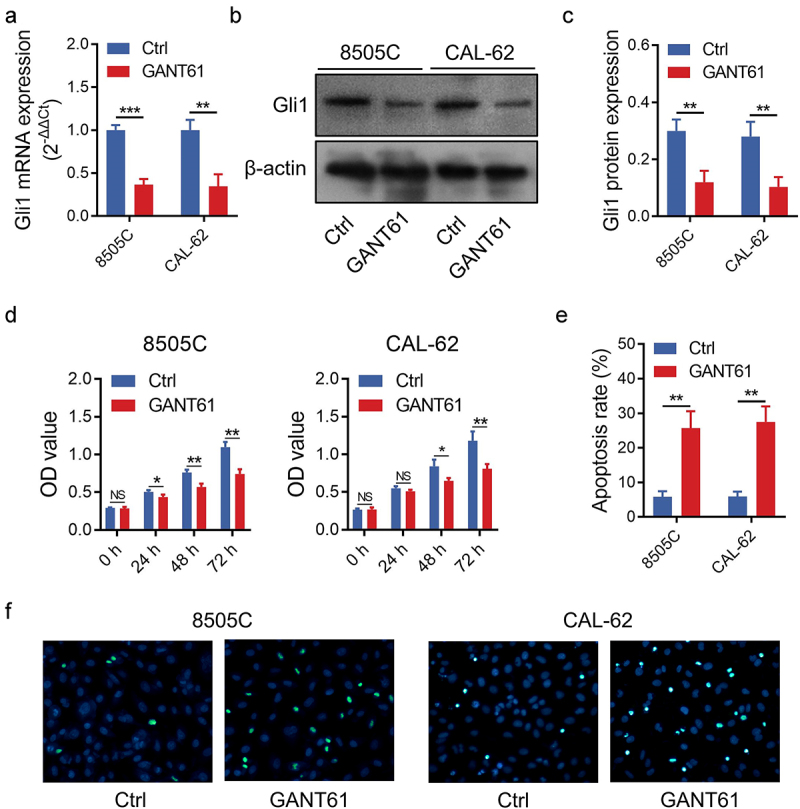
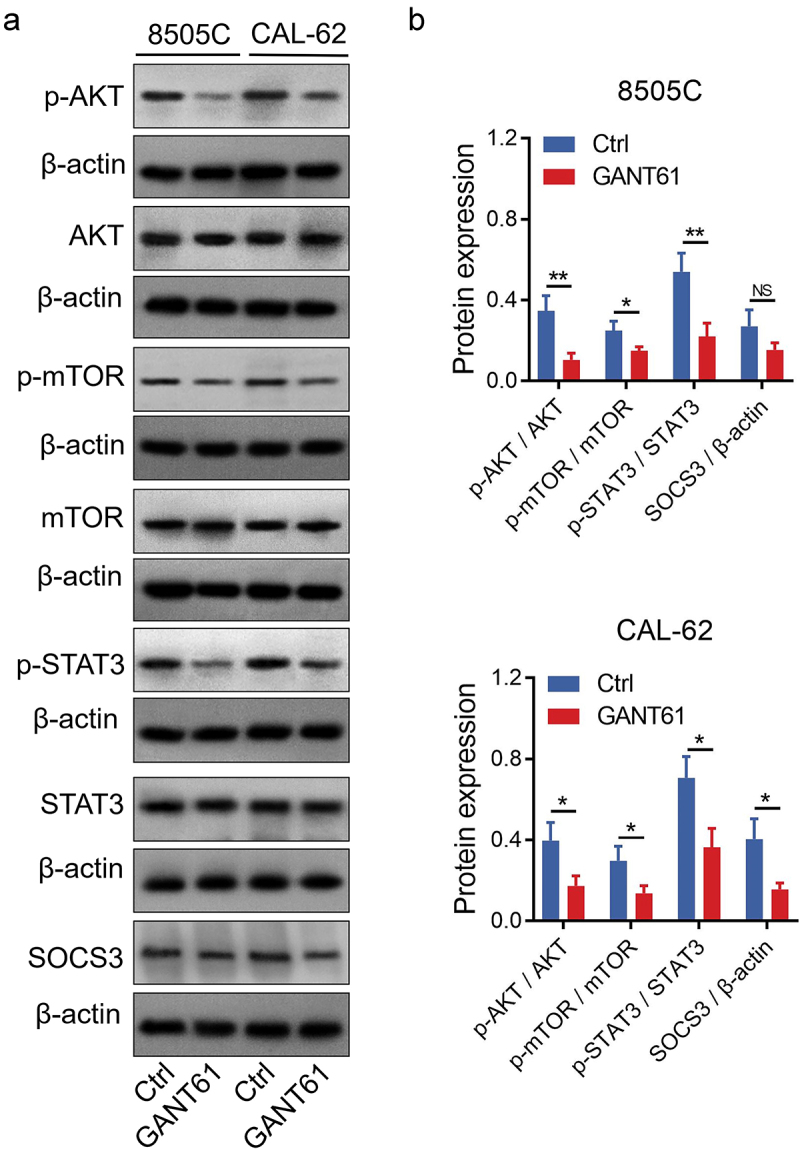
Glioma-associated oncogene (Gli) antagonist-61 (GANT61) not only suppresses the malignant behavior of several cancers but also presents synergistic effects with other anticancer agents on suppressing the progression of cancers, while relevant information is rare in anaplastic thyroid carcinoma (ATC). This study aimed to explore the therapeutic effect of GANT61 in ATC and its molecular mechanism. ATC cells (8505C and CAL-62) were treated with GANT61, followed by detection of cell proliferation, apoptosis, invasion and epithelial-mesenchymal transition (EMT) markers. Subsequently, RNA sequencing was performed to explore the potential downstream pathway. Following that, rescue experiments were conducted by SC79 (AKT activator) or colivelin (STAT3 activator) monotreatment or combined with GANT61 in ATC cells. GANT61 reduced Gli1 expression, suppressed proliferation at several time settings, promoted apoptosis, inhibited invasion and increased E-cadherin while decreased Vimentin and Snail expressions (EMT markers) in ATC cells. The subsequent RNA sequence identified 85 upregulated differentially expressed genes (DEGs) and 71 downregulated DEGs in GANT61-treated ATC cells, which were mainly enriched in PI3K/AKT, JAK/STAT, Hedgehog and mTOR pathways. Next, the inactivation of AKT/mTOR and JAK/STAT3 pathways by GANT61 treatment was verified by western blot. The following rescue experiments showed that SC79 or colivelin treatment promoted the malignant behaviors of ATC cells. More importantly, SC79 or colivelin treatment compensated the effect of GANT61 treatment on cell proliferation at several time settings and apoptosis, invasion, and part of that on EMT in ATC cells. GANT61 suppresses cell survival, invasion and EMT through inactivating AKT/mTOR or JAK/STAT3 pathways in ATC.
胶质细胞瘤相关致癌基因(Gli)拮抗剂-61(GANT61)不仅抑制多种癌症的恶性行为,还与其他抗癌药物协同抑制癌症进展,而在间变性甲状腺癌(ATC)中相关信息很少。本研究旨在探讨 GANT61 在 ATC 中的治疗效果及其分子机制。用 GANT61 处理 ATC 细胞(8505C 和 CAL-62),然后检测细胞增殖、凋亡、侵袭和上皮-间充质转化(EMT)标志物。随后,进行 RNA 测序以探索潜在的下游途径。接下来,通过 SC79(AKT 激活剂)或 colivelin(STAT3 激活剂)单药或联合 GANT61 在 ATC 细胞中进行挽救实验。GANT61 降低 Gli1 表达,在多个时间点抑制增殖,促进凋亡,抑制侵袭,增加 E-钙粘蛋白,同时降低 Vimentin 和 Snail 表达(EMT 标志物)。随后的 RNA 序列鉴定出 GANT61 处理的 ATC 细胞中 85 个上调差异表达基因(DEG)和 71 个下调 DEG,主要富集在 PI3K/AKT、JAK/STAT、Hedgehog 和 mTOR 途径中。接下来,通过 Western blot 验证了 GANT61 处理对 AKT/mTOR 和 JAK/STAT3 途径的失活作用。以下挽救实验表明,SC79 或 colivelin 处理促进了 ATC 细胞的恶性行为。更重要的是,SC79 或 colivelin 处理补偿了 GANT61 处理对 ATC 细胞增殖和凋亡、侵袭以及部分 EMT 的作用。GANT61 通过在 ATC 中失活 AKT/mTOR 或 JAK/STAT3 途径抑制细胞存活、侵袭和 EMT。