Lendel Christofer, Solin Niclas
Department of Chemistry, KTH Royal Institute of Technology Teknikringen 30 SE-100 44 Stockholm Sweden
Department of Physics, Chemistry, and Biology, Electronic and Photonic Materials, Biomolecular and Organic Electronics, Linköping University Linköping 581 83 Sweden
RSC Adv. 2021 Dec 8;11(62):39188-39215. doi: 10.1039/d1ra06878d. eCollection 2021 Dec 6.
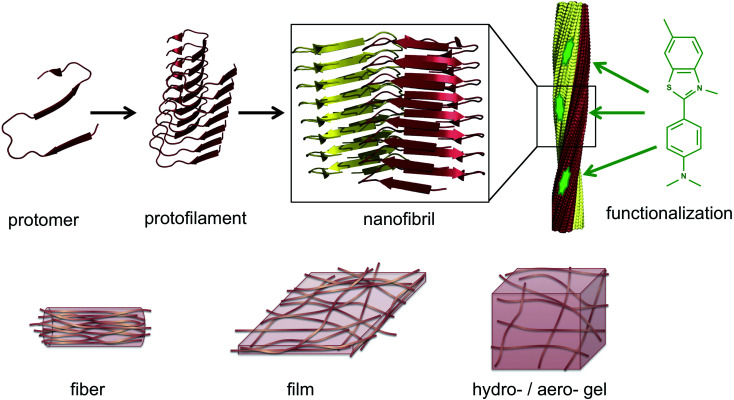
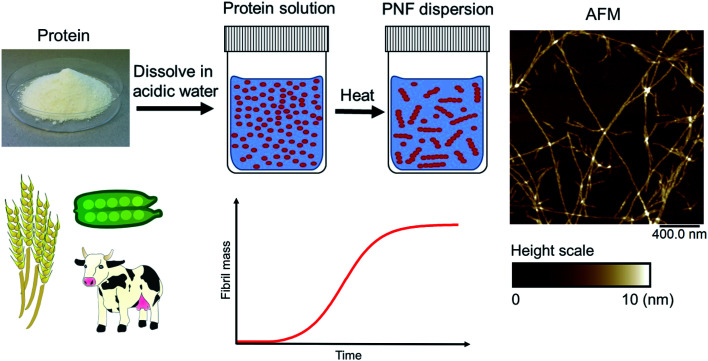
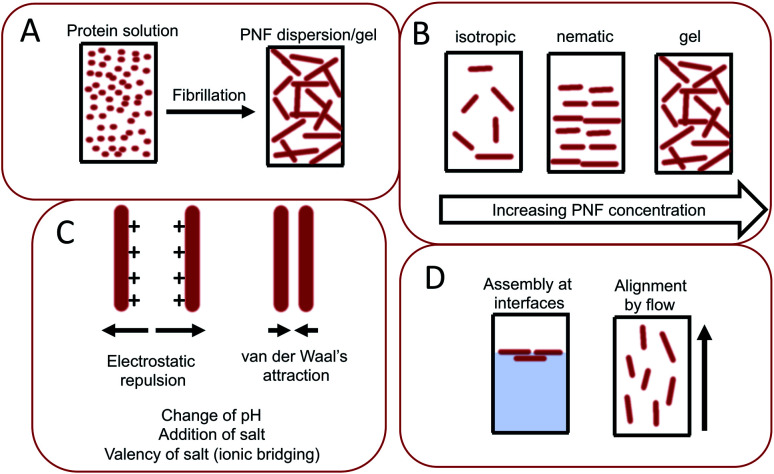
The development towards a sustainable society requires a radical change of many of the materials we currently use. Besides the replacement of plastics, derived from petrochemical sources, with renewable alternatives, we will also need functional materials for applications in areas ranging from green energy and environmental remediation to smart foods. Proteins could, with their intriguing ability of self-assembly into various forms, play important roles in all these fields. To achieve that, the code for how to assemble hierarchically ordered structures similar to the protein materials found in nature must be cracked. During the last decade it has been demonstrated that amyloid-like protein nanofibrils (PNFs) could be a steppingstone for this task. PNFs are formed by self-assembly in water from a range of proteins, including plant resources and industrial side streams. The nanofibrils display distinct functional features and can be further assembled into larger structures. PNFs thus provide a framework for creating ordered, functional structures from the atomic level up to the macroscale. This review address how industrial scale protein resources could be transformed into PNFs and further assembled into materials with specific mechanical and functional properties. We describe what is required from a protein to form PNFs and how the structural properties at different length scales determine the material properties. We also discuss potential chemical routes to modify the properties of the fibrils and to assemble them into macroscopic structures.
向可持续社会的发展需要对我们目前使用的许多材料进行彻底变革。除了用可再生替代品取代源自石化资源的塑料外,我们还将需要功能性材料,用于从绿色能源、环境修复到智能食品等各个领域。蛋白质凭借其自组装成各种形式的有趣能力,可能在所有这些领域发挥重要作用。要实现这一点,必须破解如何组装类似于自然界中发现的蛋白质材料的层次有序结构的密码。在过去十年中,已经证明淀粉样蛋白纳米纤维(PNFs)可能是完成这项任务的垫脚石。PNFs是由一系列蛋白质在水中自组装形成的,包括植物资源和工业副产品。纳米纤维具有独特的功能特性,可以进一步组装成更大的结构。因此,PNFs提供了一个从原子水平到宏观尺度创建有序、功能性结构的框架。本综述探讨了工业规模的蛋白质资源如何转化为PNFs,并进一步组装成具有特定机械和功能特性的材料。我们描述了蛋白质形成PNFs所需的条件,以及不同长度尺度的结构特性如何决定材料特性。我们还讨论了修饰纤维特性并将其组装成宏观结构的潜在化学途径。